Art Basel Miami Beach is one of the most important art fairs in the world. We went along as guests of Bernardo Zuccon, a big name in Italian nautical design and a great enthusiast
by Bernardo Zuccon
The way someone who designs spaces, volumes and proportions looks at art can be beneficial. You can also use this approach when working on a new project: listening, watching and being open to suggestions without looking for the answer. This exercise in observation is happening at Art Basel Miami Beach. If you’re used to dealing with complex objects like yachts, which are like a mix of technique and vision, you might not think Art Basel is the best fair to visit. For me, it’s more like a place to explore. Art is never just art there, but a story of the present and what’s going to come, sometimes a bit controversial.
Jeffrey Deitch, Tom Wesselmann.
At a certain point, Art Basel ceases to be a fair and becomes what it should always be: a space for interaction, where different languages – art, architecture, design – find authentic points of contact. And it is often in these intersections, rather than in official events, that the real value of the experience is measured.
Miami, with its bright lights and busy energy, makes everything seem louder: the art, the market, the cultural differences. It’s a city that doesn’t do half measures, and maybe that’s why it’s a good place to see what’s going on in our world right now. When I’m walking around the stands at the Convention Centre, I look at each section as part of a bigger project. I’m not looking for a big name or an ‘iconic’ work, no matter what. I’m more interested in how something can say a lot with a little, when a shape just has to be there, almost like it’s necessary.
Library Street Collective, Kennedy Yanko.
This idea keeps coming up in my thoughts: designing means taking away, not adding. And, at its highest level, contemporary art works in the same way. It does not explain, reassure or decorate. It suggests. Sometimes it makes us uncomfortable. But it always forces us to take a stand. At Art Basel Miami 2025, this tension is evident: works that deal with time, memory and identity; installations that interact with the body and space; languages that hybridise technology and raw materials. Not everything is convincing, but almost everything raises questions.
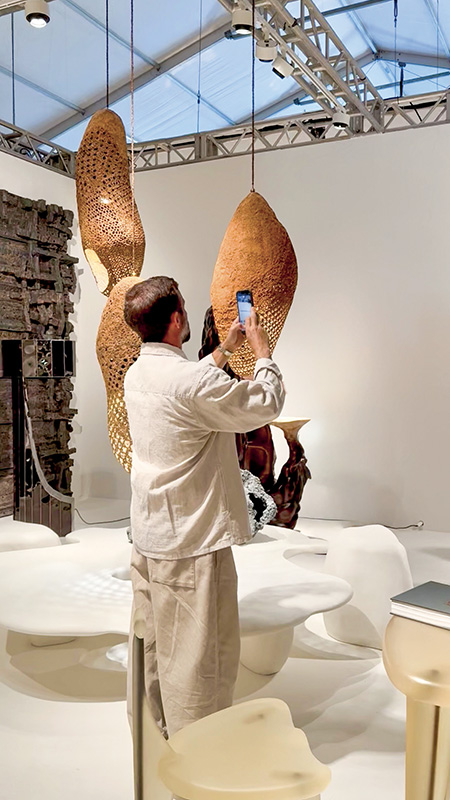
Among the most significant moments, one in particular stood out naturally, without being sought after. The encounter with the works of Luis Fernando Zapata, presented by the Galería Elvira Moreno in Bogota. A silent, measured work, in which material, rhythm and spatial construction seem to dialogue with a language surprisingly similar to that of architectural design. These works do not seek immediate effect but rather convey a sense of imaginary archaeology. Objects that seem like discoveries from ancient civilisations, totemic and archetypal figurations that evoke nameless rituals, thresholds between the ephemeral and the eternal.
1. Roberts Projects, Betye Saar. 2. Neugerriemschneider, Renata Lucas. 3. Fellowship and ArtXCode, IX Shells. 4. Onkaos, Mario Klingemann. 5. Mendes Wood DM, Patricia Ayres. 6. Gomide & Co, Adriana Varejão 7. Pace Gallery, James Turrell. 8. Rolf Art, Silvia Rivas. 9. Alisan Fine Arts. 10. Fellowship and ArtXCode, IX Shells. 11. Galerie Alberta Pane, Luciana Lamothe. 12. Holly Herndon and Mat Dryhurst. 13. Pace Gallery, Elmgreen & Dragset. 14. The Modern Institute, Andrew Sim.
Art does not coincide with its exchange value; it is a recurring thought. Just as it does not coincide with luxury. Luxury, if anything, is the time devoted to understanding, to really looking, to developing a personal perspective. In this sense, Art Basel remains an extraordinary laboratory: concentrated, chaotic, at times excessive, but capable of providing a sincere snapshot of the contemporary world.
Outside the Convention Centre, Miami continues to buzz with excitement: side exhibitions, private foundations, and independent spaces. It is in this widespread fabric that the experience is completed. As in any good project, it is not the individual elements that count, but the relationship between the parts.
Art Basel is also – inevitably – a powerful economic machine. The market is everywhere, visible, declared. But this is not the level that really matters. As is often the case, the best art manages to escape the noisiest logic, carving out spaces of silence even in the heart of the fair.
Zapata’s works seem to arise from a deep inner need, from meditation on human fragility, spirituality and memory, in which time becomes a constituent element of the work, not simply a context. It is in dialogue with the gallery owner that the encounter takes on a further dimension. A series of unexpected connections. Partly shared Argentine roots, a common sensitivity for work built up over time, but above all, a similar vision of the relationship with clients. Not simply clients, but people with whom to establish lasting relationships, based on trust, listening and mutual pleasure in working together.

This is familiar territory for someone like Zuccon, who is accustomed to developing complex projects that require continuity, dialogue and a deep understanding of the explicit and implicit needs of those who will inhabit them. In this sense, the encounter with the gallery is not only artistic but also cultural: a broader recognition that goes beyond the work on display.
For an architect accustomed to long cycles and processes that take years to take shape, art has the privilege – and responsibility – of being immediate, reacting in real time to the present. But this immediacy is not superficiality: on the contrary, it is a form of lucidity. I observe how many works seem to operate on a temporal dimension similar to that of the project: not the instant, but the duration. Traces, stratifications, signs that seek not effect but permanence. This attitude resonates deeply with his knowledge of architecture and nautical design: objects destined to age, change and be lived in. Art Basel Miami 2025 thus closes, not with a definitive answer, but with a series of open questions. And perhaps this is the best outcome: returning to work with a slightly shifted perspective, one that is more attentive, more critical and more free. After all, designing and observing contemporary art share the same ambition: to give shape to the present without ceasing to question the future.


(Art Basel Miami Beach – Art as syntesis – Barchemagazine.com – Excerpted from Barche, February 2026)