Have you ever put on old running shoes and found them uncomfortable, hardened, slippery and not amortized any longer? Welcome to the Real World, would say Morpheus: rubber gets old!
Natural rubber is widely present in our day-to-day life for decades: tires and other car components, floors, food, medical items are all made of rubber! Natural rubber represents almost 40% of the total amount of rubber used in the entire world. It is collected by making an incision in the bark of a tree, the rubber tree indeed. The lifeblood that comes out is collected in special containers, processed to remove water, exposed to acidic agents to get raw rubber, then, pressed into sheets and transported for further processing.
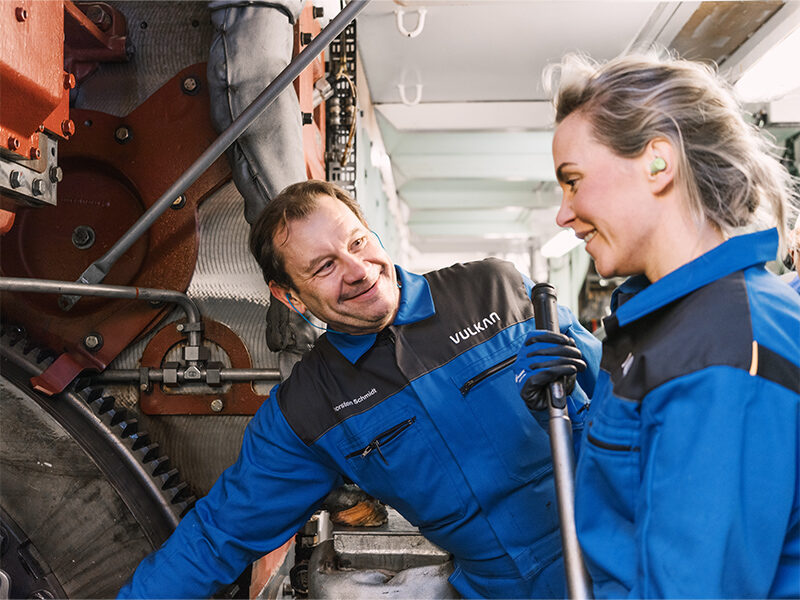
Natural rubber has two main features, flexibility and damping capacity: it can be deformed by external forces, then it comes back to its original shape, when stresses stop, and it converts mechanical energy into heat. These features make it suitable for vibrations damping. For this reason, it is used on board vessels as a key component of flexible couplings and resilient mounts.
How are flexible couplings and resilient mounts produced starting from simple natural rubber? Vulcanization is the process to get the elastic compound resistant to abrasion and especially to tensile forces: mixed up with appropriate additives, such as sulfur, smoke-back and inter fillers (the compound), it is subjected to heat treatment at high temperature (140-180°C). During the vulcanization process, whose duration depends on part’s compound and sizes, the product takes its final shape. In case of flexible couplings and resilient mounts, vulcanization is carried out in closed molds, where the metals parts are placed for the rubber to adhere, and it forms the connecting element.
Elastomer is subject to deterioration; its initial features could change to almost total loss of elastic and performance characteristics.
1. Contact with oxygen and ozone in the air could causes molecular chains breaking-up
2. Light exposure (ultraviolet rays), repeated and periodic mechanical stresses such as vibrations (fatigue aging)
Giulio Alberti, After Sales Manager, Vulkan Italia
If you have questions and would like to discuss specific topics, contact us: [email protected]
Vulkan auscultates and supports
– FAQ n.1 What is a hybrid vessel?
– FAQ n.2 Is a yacht always COMFORTable?
– FAQ n.3 Does rubber get old?
– FAQ n.4 What does COMFORT means?
– FAQ n.5 Is there only 1 hybrid?
– FAQ n.5 BIS Is there only one hybrid?
– FAQ n.6 Batteries on a trip toward safety, autonomy and sustainability
– FAQ n.7. Are you yachting comfortably?
– FAQ n.8. Noise is keeping me awake: what can I do?
– FAQ n.9. To erase noise, you need rubber!
– FAQ n.10. If you don’t think about maintenance… your yacht will do it for you (when you least expect it!)
– FAQ n.11. Do you think of maintenance?
(Does rubber get old? – Barchemagazine.com – March 2024)