The Cape Verde archipelago is an excellent destination for water and sea sports enthusiasts
by Clelia Pirazzini
It is no coincidence that the second leg of the latest edition of the Ocean Race included a stopover in the islands of Cape Verde, drawing the attention of the United Nations, which decided to hold the Climate Change Summit in Mindelo, on the island of Sao Vicente, to raise awareness and garner support for ocean rights. UN Secretary-General Guterres stressed that Cape Verde has always shown a strong commitment to environmental issues, such as supporting the blue economy, to the point that today 20% of the islands’ energy production comes from renewable sources. However, the local authorities are working to develop other projects, such as the one designed to combat marine plastic pollution, which is altering underwater ecosystems and killing off the marine fauna that is a source of wealth for the population.
Expanding marine protected areas
It should not be forgotten that fishing has always been the main source of income for the inhabitants of these ten islands and, unfortunately, in recent years the catch of edible fish such as mackerel and yellowfin tuna – both very important in the local cuisine – has decreased significantly due to the higher temperatures in the marine waters. One of the recent strategies adopted to combat this phenomenon has been to extend the various marine protected areas around the islands. These initiatives are increasingly appreciated at international level and attract many visitors who wish to spend their holidays in a healthy environment, immersed in a simple nature that conveys an image of something pure, whose appeal lies not only in its inconspicuous beauty, but also in its imagery and perception. This is particularly true of the sea, which, although it has suffered from global climate change, still boasts seabeds of great biodiversity. Its waters are still inhabited by various species of cetaceans, such as whales, dolphins and orcas, as well as thousands of turtles that love to nest on its calm beaches.


Boa Vista’s nature still has that taste of something exotic, of a primitive and almost suspended time, even in the small villages made of simple yet pleasant houses brimmed with colour that contrasts with the dry soil.

Boa Vista
Boa Vista is not just about the sea. The island has many faces and hides many different nuances. While some areas have sedimentary rocks with mysterious caves, in general, the island has large stretches of sand with dunes that slide into the sea. It also has something that reminds you of Africa, which is about 500 kilometres away. That something is the Viana Desert, formed over time by the trade winds coming from North Africa, carrying sand from the Sahara. Located in the northwest of the island, it has dunes of white sand sculpted by the wind, alternating with black rocks of volcanic origin. It is not a very large desert, only 5 kilometres long and about 1,000 metres wide, but its characteristic silence is very evocative, as it gives the feeling of being surrounded by absolute emptiness. Walking on the sand, which meets the sky in such a natural way, is truly fulfilling. Motorised vehicles can only reach the edge of the desert in certain areas.
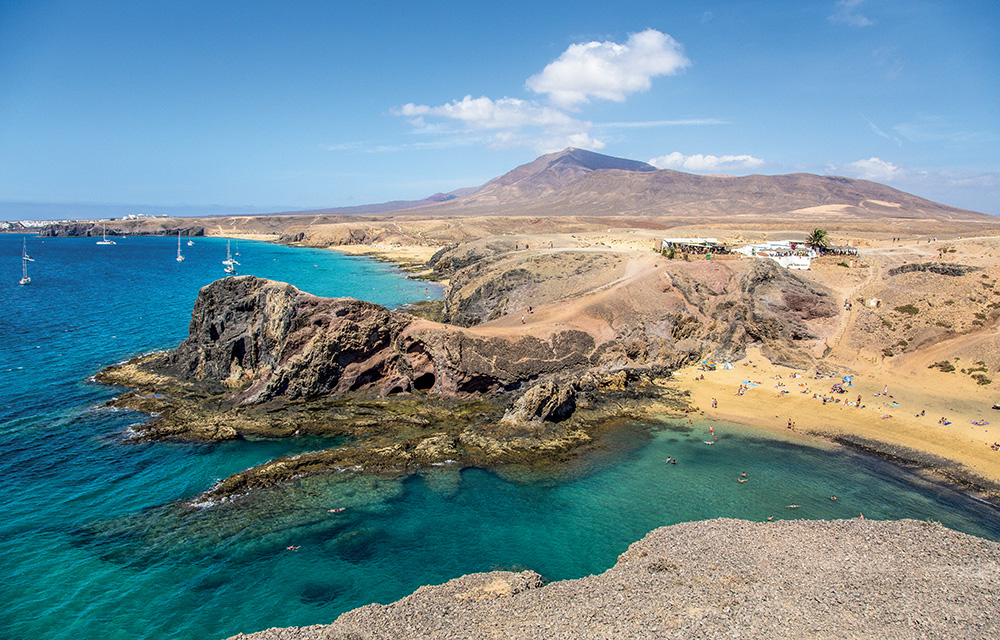

When Christopher Columbus landed on the island of Boa Vista on his third voyage to the Americas in 1498, he said: “They have a misleading name because they are very dry and I have seen nothing green”.
On the island of Mayo, but above all, on the island of Boa Vista, each year, between July and late October, thousands of turtles, in particular of the species Caretta caretta, reach the candid and wild beach of Praia de Joao Barrosa and other beaches on the south-east of the island to lay their eggs. The incubation period lasts just over fifty days and when the eggs hatch, the baby turtles instinctively crawl towards the sea. This custom has lasted since the beginning of time and, thanks to the measures taken to protect the site, seems to be as strong as ever. The island of Cape Verde is still the third nesting place in the world, after Florida and Oman.


On the island of Boa Vista, each year, between July and late October, thousands of turtles, particularly the species Caretta caretta, reach the candid and wild beach of Praia de Joao Barrosa and other beaches on the south-east of the island to lay their eggs.
Where to practice kitesurfing
But with its surface of 630 square kilometres and prevalently flat terrain – except Pico d’Estancia just 390 metres tall and Pico de Santo Antonio, which is slightly lower – Boa Vista, which belongs to the Barlavento group, and its 55 km of beaches, many of which are secluded, is particularly appreciated by surfers and lovers of kitesurfing. The latter is a sport that can be practised anywhere, but particularly from certain beaches, like the wild beach of Ervatao. This is a long stretch of snow-white and fine sand that dives into a turquoise sea with a sandy bottom, with the only exception of a few isolated and harmless underwater rocks. The wind is ideal, especially if it is regularly blowing from the north-east. But apart from the satisfaction of flying on the waves, this area, which is completely deserted, is still a wild region capable of triggering the strongest emotions and can be reached only after travelling dirt roads among large barren rocks reminiscent of lunar landscapes.
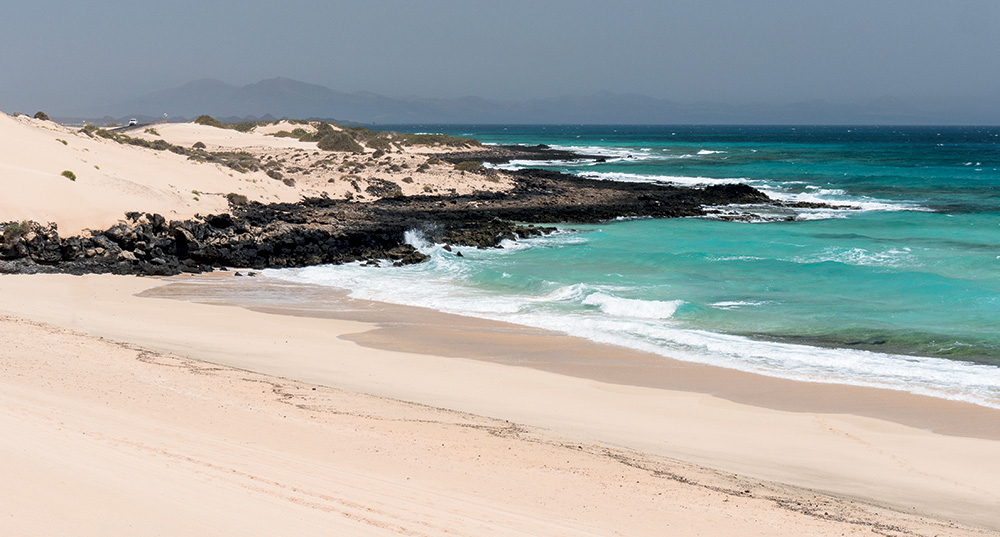

The islet of Djeu
Today, the waters surrounding its uninhabited islet are the destination of divers interested in exploring its seabed, which is full of surprises. It is easy to spot different species of sharks, including hammerheads, blacktips, nurse sharks and threshers. These Selachians are specially protected and have earned Boa Vista the nickname of a multi-species shark nursery. You can see much tropical fish such as parrotfish, triggerfish, angelfish and porcupine fish swimming among the corals, as well as the fish we are used to seeing in the Mediterranean such as red mullet, white bream, sea bream and moray eels. A great variety of species, many of which can be enjoyed in the traditional culinary speciality cachupa, prepared with beans, manioc, corn, sweet potatoes, fish or meat. The seabed is also rich in crustaceans, especially lobster. However, it is forbidden to fish them during their mating season.
Sport lovers also seek out other beaches, such as Curralinho, which unwinds for almost 18 kilometres on the island’s south-western coast and goes by the nickname Santa Monica due to its resemblance to the famous beach in California. And then there is Praia Varadinha, which can be reached if you walk over the dunes that lead to the shore as well as Praia de Chaves, close to the centre and no doubt the busiest of them all. But there is also another very unusual coastline that deserves a visit: Praia Atalanta, known by the name of Cabo Santa Maria. The area is always beaten by long and incessant waves, which often put a break on any water activities, but has risen to prominence because it hosts the historical wreck of the Spanish merchant ship Cabo Santa Maria, which was stranded on a sandy seabed in 1968 for reasons that are still unknown today. The crew, composed of 38 men in addition to Captain Fernando De Solis, apparently succeeded in saving themselves, while the load, mainly constituted of food products, was recovered by the island’s inhabitants.

You can practice sandboarding in Boa Vista, a recently developed sport and tourism-recreational activity, similar to the more famous snowboarding but practised on dunes.

Leaving behind Praia Atalanta, just 6 kilometres away, lies the graceful capital of Boa Vista: Sal Rei. A lively city which is the home of most of the 9,000 inhabitants of this barren island in the Atlantic and can boast two magnificent white sandy beaches in addition to a small marina that can accommodate ships of different sizes. It is very popular both among locals and those who wish to go rod or drift trolling. The prey in this area is guaranteed: white bream, groupers, rockfish, sea bass, sea bream, and mullets. But also large-size pelagic species like amberjacks, wahoo, sailfish, marlin, and barracuda. A true paradise for those who love deep-sea fishing. But also in this case, the local authorities recommend using the “catch and release” technique for large fish that are not particularly appreciated as food. And on the way back you even have the chance to take a short break on the islet of Djeu.

Its waters are inhabited by various species of cetaceans, such as whales, dolphins and orcas, as well as thousands of turtles.

Here, in addition to the lighthouse, you can visit an ancient fort – the fort of the Duke of Braganza of 1820 – built to defend the island against the attack of pirates who used to loot the island to take possession of its wealth, constituted by salt, cotton, and ceramics. Still in excellent condition are the cannons directed towards the open sea, on the point where attacks from enemy ships used to take place.


The barren soil doesn’t allow grass, bushes or trees to grow and flourish. There are some shy flowers grow on the beaches.
The nature of Boa Vista still has an exotic, primitive and almost suspended flavour, even in the small villages made up of simple but pleasant houses, full of colours that convey the emotion triggered by the light of an almost omnipresent sun that gives the landscape that vitality of strong tones that are absent in the terrain. The barren soil doesn’t allow grass, bushes or trees to grow and flourish. There are a few endemic plants such as the Cape Verde dragoeiro or tamareiro, as well as date palms and acacias. And then some shy flowers grow on the beaches. But the colours are almost absent due to the island’s extremely dry soil. Even Christopher Columbus noted this in his writings when he landed on the island of Boa Vista during his third voyage to America: “They have a misleading name because they are very dry and I have seen nothing green”. Charles Darwin shared this opinion, but he was compelled by the wild nature, and when he landed in the archipelago in 1832, he declared: “Any kind of vegetation would spoil the grandeur of this landscape”.
(Cape Verde – Floating above the sea – Barchemagazine.com – Excerpted from Barche, January 2025)