In the immensity of the Indian Ocean, south-east of Sri Lanka, are the 1,190 islands of the archipelago of the Maldives that tell a thousand-year-old story about the balance between man and nature: a fragile heritage between tradition and future
by Ornella D’Alessio
With two hundred inhabited islands, the Maldives are microcosmos where time follows the gentle rhythm of the tides and the dance of the monsoons. Here, in a region straddling the Equator, the temperature stays constant around 30 °C all year, creating an environment where marine life thrives in an explosion of colours: 187 species of corals create underwater architectures that host 1,900 fish varieties, more than 400 species of molluscs, and 350 species of crustaceans that people these sea beds.
The landing point is Malé, a capital with a surface area of just six km², whose colourful skyscrapers are reflected in the aquamarine-coloured ocean, conveying the story of a people in between tradition and modernity. At sunrise, when the fish market comes to life, the authentic soul of the Maldives is unveiled: among the stands, where you can hear people speak both English and Dhivehi (the local Maldive language), the scent of the mas huni – the traditional dish where smoked tuna meets coconut and chilli pepper – expresses the essence of the local gastronomy. Just a few steps away, the Hukuru Miskiiy mosque from 1658, built with the skilful technique of interlocking blocks of coral and decorated with elaborate carvings, together with its minaret from 1675, bears witness to the architectural art that earned UNESCO’s acknowledgement in 2008. These buildings – the most ancient in Malé – speak of a time when man built in harmony with the surrounding environment.


Each atoll in the Maldives reveals a delicate balance between development and conservation. Suffice it to think that 99% of the nation is constituted by water and just 1% by the islands. These waters are the home of 187 corals that build underwater architectures, hosting 1,900 fish varieties, more than 400 species of molluscs, and 350 species of crustaceans that people these sea beds.
In the Maldives, each atoll reveals a delicate balance between development and conservation. Just consider that 99% of the nation is water, and only 1% is represented by the islands. The resorts, which by law are limited to one per atoll and bound not to reach beyond the height of the highest palm tree, are perfectly integrated into the landscape and guardians of this frail beauty. From coral farming or gardening to the conservation policies launched in the 1970s, the archipelago faces the challenge of climate change with determination. Hulhumalé is the boldest response to the threat of rising sea levels: an artificial island that experiments with sustainable solutions for the future like an open-air laboratory.


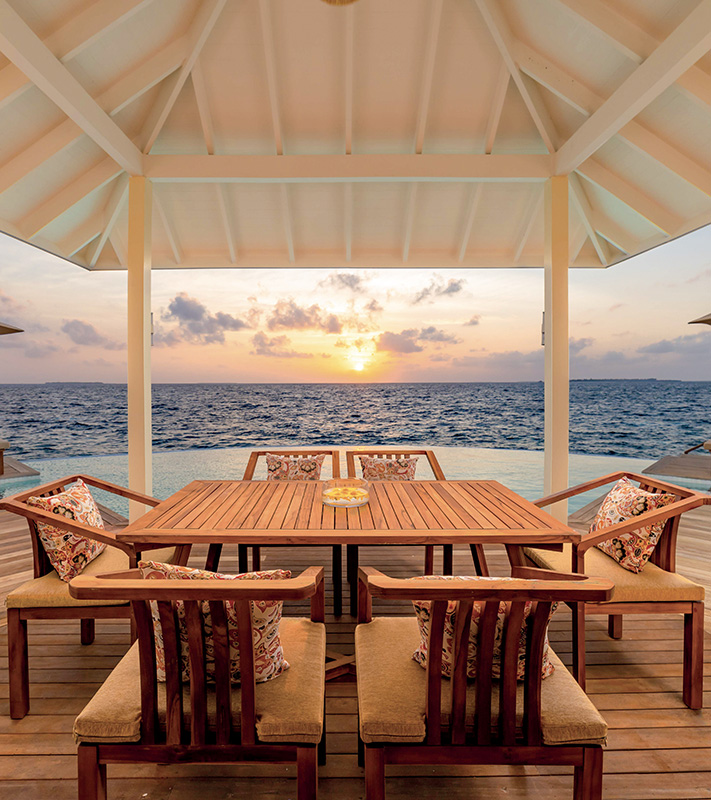
«We want Siyam World to be accessible to everyone: families with children, groups of friends, sports enthusiasts and nature lovers». Ahmed Siyam Mohamed
In this country, which is the flattest on the planet, reaching 1.8 metres above sea level at most, the environmental challenge is also an opportunity for innovation. A short flight in a seaplane yields a birds-eye view of a mosaic of blue, light blue, and indigo surrounding islets with rounded shapes, where the tropical vegetation embraces tourism facilities designed to respect the environment. Every corner tells a story of respect and adaptation to the territory. “The idea that the Maldives are only for honeymooners is outdated”, says Ahmed Siyam Mohamed, a visionary entrepreneur who is redesigning the face of the archipelago. “We want these islands to be inclusive for all: families with children, groups of friends, and, more and more often, groups of female friends, lovers of sports, nature”. Siyam World (sunsiyam.com) shows this transformation clearly. In the underground wine cellar, where the coral walls host labels from every corner of the world – Japan, India, Argentina, New Zealand, or Lebanon – the local sommelier explains how the clientele has changed: “We no longer see just couples on their honeymoon, now we organise tastings for friends and entire families”.

This destination is ideal for surfers. The best spots are spread between north and south Malé: Ninjas, Sultanse Honkys for beginners, and the more challenging waves of Lohis and Jailbreaks for more expert surfers, surrounded by the largest coral reef in the world (8,920 km²).
At sunrise, on the pristine white beach, the horses from the ranch wait for the first riders of the day, for a gallop on the sandy shore. Not far away, a group of teenagers (but also suitable for adults) is getting ready for a mermaid lesson, wearing mermaid tails in various sizes. “This is the highest-demand activity”, explains Ali, a swimming instructor. “It transforms a simple swim into a fairy-tale-like and truly entertaining adventure”. But even a simple swim in these warm, transparent waters truly reconciles you with life. And the memory of that incredible feeling is unforgettable. The go-kart track – the largest in the Maldives – once and for all breaks the schemes of the traditional tropical resort. But it is in environmental conservation that the new course of Maldivian tourism finds its highest expression: “Every guest can become a guardian of the ocean”, explains marine biologist Sarah Thompson. At the same time, she guides a group of tourists through the observation of manta rays. The projects for the conservation of marine turtles include the active participation of guests and making their holiday into an experience of environmental awareness.


Projects for conserving marine turtles and coral reforestation involve the active participation of the islands’ guests, who transform their holiday into an environmental awareness experience.
On the close-by atoll of Baa, the Irufushi resort (sunsiyam.com/sun-siyam-iru-fushi) is going through the same green revolution. The marine research centre has become an international point of reference where tourists and scientists collaborate. “Last year, we recorded a 40% increase in participation in our conservation programmes”, the centre director tells us, and participants even included a group of scholars from Milan’s Università di Milano Bicocca.
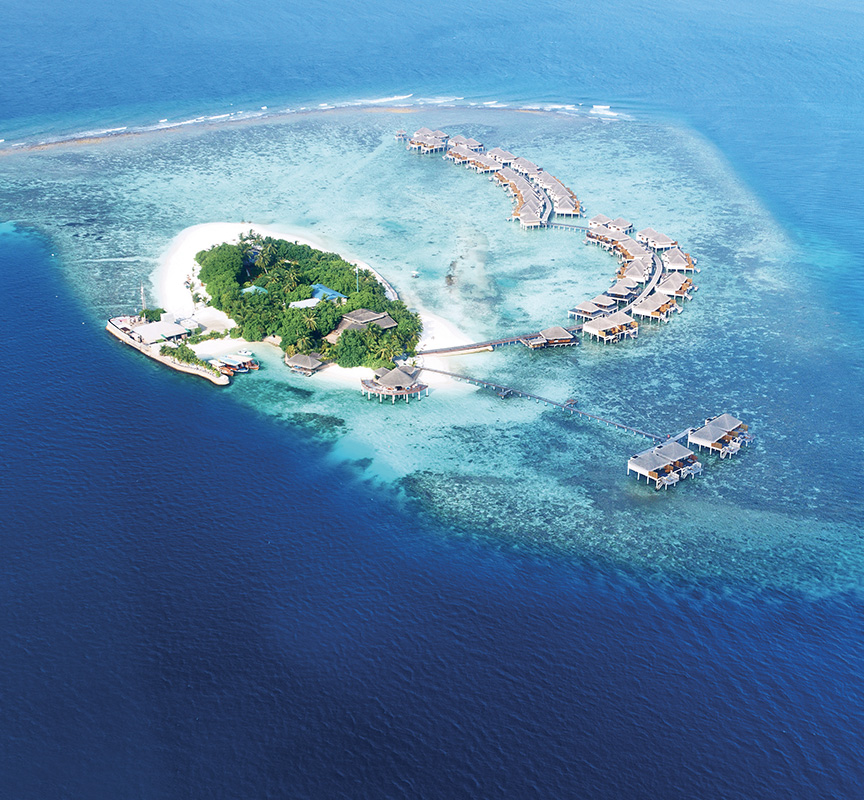

Hulhumalé is the boldest response to the threat of rising sea levels: an artificial island that experiments with sustainable solutions for the future like an open-air laboratory.
Sustainability is not just a slogan: the standard is solar panels, cutting-edge desalination systems, and innovative waste management. However, actual change can be measured in the relationship with local communities. “70% of our staff comes from nearby islands”, explains Mohammed Hassan, human resource manager. “We offer lifelong learning programmes and opportunities for professional growth”. While the sun sets over the lagoon, a nurse shark peacefully swims under a water villa. From the upper deck, adults and children are getting ready to take the last ride down the blue slide. The Maldives of the 21st century are about entertainment and awareness, luxury and sustainability, tradition and innovation.
(Maldive – Archipelago of wonders – Barchemagazine.com – Excerpted from Barche, February 2025)