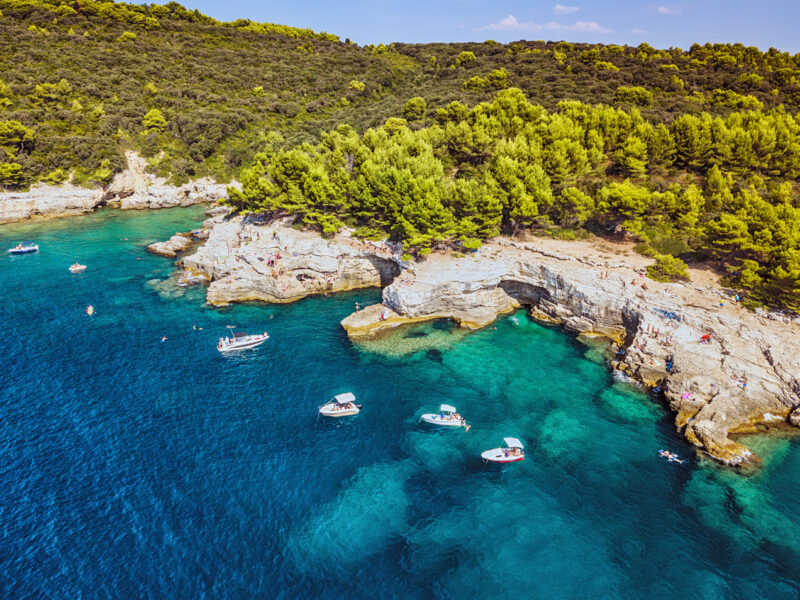
Offering sea, history, culture, and nature, Istria is one of the preferred destinations of European pleasure boaters
by Ornella D’Alessio
In Istria, the biggest green oasis in the northern Adriatic Sea, 35% of the surface is covered by holm oak, strawberry tree woods, and Mediterranean scrub. Intense scents and aromas accompany sailors exploring the Gulf of Medulin and the archipelago of the same name, where the sun shines 2.400 hours per year. The Adriatic coastline is one of the most rugged on the planet, recorded on nautical maps as one of the best destinations in the world due to its clear sea and immense natural beauty, and the peninsula of Istria is its display window.

Isole Brioni © Julien Duval
The minimum distance from the coast for boats up to 15 metres in length is 50 metres, 100 metres for boats between 15 and 30 metres in length, and 300 metres for boats over 30 metres.
If you want to experience the charm of these coasts, sailing begins on the southern part of the Croatian peninsula, 8 kilometres southeast of Pula. Medulin can boast a rather original skyline due to the two 33-meter-tall bell towers of the Church of Saint Agnes, which are almost reflected in the waters of the new Marina and immersed in the extremely ancient history of the place. The most recent archaeological discoveries have revealed traces of Medulin’s prestigious past, the ancient Mutila, on the peninsula of Vižula (which was an island in Roman times), in front of the city centre, which hosts the remains of one of the most beautiful Roman residential villas on the eastern Adriatic coast. Today, it is a modern multimedia archaeological park, which can easily be reached from the Marina. Within it, you can walk in nature and relive the pomp of the period, wearing VR visors to admire the remains of the imperial maritime compound of the late antique period. The beautiful mosaics, multi-coloured marbles, and long colonnades are genuinely stunning. They are submerged mainly by the wind, the erosion and the rising sea.


Medulin Bay is the most complex and best-protected bay in the region. The sea depth varies from one metre near the beaches to twenty-three metres in Premantura. The municipality is divided into seven settlements, including Banjole, Pomer, Premantura, Pjescana Uvala, Vinkuran, and Vintijan. In the third image, panoramic view of the enchanting Vrsar Marina.
The other surprise in Medulin, a necessary sight before you sail northward up the coast, is the Kamenjak promontory, one of the last oases on the coast, which is protected by a natural park. It is a mosaic of pastures and woods, almost immersed in the sea, and a succession of beaches and secret coves. The entire area of Kamenjak is ideal for anyone who loves to move in nature and sleep at anchor. The cycle paths allow you to circumnavigate the island, riding through the most suggestive corners of Gornji and Donji Kamenjak, even on an e-bike. To discover the best sights by bike, there is a three-hour guided tour (jistra.com) along the majestic cape coast up to the southernmost tip of Istria. One of the scheduled stops is the cult Safari bar, which offers one of the three most panoramic points of Istria with views over the Adriatic Sea and the Kvarner islands.


Considered one of the most beautiful towns on the Istrian coast, Rovinj is a charming village set on a small peninsula jutting out into the sea. The imposing Church of St. Euphemia dominates the old town. The blue sea, the enchanting beaches, and the islands of the archipelago are the backdrop to the town’s architectural beauty.
After leaving the berths from the Medulin pier, it is worth stopping at Sv. Ivan na Pučini (Saint John on the open sea), the most distant islet of the small Rovinj archipelago, with a 23-meter tall habitable lighthouse. Even further up the coast lies Rovinj, ancient and modern at once, where you can choose to moor at the Marina or the buoys in the Uvala Lon inlet. It is the largest city on the Istrian coast. For more than half a century, it was part of the Republic of Venice as evidenced by the elegant façades of the buildings with mullioned windows, the small squares, and the bell tower of the church of Sant’Eufemia, a more than 60-meter-tall copy of the church of San Marco in Venice. The dense alleys and narrow passages hide beautiful Romanesque, Gothic, Renaissance, Baroque, and neoclassical buildings. At Campiello al Monte lies the church of San Tommaso, one of the most visited monuments in the city. It is nice to enjoy local delicacies in one of the cafés on the central square, whose tables almost reach the marina, where sailing and fishing boats land. The pleasant atmosphere has attracted many artists who have opened their ateliers in this town.


Pula is located in the extreme south of the Istrian peninsula and offers beautiful natural landscapes and numerous leisure opportunities. It is the seat of the city’s administrative offices and the Istrian region. The town is approximately 126 kilometres from Trieste and is close to the Brijuni Islands National Park, Rovinj, Medulin, and the Santo Stefano thermal baths. Pula is at the heart of Istrian shipping routes thanks to its large marinas. It is an ancient city whose main symbol is the well-preserved Roman amphitheatre.
Once you pass Punta Kriza, a renowned nudist beach, you sail 12 kilometres through the Lim Channel and reach almost as far as Pazin in central Istria. Although it is often referred to as a fjord, the channel is the submerged part of a karst valley. The misunderstanding may arise because the film The Vikings, with Kirk Douglas and Tony Curtis, was shot here in the 1950s.

The Lim Channel is an 11-kilometre-long inlet surrounded by lush forests, which are home to many wild animals and hide numerous historical monuments, such as the cave of San Romualdo.
Navigation resumes towards the medieval Vrsar, which Giacomo Casanova also visited twice. Protected by islets, it is worth visiting the centre for the picturesque atmosphere and beautiful stone houses. Two miles from Vrsar lies the castle-fortress of Funtana, another panoramic point. A series of coves anticipates the port of Porec, which is closed off to the west by the island of St. Nicholas. After passing Novigrad and taking a walk along the Venetian walls that surround it to then lose yourself in the narrow alleys and small squares, you continue to the fishing village of Daila, known for its monastery which hides a small strip of land called Punta with natural stone and pebbel beaches surrouned by a deep blue sea.

Capo Kamenjak

Capo Kamenjak – Faro Porer, photo by Ivo Biočina
From here, you point the bow southward, in the direction of the Brijuni archipelago, the pride of the Istrian peninsula, which is today a park where the ancient Romans used to relax in luxurious villas. The port of Brijuni (np-brijuni.hr) hosts boats of up to 55 metres, while larger ones can anchor in the Fazana Channel. The cultural, historical, and natural heritage is partly enclosed in the Boat House, built in a 19th-century Art Déco style, which stands out as you arrive in the marina.



Brijuni Isles are a true paradise for sailors. The Maggiore harbour is a safe haven for boats and ships up to 55 metres long. Larger vessels can anchor at buoys in the Fazana Channel.
In this strip of land surrounded by the sea, history has unfolded since dinosaurs, who left two hundred footprints here, and until Jozip Brox Tito’s stay on the island, which he had chosen as his summer residence. Fascinating is the Tito Museum, with its 1953 Cadillac Eldorado produced by General Motors in Detroit parked in front. Inside, it is a kaleidoscope of photographs evoking many significant memories. Among the people portrayed in the pictures are Hailé Selassié, Emperor of Ethiopia; Fidel Castro, President of Cuba; and Ho Chi Minh, President of Vietnam. On the top of the heart-shaped Istrian Island is Pula, with its famous arena from Emperor Vespasian, the Temple of Augustus, the Roman forum and the impressive Arc de Triomphe.

To sail in Croatian waters, you must pay a tax for the safety of navigation. It is paid at the Port Authority office and allows you to sail in Croatian territorial waters for one year. The tax is paid annually and is valid until 31 December of the reference year. Tourist tax is paid separately, depending on the length of your stay in Croatia.
Not far away lies the new marina of Veruda, which stretches for 1.5km along the bay of the same name up to Pješčana Uvala. The cruise ends when you start to make out two bell towers on the horizon, announcing your arrival at the Medulin marina.
For more information, visit the Croatian Tourist Board’s website at https://croatia.hr/it-it.
Opening image a Galebove stijene-Pula beach, photo by Aleksandar Gospić
(Istria – Between history and nature – Barchemagazine.com – Excerpted from Barche, July 2025)