Aboard Norwegian Spirit, wandering around the stunning coastlines of Asia
by Ornella D’Alessio
Okinawa is the Japan you don’t expect. At first glance, it’s an explosion of blue, with shades ranging from crystal turquoise to deep cobalt, a play of colours that seems invented to convey the magic of this archipelago, the southernmost in the Land of the Rising Sun (visitokinawajapan.com). Here, colours speak louder than words. Every shade tells a story. The emerald green evokes the forests of Yambaru, north of Okinawa Island, the white sand of Zamami is lapped by waters that change colour with the movement of the waves, and the sun lights up the red roofs of the traditional houses on Taketomi Island and makes the five- or six-pointed star-shaped arena, measuring just a few millimetres, sparkle.


When you arrive in Naha, which is in the Okinawa archipelago, you’ll find that one of the stops on the cruise is full of surprises. This stop is on the Norwegian Cruise Line’s elegant ship, the Spirit.
And then there is the light: in Okinawa, it is different, intense, vivid. In the morning, the ginger fields are tinged with a soft green, while the fishermen of Naha, the capital, set out in their painted boats. Arriving by ship, Naha – one of the stops on the cruise aboard the Spirit, an elegant ship belonging to Norwegian Cruise Line (ncl.com) – is a surprise.
Leaving the harbour towards the centre, you come across Kokusai Street, a shopping street that could be in any Asian capital. A succession of modern buildings, shopping centres, oriental fast food outlets and markets, such as the Makishi public market, at the end of which you can still find beautiful handmade silk kimonos.


The Okinawa archipelago is the southernmost in Japan, made up of 160 islands, many of which are uninhabited, and covers an area of 2,000 square kilometres with a population of approximately 1.4 million.
To get around the city, there is a convenient elevated urban monorail, Yui Rail, which takes you to Shuri Castle. Rebuilt after the bombings of the Second World War, it was destroyed again by fire in 2019. The castle continues to represent centuries of history through its elaborate architecture, which blends Japanese and Chinese influences.

Another almost mystical stop is the Shikinaen Royal Garden: an oasis of peace and the second residence of the Okinawan royal family, where the most important guests were received and entertained. Peace and serenity surround the central lake, overlooked by the palace and surrounded by a forest of tropical plants. Continuing aboard the Spirit, you will find yourself on Ishigaki Island, famous for Kabyra Bay, where you can admire corals, fish and sea turtles from the glass bottom of small boats. However, swimming is prohibited here due to the cultivation of black pearls ((japan.travel). On board large, elegant ships such as the Norwegian Spirit, you will never get bored, and even those travelling alone are welcome, with programmes designed especially for them.
In January 2020, the ship underwent a major refurbishment project. Today, Spirit has six new restaurants, seven new bars and lounges, improved public areas, a spa, modernised cabins and new hull graphics. Continuing the cruise, you arrive in Taipei, the de facto capital of Taiwan, the rebellious island, which is bustling at all hours of the day and night and in every corner of the city (tva.org.tw). Amidst dizzying skyscrapers, concrete and aluminium avenues, and elevated high-speed rail tracks, there is so much to discover to immerse yourself in the true Taiwanese lifestyle and the compelling stories of popular deities who, even today, are so important in everyday life. A fascinating history of settlements, colonisation and immigration has shaped Taipei.

Taipei is the de facto capital of Taiwan. With its dizzying skyscrapers, concrete and aluminium avenues, and elevated high-speed rail tracks, there’s plenty to explore and experience to get to know the authentic local lifestyle.
Today, Taipei is a melting pot of cultures, traditions, religions, and cuisines to discover day after day. From Keelung Harbour, you can easily reach the Main Train Station by metro. This is the meeting point for the Free Walking Tours (likeitformosa.com), during which young volunteers accompany tourists on walking tours of their city. From here, head towards Longshan Temple Station to visit the Buddhist, Taoist and other temples of the same name, located in the western part of the city. In about ten minutes, you will arrive at Bopiliao, an old commercial centre in northern Taipei, where Chinese immigrants traded with the indigenous community.

The style of the former octagonal red-brick public market, Ximen Red House, built in 1908, is entirely different, exemplifying the Japanese colonial style. Today, diverse and multicultural Taiwan has become a magnet for young artisans and artists to exhibit their work. It is pleasant to end the day in one of the many bars in the bustling Ximending district, ideal for shopping. Nearby stands the imposing presidential office, designed to house the governor of Taiwan during Japanese colonial rule. Today, it is the political centre of the island and one of the city’s most recognisable landmarks, thanks to its Western style and 130-metre-long façade overlooking Ketagalan Boulevard, which provides a great vantage point for taking photos of this imposing building. A short distance away is the national monument, the Chiang Kai-Shek Memorial Hall, which was completed five years after his death.
The architectural narrative is based on the Chinese imperial style and Chiang’s life as a political figure, who went from being a great national leader to a symbol of an authoritarian regime during the martial law era. The new district of Xinyi, the world capital of semiconductors and high technology, is the perfect location for Taipei 101 (taipei-101.com.tw/en), a 508-metre-high glass-and-steel tower that symbolises dynamic, modern Taiwan.
Gastronomy is so important in Taipei that, in certain neighbourhoods, the air smells of soy, rice wine, sesame, spices, frying oil and grilled meat, accompanied by the cries of street vendors. Be sure to try the dumplings, which can be found for just a few pounds at one of the most gourmet night markets, the Raohe Street Night Market. The steamed dumplings at one of the many branches of the now international chain Din Tai Fung (dtf.com/en), with its open kitchen, are very good, as are the delicious meat xiaolongbao and beef noodles.

Some people love them, and some people hate them. Still, when the itineraries are off the beaten track, and you disembark every day in different places and countries to discover different cultures and customs, without ever having to think about your luggage, cruises prove to be an excellent travel choice.
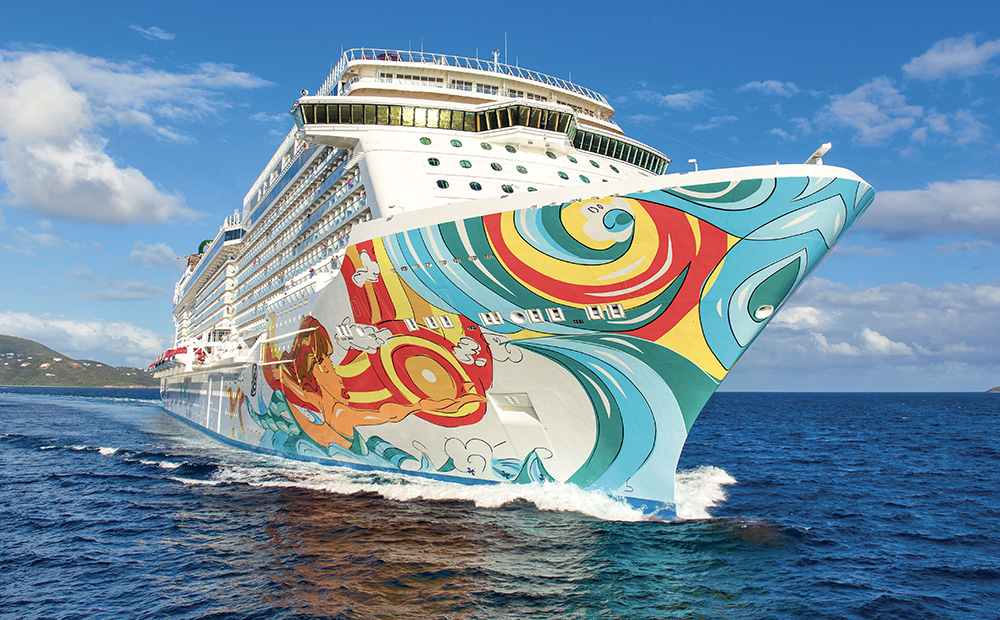
(Norwegian Spirit – Asia you wouldn’t expect – Barchemagazine.com – Excerpted from Barche, February 2026)