Liguria is the region in Italy offering the most marinas and berths, but it could further increase availability by developing existing facilities
by Paolo Viola* and Niccolò Volpati
This is the first episode; fourteen more are to follow because there are fifteen coastal regions in Italy. In this issue and the next ones, we will deal with ports in Italy and analyse the situation region by region, along the country’s 7,375 km-long coastline. One necessary premise should be made: we do not presume to be exhaustive in this account. Our intention is twofold, i.e. to explain the state of the art and to explore how the reception capacity of every single port can be enhanced. The following pages are not intended to be a pilot book, although you will find a series of charts with the addresses and contacts of the marinas in each region. Equally, we do not want it to be a list of problems and discontents, as is often the risk regarding marinas. On the other hand, we will try to think about the figures, critical issues and excellences, to find out how the situation could be improved.
Let us immediately clear the field of the age-old feud between supporters of the construction of new marinas and those who believe such constructions would be an unbearable violence to the landscape and territory. In all modesty, we will try to go beyond this feud, which leads us nowhere and resembles a ship stranded on shallow waters. There can be no doubt that a port has positive economic repercussions on the local territory. Still, it is not necessarily true that you must build new marinas to increase berth availability. You could use and adapt existing ones to improve their reception capacity. It will be our task to think about these aspects by providing you with some examples of ways in which obsolete marinas can be redeveloped. We will begin this exploration in the Liguria region. After all, 21% of the Italian nautical fleet is located in this region, because 30% of all sailboats registered in Italy is berthed in Liguria, and because from Ventimiglia to Bocca di Magra you can find the highest number of berths available – as many as 6,832 – if you count the ones in actual marinas and exclude the temporary berths used during the summer season. These figures refer to 2023, which can be found in the study The Nautical Industry in Figures, promoted by Confindustria Nautica, which is well-known among industry experts.
Ligurian’s harbours
Marina di Cala del Forte, Ventimiglia (IM), www.caladelforte.it
Porto di Bordighera, Bordighera (IM), www.comune.bordighera.im.it
Marina PortoSole, Sanremo (IM), www.portosolesanremo.it
Marina degli Aregai, S.Stefano al Mare (IM), www.aregaimarina.it
Marina S. Lorenzo, S. Lorenzo al Mare (IM), www.marinadisanlorenzo.it
Porto Maurizio, Imperia, www.navily.com/it
Porto di Oneglia, Imperia, www.goimperia.it
Porto di Diano Marina, Diano Marina (IM), www.gestionimunicipali.com
Porto Turistico di S. Bartolomeo al Mare, S. Bartolomeo al Mare (IM), www.comune.sanbartolomealmare.im.it
Marina di Andora, Andora (SV), www.portodiandora.it
Marina di Alassio, Alassio (SV), www.marinadialassio.net
Marina di Loano, Loano (SV), www.marinadiloano.it
Marina di Capo S. Donato, Finale Ligure (SV), www.marinafinaleligure.it
Marina di Varazze, Varazze (SV), www.marinadivarazze.it
Marina di Arenzano, Arenzano (GE), www.portodiarenzano.it
Marina Genova Aeroporto, Genova, www.marinagenova.it
Marina Porto Antico, Genova, www.portoantico.it
Marina di Portofino, Portofino (GE), www.portofinoyachtmarina.com
Porto di Santa Margherita Ligure, Santa Margherita Ligure (GE), www.marinadisanta.it
Porto Carlo Riva, Rapallo (GE), www.portocarloriva.it
Marina di Chiavari, Chiavari (GE), www.marina-chiavari.it
Marina di Chiavari – Calata Ovest, Chiavari (GE), www.marinadichiavari.it
Porto turistico di Lavagna, Lavagna (GE), www.portodilavagna.com
Porticciolo di Portovenere, Portovenere (SP), www.portodiportovenere.it
Le Grazie, Portovenere (SP), www.portodiportovenere.it
Marina del Fezzano, La Spezia, www.marinadelfezzano.it
Porto Mirabello, La Spezia, www.portomirabello.it
Porto Lotti, La Spezia, www.portolotti.it
Porto di Bocca di Magra, Ameglia (SP), www.navily.com


Ports in Liguria
The construction of the first marinas in Liguria dates to the late 1960s and early 1970s. Carlo Riva was the first to launch this process with the Rapallo marina, and soon others like the one in Lavagna followed. The second wave came in the late 1990s following the enactment of Italian Presidential Decree 509 of 1997, better known as the Burlando Decree. The then Minister of Transportation and former mayor of Genoa set himself the goal of streamlining and simplifying procedures to build marinas in Italy. Also, in the early 1970s, the region of Liguria was far behind neighbouring Côte d’Azur. In 1972, the research centre Centro Studi Unioncamere Liguria published the study “Porti Turistici ed Approdi in Liguria” (Marinas and Docking Facilities in Liguria), which compared the situation of two territories with similar lengths, i.e. all of Liguria and the French coast up to Marseille. The comparison was ruthless because the Ligurian marinas were small docks with few berths. At the same time, Menton and Beaulieu had already developed into actual marinas with hundreds of berths. In the following years, things changed significantly.
There were essentially two reasons for the development of marinas in Liguria. Genoa, together with Milan and Turin, is one of the summits of the “industrial triangle”: three large cities with many industries and inhabitants. And “industrial triangle” also meant a triangle of industrialists (but also of professionals, small entrepreneurs, craftsmen, and merchants), of all those people, that is, who were and are often owners of sail- or motorboats. Also, Liguria, besides being a sea location for Genoa’s population, has always been the preferred seaside location for people from Milan, Turin, and the Eastern Riviera, even from Parma. Holiday homes – the so-called ‘second homes’ – multiplied on the Ligurian coast, together with boats searching for places to moor. The second reason that boosted the construction of marinas in Liguria, in addition to its fortunate (or unfortunate, according to some locals) geographic location, is the formation of its coastline. Liguria is not known for its long or deep sandy beaches, but rather for its inlets, some of which are already natural harbours. The most significant is Genoa, especially in the old harbour area, where the Porto Antico marina and aquarium are located today. It is no coincidence that the first port facilities in this basin date back to the XII century. In addition to these records, figures, and history, tourist harbours in Liguria also present specific critical issues. Let’s take a closer look at some of them.
Liguria is not known for its long or deep sandy beaches, but rather for its inlets, some of which are already natural harbours. The construction of the first marinas in Liguria dates to the late 1960s.
The weaknesses
Marinas, precisely because the first of them were built over half a century ago, have aged mainly. In the 1970s, when people spoke of mega yachts, they meant boats a dozen metres in length. Since then, the world has changed, and with it, pleasure boating. And, unfortunately, things did not always go well. In 2018, the storm destroyed the outer dam of Porto Carlo Riva in Rapallo, causing hundreds of boats to sink. Today, the renovation of that marina has almost been completed. The work was carried out by Bizzi & Partners, which took over the concession company. An extraordinary and catastrophic event was thus met with a positive response from private individuals and the public administration.
The situation in Imperia, however, was even more critical. We do not intend to provide a full report of what happened with the company’s bankruptcy, which didn’t finish the construction of the marina. Instead, we would like to focus on the prospects. As mentioned, the work has not yet been completed; in fact, even the fuel dispenser is missing, and the accessibility for boats of up to 90 metres still needs to be assessed, as they might have difficulty manoeuvring. A new project to complete the harbour was recently submitted, with a budget of 196 million euros. It was promoted by the company “Go Imperia”, which still needs to find a private partner to fund the project. The beginning of the work is scheduled for this year if the Region of Liguria issues the Environmental Impact Assessment, which should be concluded by 2031.
Just a few miles to the west, in Ospedaletti, the port of Baia Verde is not doing much better. It only has the outer dam, which has been there for fifteen years. The harbour project dates back to 2001, but the bankruptcy of “Fin.Im” interrupted all works in 2010. In 2013, the State Council ruled in favour of those who opposed the harbour construction, determining the company’s bankruptcy and putting everything on hold. Hopes for Baia Verde in Ospedaletti are now pinned on a French company, which, together with CEM spa, which had carried out the works for the dam, submitted a project to complete the marina.
Lastly, it is worth mentioning the case of the marina in Lavagna, which – after the bankruptcy of “Cala dei Genovesi”, the company that built it in the 1970s, and the takeover in the concession of the current managers, “Porto Turistico di Lavagna spa” – saw its concession expire last July. The harbour was built in 1974, and the concession lasted 50 years. The Municipality of Lavagna extended it until 31 October 2025 and chose an ambitious renovation project that would imply the loss of about 200 berths for the benefit of a larger space to accommodate 50-metre superyachts. To proceed, it is expected that there will be a European tender that needs to be prepared and published by the Region of Liguria and which will likely last more than five years and establish who will carry out the work. The legal proceedings that involved former President Toti and the new regional elections that led to the presidency of Bucci, former mayor of Genoa, certainly did nothing to speed up the process. At the moment, there is still no trace of the tender. Ospedaletti, Imperia, and Lavagna teach us that, in addition to the objective hurdles, disputes, and bankruptcies, uncertainty and red tape are the number one enemy of marinas in this region. They represent an obstacle to the construction of new harbours and the renovation and adaptation of existing ones.
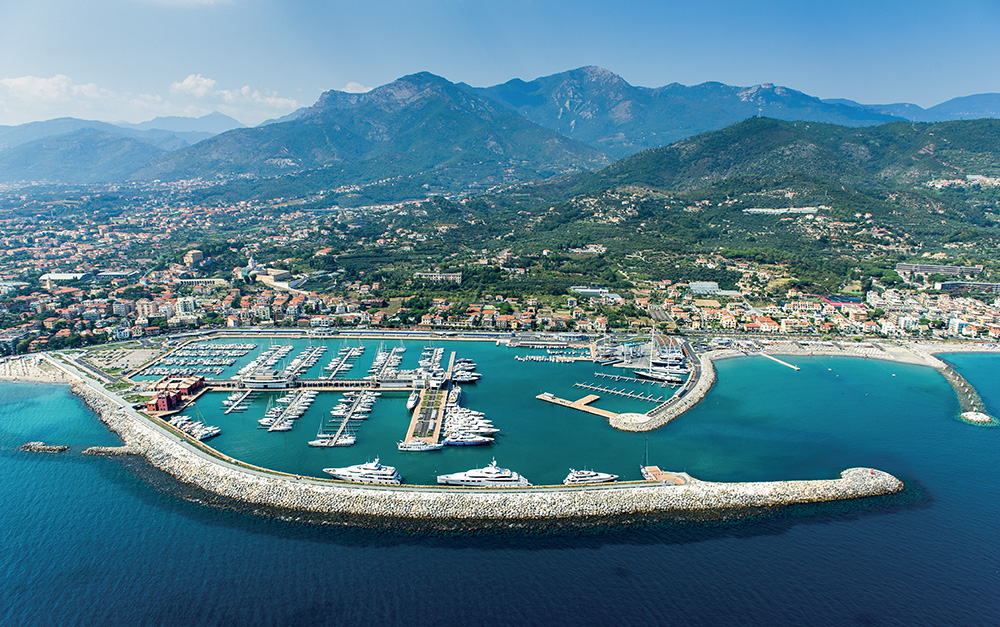
Porto di Loano
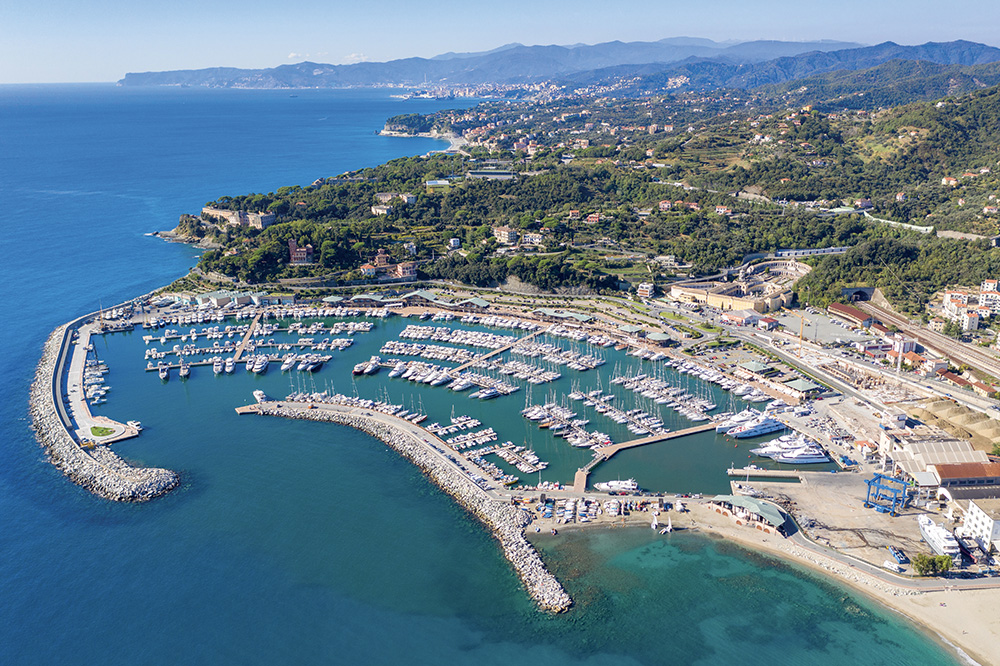
The port of Loano can accommodate 900 boats from 8 to 82 metres in length. There are over 1,000 berths in total. Services and hospitality are guaranteed 24 hours a day, 7 days a week. There are 35 berths for large yachts, 899 parking spaces, 35.5 hectares of land and 16 km² of public green space. Within the marina, there is a shipyard for maintenance and repairs. A long breakwater ensures that the water inside the marina is always calm. Thanks to a project planned down to the last detail, there is no swell in Loano.
Excellences
There could be countless examples, but we felt we should focus on three marinas on the western Riviera: Loano, Varazze, and Cala del Forte. Loano was a small harbour that hosted boats up to ten metres in length and, in the outer pier, two pleasure boats of more than 24 metres. In 1989, the mayor and the harbour master summoned the owners of those two ships and offered them to turn the little harbour into an actual marina. The project was entrusted to engineer Malfatti and Professor Acquarone and drawn up by the design team at Viola Associati, in collaboration with architects Polastri and Traldi and engineers Ballerini and Stura. It quickly obtained the necessary permits, and the works were initiated. Why do we define Marina di Loano as one of the region’s excellences? Because it has a highly efficient outer pier, which effortlessly withstood the many sea storms that have raged on the Ligurian coast in recent years, it does not represent a visual barrier since it lies very low above sea level. This is the merit of the wide berm, which protects the well-equipped and long promenade, which has enhanced and favoured visitors’ enjoyment of the seafront and made it a charming place to spend time. The harbour now offers one thousand berths from 6 to 77 metres in length, and during all these years, it has promoted initiatives and events that have strongly favoured the integration between port and city.
Varazze
The Marina di Varazze was designed by the Turin-based architectural firm Aimaro Isola with respect for the surrounding environment. It can accommodate around 800 boats of up to 35 metres in length and offers a complete range of nautical services, including refitting and maintenance, personnel specialised in various nautical fields, a fuel station, a high level of security with night video surveillance and divers in the harbour, to satisfy even the most demanding yachtsmen. Located just a few kilometres from Genoa International Airport, it is the perfect base from which to explore the world-famous beauty of Liguria by boat or car.
The same can be said of Varazze, which has always been very active in promoting cultural and recreational events to benefit those who regularly experience the marina and tourists who come to the town. The harbour was built in the early 2000s and was directly promoted by the “Azimut” Group in Avigliana. It was designed by architects Gabetti and Isola in collaboration with architect Venezia and engineers Bussetti and Cozzi. Also in Varazze, the outer dam is very particular. Its design represents an extension of the coastline, and the result is exquisite. The ground facilities and the “Lusben” refit yard include many bars, restaurants, shops, and some private homes. Those who have been there know that the entire port area is perceived not as a foreign body separate from the city, but rather, even though they are not exactly facing each other, as an element perfectly integrated in the city and its surrounding environment.
Cala del Forte
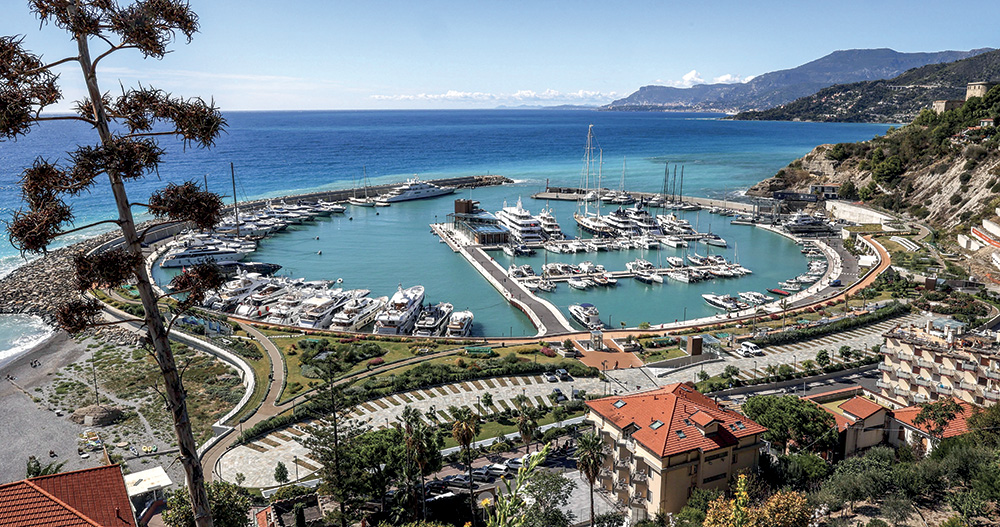
Cala del Forte is only 7.9 miles from Monaco and is immersed in the charm, both historical and natural, of the Riviera dei Fiori in western Liguria. It is not large, with 178 berths, but the aim is to replicate the model of comfort and hospitality that reigns in the SMIP facilities in the Principality. A berth first and foremost for large yachts (at the entrance, the depth is 7 metres) with the necessary services to best meet the needs of owners and their guests, as well as those of the crews, who have to make these boats sail at their best and in safety.
Cala del Forte in Ventimiglia is a marina conceived for large boats, dedicated to the highest level of hospitality and professionalism. It comes from the experience of nearby Port Hercules and Fontvieille in the Principality of Monaco. Seen from above, it looks like a sea snail, with its circular plan that closes in on itself. If you approach it from the sea, it is almost invisible as you arrive by boat. Cala del Forte is a perfectly set marina in the surrounding environment – a winning example of a complete symbiosis between man and nature. That shape results from a careful study in collaboration with the University of Florence to reduce the power of the frontal impact of waves coming in from the sea, which, as recent history has sadly taught us, can be particularly devastating. Société Monégasque Internationale Portuaire created it under the direction of Aleco Keusseoglou.
PortoSole Sanremo
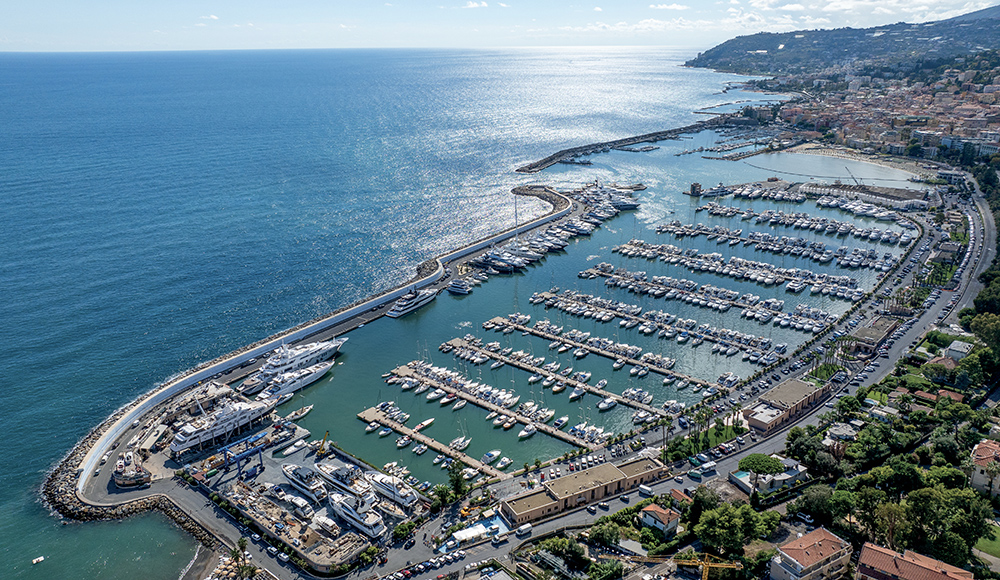
PortoSole has 770 medium to large berths and can accommodate yachts up to 90 metres in length. Key facilities for boaters include 24-hour mooring service, night watch, fuel station, water and electricity supply, quay lighting, firefighting service, toilets and showers, car parking, shipyards and Wi-Fi Internet access. The marina houses a variety of commercial businesses, including two large shipyards, a mechanical workshop, a fuel station, various nautical agencies, chandlers, qualified marine electronics shops, marine upholsterers, a specialist boat laundry and several bars, restaurants/pizzerias and a tobacconist.
New projects
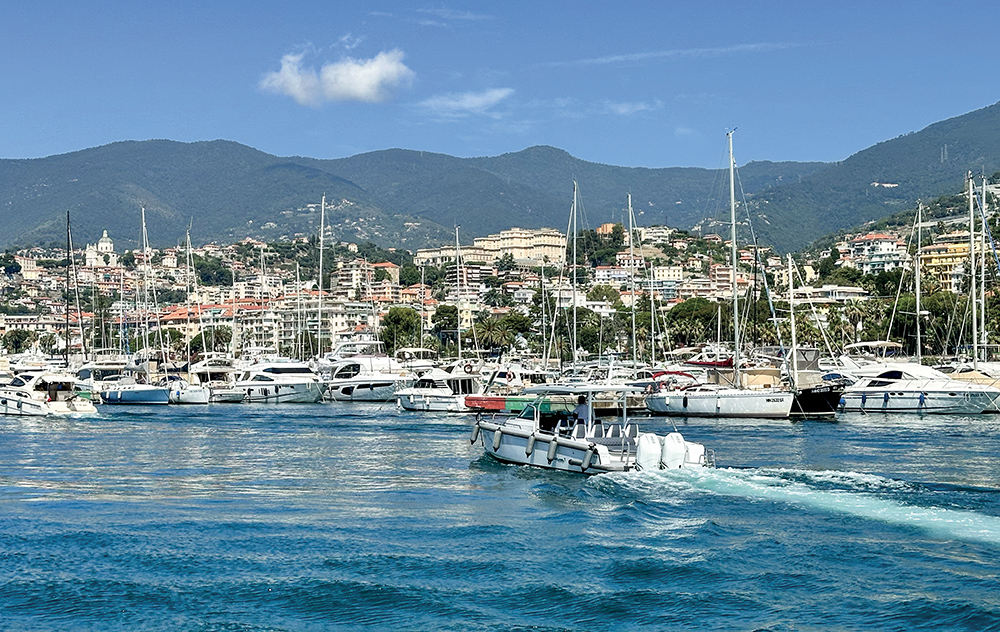
Also, the list could be long in this case, but we will limit ourselves to a selection. The first project, which, in our opinion, is worthy of mention, is the Porto Vecchio (old port, or public port) of Saronno, a project at a relatively advanced stage of development. It is currently going through the ‘pre-conference of services’ (a preliminary meeting with the public authorities) – which should be held within a couple of months – and it would be realistic to assume that works can begin in the first months of 2026 to be concluded in about three years. The project is authored by architects Calvi, Ceschia and Viganò. At the same time, the entire initiative is promoted by the Porto Sole marina, a private marina located right in front of the public port. The idea is to redevelop the existing structure to obtain new berths, many of which will be destined for superyachts. It is easy to imagine that with a new marina managed by the same subject emerging right next to it, Porto Sole could function as a bridge between Sanremo and Cannes, where the Vieux Port and Port Canto lie facing each other.

Porto Lotti
Large yachts have chosen Porto Lotti as their home port because of its logistical and structural characteristics, including its geographical position, which makes it possible to plan trips at any time of the year and in any weather. A 160-tonne travel lift, 500 berths, all types of assistance, shipyards capable of carrying out all kinds of work, from carpentry to painting and refitting vintage boats, are just some of the services available. Others include those contributing to Porto Lotti’s reputation: a fitness centre, beauty farm, swimming pool, tennis court, bar, cinema, restaurants, Wi-Fi throughout the marina, conference room, taxi boat and much more.

Another already approved project that should see the beginning of the work in September of 2025 is the expansion of Porto Lotti in La Spezia. The new docks, which will cover an area of 20,000 m2 and include ten berths for superyachts (above 50 metres), should be built in just 18 months. The time frame is limited because the plan is to recycle the caissons used to straighten out the Costa Concordia, the ship that sank off the island of Giglio more than ten years ago. These caissons no longer serve a purpose and would have been difficult to dispose of. Now, thanks to this wise project, they can be reused. Filled with inert material, they will rest on the seabed, and the new docks will be built on top of them. Once the work is completed, the Porto Lotti docks will be the world’s first “sustainable” docks constructed with recycled materials!
Lastly, the case of Oneglia in Imperia is worth mentioning. Here, more than a project, there is an intention for the time being. The port of Oneglia is located right next to the Imperia marina, which we have already mentioned. It has been a commercial port with very little traffic for quite some time, practically empty. The idea that the mayor of Scajola has in mind is to transform this port into a marina as well. The plan is to eliminate all the commercial activity and use the so-called “oceanic” dock for mega- and gigayacht berthing. Furthermore, the port has shallow waters and poor protection from the winds of the third quadrant, so much so that its mouth needs to be improved. However, perhaps we could settle for letting the tourist activity coexist with the commercial one to safeguard the dockworkers’ jobs. However, this does not seem to be the mayor’s intention.

* Paolo Viola
Paolo Viola (Naples, 1936) is an engineer and urban planner specialising in harbour design, head of the “Marina & Waterfront” area at WiP Architetti s.r.l., ranked among the top 100 architecture and design firms in Italy. He founded the Master’s programme on “Sustainable planning and design of harbour areas” at the Università Federico II° in Naples and is the author of the book “Porti turistici, approccio multidisciplinare per una strategia progettuale integrata” (Marinas, a multidisciplinary approach for an integrated design strategy – Flaccovio, 2010).
(Focus Harbours – Liguria, 1st chapter – Excerpted from Barche, June 2025)