So much coastline, so few ports and so few moorings. But it’s never too late to remedy that
by Paolo Viola* and Niccolò Volpati
This had already been understood at the time of the Magna Graecia colonies and also during the maritime republics in medieval times. The Tyrrhenian and Ionian coasts of Calabria are key hubs. Ships, many of which came from France and were bound for the Holy Land, stopped at Roccelletta, in the Gulf of Squillace, before continuing to Palestine. After all, there was no naval blockade, and they were not attacked before reaching their destination. The reverse route was also valid. Those who set sail from the east stopped at Crotone or Sibari before heading for Sicily. After all, even today, the routes have not changed much. Many yachts are sailing in these waters bound for Malta, Greece or Turkey, particularly pleasure boats, i.e. yachts over 24 metres in length. Yet there are no ports, especially for transit. Politicians and administrators in ancient times were probably more forward-thinking than their modern counterparts.

Agropoli.
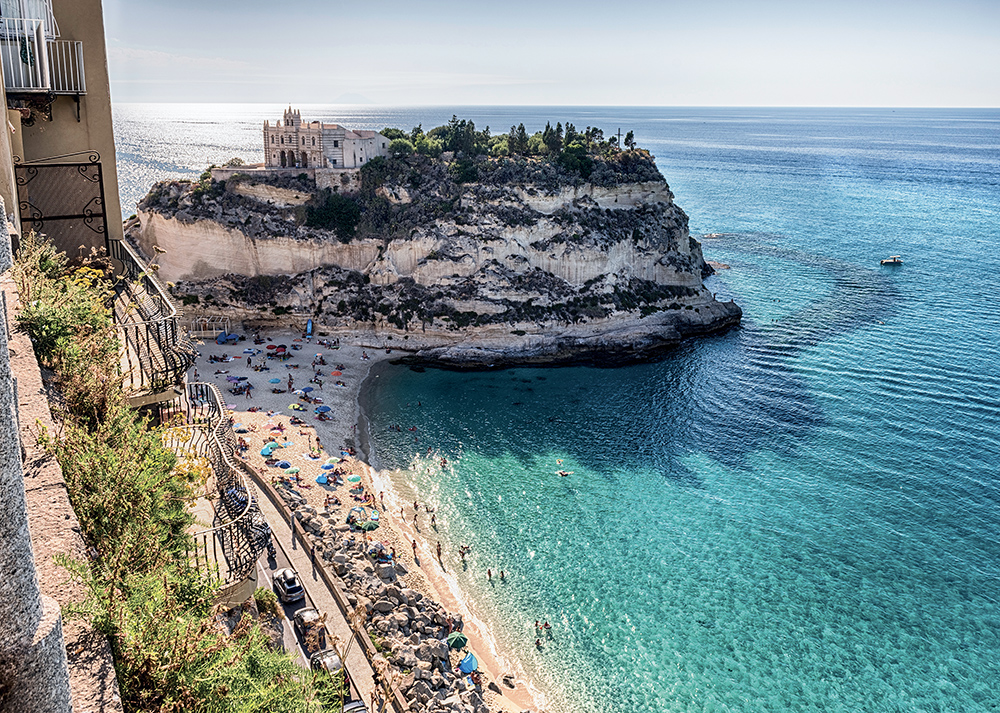
Tropea
Many yachts and superyachts sail along the coasts of Calabria and Basilicata, heading for Malta, Greece and Turkey, but there are no ports where they can dock.
Calabria and Basilicata border both the Tyrrhenian Sea and the Ionian Sea, which is why we have decided to treat them together. Another reason is that the Basilicata coastline measures a total of 70 kilometres, which, added to the 788 kilometres of the Calabrian coast, makes a total of more than 850 kilometres, over 10% of the Italian coastline. There are very few marinas and, consequently, very few berths. There is no mooring for yachts measuring over 55 metres. Moreover, this size is only accepted in Tropea or Roccella Jonica, where the maximum length is 50 metres.

The marinas of Calabria and Basilicata
Maratea, Maratea, www.maratea.info
Cetraro, Cetraro Marina, www.portocetraro.it
Tropea, Tropea, www.portoditropea.it
Taureana di Palmi, Palmi, www.portodigioiatauro.it
Porto delle Grazie, Roccella Jonica, www.portodellegrazie.com
Marina Laghi di Sibari, Sibari, www.marina-sibari.it
Marina di Policoro, Policoro, www.marinedi.com/marina-di-policoro
The Tyrrhenian Sea offers an extraordinary opportunity that seems to be overlooked: the presence of the Aeolian Islands off the coast, stretching from Tropea to Scilla – accessible from the north by both rail and motorway, before crossing the Strait! – which should activate a port competing with those of Milazzo, Porto Rose and Capo d’Orlando in Sicily. It would be sufficient, for example, to adequately equip the port of Vibo Marina, just a bit further north, which is underused for commercial traffic and severely penalised for recreational boating, or to sufficiently expand the marinas of Palmi and Scilla.
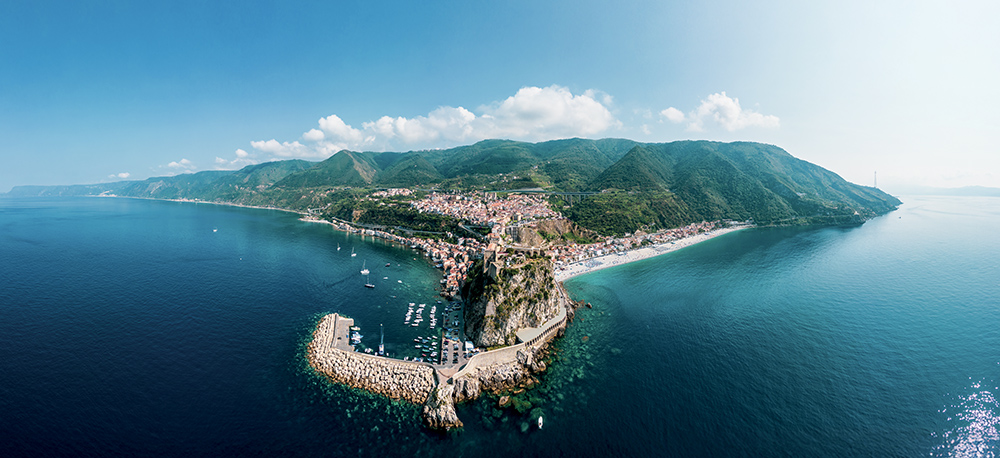
Chianalea
Marinas could also offer maintenance services, capitalising on the revenue generated by mega yachts.
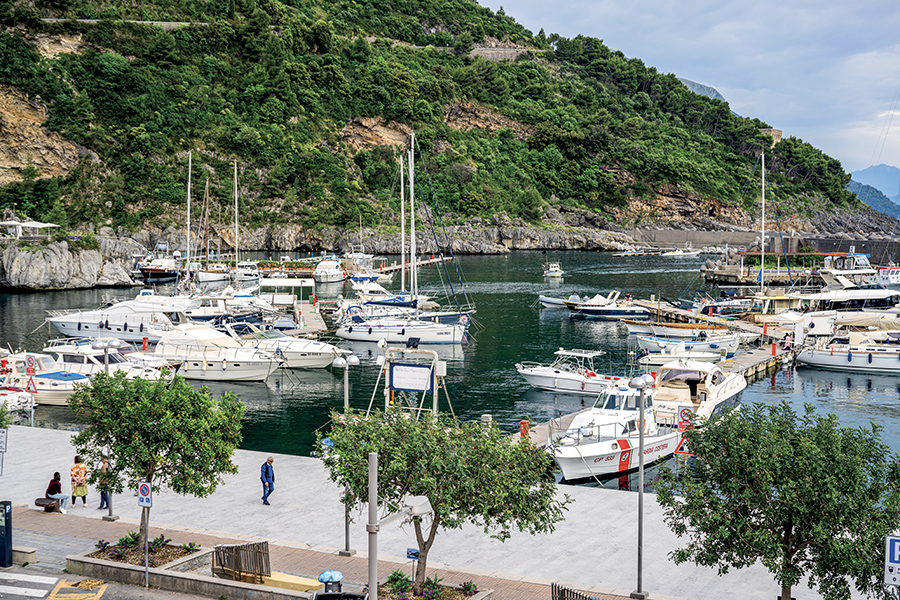
Maratea
Then there is the Strait. It is one of the most legendary places in the Mediterranean, in the true sense of the word, the most celebrated, desired by all sailors and yachtsmen. The waters are crystal clear and teeming with life and, at the same time, home to ancient and colourful deep-sea fishing traditions (swordfish!). On one side, the Aeolian Islands are just a few miles away; on the other, Malta and the Pelagie Islands are a little further away. Everything suggests that the two shores of the Strait should be the capital of international yachting: large ports with large boats that come to spend the winter there, crews enjoying the urban presence of Reggio and Messina, shipowners using the airports of Catania, Reggio and even Lamezia, close to the sea on both sides, and enjoying magnificent places such as Taormina, Mount Etna and Aspromonte. But none of this is the case.

Policoro
Marina Laghi di Sibari and Marina di Policoro are hybrid structures, i.e., seaside villas with private moorings. They are more suited to permanent tourism than to tourists passing through.
On the Ionian coast, another curious case is the two marinas called Laghi di Sibari and Marina di Policoro (Marinagri), organised like Port Grimaud in Provence, or, much more simply, like Punta Faro in Lignano Sabbiadoro, between Venice and Trieste. This type of marina, which originated in Lignano Sabbiadoro in the early 1970s and was then called “Terra-mare” (land-sea), consists of a series of navigable canals dug near the coastline, overlooking residences with their own private moorings. Subsequently, one was built in New York Bay and then, in large quantities, in Miami.

Tropea
Cetraro, Tropea, and Roccella are well-equipped marinas
that, however, cannot meet high demand, especially during
the summer season.
The Laghi di Sibari were created in the mid-1970s through land reclamation by a group of entrepreneurs from Friuli. The entire complex consists of four peninsulas, each comprising 30 to 50 villas, and the internal dock is accessible via a canal. The draught in the pier is two and a half metres, and the width of the canal is six metres; therefore, the maximum size of boats allowed cannot exceed 18/20 metres in length. In addition to numerous berths, the complex includes shops, a hotel, a shipyard and several sports facilities. Today, Friulian entrepreneurs have almost wholly disappeared, and a laborious relaunch has been underway for some time. The hope is that, as in the days of Magna Graecia, people will understand what the Calabrian and Lucanian coastline is still today: a place to intercept passing ships and provide them with the services they need, in a word: to build a port, not a resort.

* Paolo Viola
Paolo Viola (Naples, 1936) is an engineer and urban planner specialising in harbour design, head of the “Marina & Waterfront” area at WiP Architetti s.r.l., ranked among the top 100 architecture and design firms in Italy. He founded the Master’s programme on“Sustainable planning and design of harbour areas” at the Università Federico II° in Naples and is the author of the book “Porti turistici, approccio multidisciplinare per una strategia progettuale integrata” (Marinas, a multidisciplinary approach for an integrated design strategy – Flaccovio, 2010).
(Focus Harbours – Calabria and Basilicata, 5th chapter – Barchemagazine.com – Excerpted from Barche, March 2026)