Historically, a crucial hub for maritime trade, the island offers pleasure boaters a very limited number of marinas, despite its enormous potential
by Paolo Viola and Niccolò Volpati
Trinacria is the ancient Greek name for Sicily. It derives from the words treis (three) and akra (promontory), specifically referring to the island’s main promontories: Capo Peloro in the north-east, Capo Passero in the south-east, and Capo Boeo or Lilibeo in the west. These strategic points, in turn, mark the great Sicilian coasts: the Tyrrhenian in the north, the Ionian in the east, and the southern coast facing the Strait of Sicily. Then, there are the Aeolian Archipelago (Alicudi, Filicudi, Salina, Lipari, Vulcano, Panarea, Stromboli), the Egadi Islands (Favignana, Levanzo, Marettimo), and the Pelagie Islands (Isola dei Conigli, Lampedusa, Lampione, Linosa). As well as the more solitary islands of Ustica and Pantelleria. Sicily, in other words, is, and has always been, a crucial naval hub.

Siracusa.
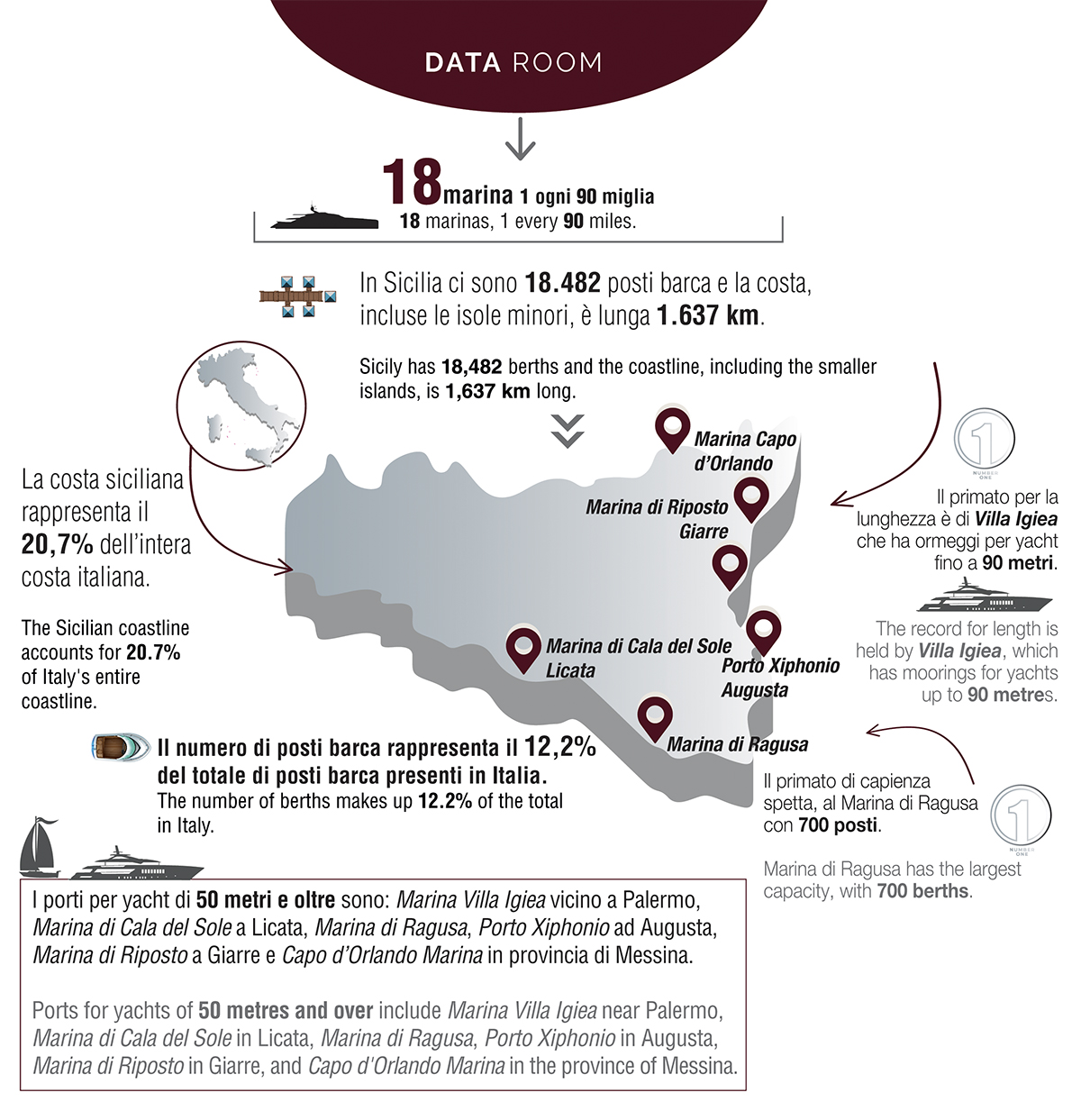
Despite this vast geographic heritage of unparalleled beauty, and although today the island boasts several smaller harbours – 84 in total – the ports that can be classified as real marinas are only 18. This is indeed a shame, because Sicily, as is well known, is a highly sought-after tourist destination, whose waters are often navigated by both large and small yachts which, however, struggle to find a docking place.
Until recently, the northern coast only had Marina di Villa Igiea, close to Palermo. In recent years, and solely thanks to a series of private initiatives, two new marinas facing the Aeolian Islands have been completed: Portorosa and Capo d’Orlando. In the south, Marina di Ragusa is well organised, while in the east, between Catania and Messina, the only available point of contact is Marina di Riposto, which, however, is still under construction. Furthermore, we should not forget hurricane Harry, which caused significant damage on the island. It wrought havoc in Porto Rossi, Catania, and only caused minor damage, fortunately, at Marina di Santa Maria Maggiore, near Milazzo.

Catania.
As always, there is both good and bad news. Let’s begin with the bad. Marsala was expected to see the construction of a port by 2019, featuring over one thousand berths and moorings for yachts up to 75 metres long. The project included a complete restoration of the city’s waterfront. It was very promising, especially because the strategic islands of Favignana, Marettimo, and Levanzo – collectively the Pelagie– are nearby and continue to attract many tourists. However, nothing came of it. The same fate befell the coast of Trapani. The concession was granted to the Marsala Yachting Resort in 2016, but it was withdrawn four years later. As a result, the project literally shipwrecked. Massimo Ombra, the company’s CEO, stated that he was expecting public funding to build the breakwater. However, the funds never materialised.
Less serious, but still far from commendable, is the situation in Termini Imerese: the Harbour System Authority is using this location to shift container traffic away from the port of Palermo, thereby damaging the historic and charming hamlet that overlooks the port. Several years ago, the Municipality of Termini Imerese, which then managed the port, unanimously approved a Regulatory Plan to dedicate the port to pleasure boating and cruise tourism, with only a portion reserved for commercial traffic.
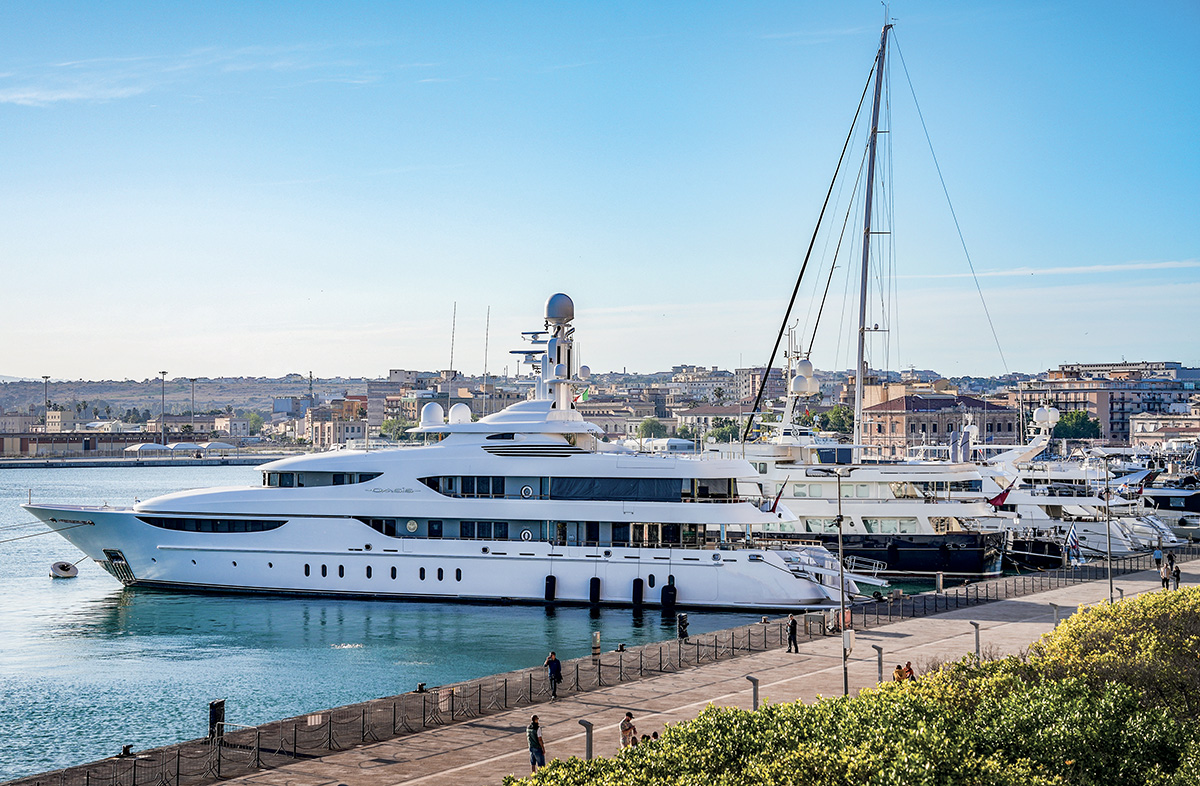
There are only six marinas capable of accommodating yachts of 50 metres or more: Villa Igiea, Cala del Sole, Marina di Ragusa, Porto Xiphonio, Marina di Riposto and Capo d’Orlando Marina.
Another delay in the development of Sicilian ports is seen in the valuable area of Taormina. A project had been prepared – and, it appears, approved – to build a marina on the promontory overlooking the town of Giardini Naxos, very close to the well-known tourist spot. The same project also included – unfortunately – the approach of a cruise ship just off the city’s large urban beach. After prolonged hesitation caused by the company’s bankruptcy, the project fell into disuse. This might be for the best, considering the severe impact it would have had on the stunning bay of Taormina. Who knows?
The marinas of Sicily
Porto di San Vito Lo Capo, www.sanvitoweb.com
Marina di Castellammare, www.marinadicastellammare.it
Marina di Balestrate, www.marinadibalestrate.com
Marina Villa Igiea, www.marinavillaigiea.it
Marina di Termini Imerese, www.artemarnautica.com
Capo d’Orlando Marina, www.capodorlandomarina.it
Marina di Portorosa, https://portorosamy.com
Marina del Nettuno, www.marinadelnettuno.it
Marina di Riposto, www.portodelletna.com
Porto di Xiphonio, www.portoxiphonioaugusta.it
Porto Grande Siracusa, www.marinayachtingsr.it
Marina di Marzamemi, www.portoturisticomarzamemi.it
Porto Turistico Marina di Ragusa, www.portoturisticomarinadiragusa.it
Marina di Cala del Sole, www.marinadicaladelsole.com
Marina di Sciacca, www.marinadisciacca.com
Marina Salina, www.marinasalina.it
Marina Pignataro, www.portopignataro.it
La Darsena, www.ladarsenafavignana.com
But, let’s hear the good news. Despite the often overly optimistic claims of local officials, we should now be very close to completing the port of Sant’Agata di Militello. It will be a facility capable of accommodating fishing and pleasure boats which, once the road network has been improved, should start operating at full capacity. Another positive example worth mentioning is the nautical base in Trapani, managed by Marinedi, which is already fully operational. Here, the intervention focused not so much on the berths but on providing services and dry berthing for yachts up to 140 metres in length. There was no disruption or cementification; quite the opposite: the initiative involved reclaiming unused port areas to create year-round jobs.
Overall, the potential of tourist marinas in Sicily has not yet been fully realised. This is a significant loss, as, besides a “residential” boating activity – mainly involving Sicilians and the numerous fishing boats (which are fortunate to exist) – there is also considerable transit traffic that could be captured. The island’s geographical position in the centre of the Mediterranean is undoubtedly an advantage in this regard. Furthermore, neither Sicily nor its smaller islands lack tourists, and busy routes to Malta, Greece, and Sardinia further underline the opportunities available.

Palermo.
There are three large marinas: Marina di Ragusa with 700 berths, Marina di Portorosa with 650 and Marina di Balestrate with 645 berths.
The total number of berths on the island is 18,482. Not insignificant (only Sardinia and Liguria have more), but we shouldn’t be misled by this figure. The coastline, including minor islands, spans 1,637 metres, and along that coast, there are only 18 marinas that qualify as such. This translates to roughly one marina every 90 miles. So, while the island does have berths, they are mainly suitable for medium-small boats. There are only six marinas capable of accommodating 50-metre yachts. Come on, Sicily, boating is rooting for you!

* Paolo Viola
Paolo Viola (Naples, 1936) is an engineer and urban planner specialising in harbour design, head of the “Marina & Waterfront” area at WiP Architetti s.r.l., ranked among the top 100 architecture and design firms in Italy. He founded the Master’s programme on“Sustainable planning and design of harbour areas” at the Università Federico II° in Naples and is the author of the book “Porti turistici, approccio multidisciplinare per una strategia progettuale integrata” (Marinas, a multidisciplinary approach for an integrated design strategy – Flaccovio, 2010).
Focus Harbours – Sicily, 6th chapter – Barchemagazine.com – Excerpted from Barche, April 2026)