An unprecedented strategic alliance between Groupe Bénéteau and Group Fountaine Pajot to accelerate the electrification of sailing and advance low-emission solutions.
Today, more than 99% of sailboats are equipped with an internal combustion engine. Contrary to popular belief, even a sailboat needs an internal combustion engine, whether for harbour manoeuvres, when there is no wind, or to cover part of the onboard energy needs. To change this, Groupe Bénéteau and Fountaine Pajot Group are creating E-Lektra Marine, an unprecedented alliance bringing together seven major sailing brands — Bénéteau, Jeanneau, Lagoon, Excess, Fountaine Pajot Sailing Catamarans, Fountaine Pajot Yachts e Dufour — to create a shared standard for electric propulsion and onboard energy autonomy, with a clear ambition: to accelerate the electrification of sailing and support the transition to low-emission solutions, while helping bring electric solutions to 10% to 15% of the global sailing market to electric by 2030.
E-Lektra Marine: two groups, seven brands,one shared goal: structuring a global standard for the electrification of sailing
Groupe Bénéteau and Fountaine Pajot Group are announcing the creation
of E-Lektra Marine, a 50/50 joint venture dedicated to electric propulsion and intelligent onboard energy management.
By bringing together, for the first time, seven major brands that remain commercially independent, the two French groups are combining their scale and capabilities to create a global standard for sailboat electrification and energy management, open to all players in the boating industry.

FP44 Electric ODSea+; Photo credit: G. Martin-Raget
Sailing is a unique case in the energy transition: it combines the challenges of the automotive industry — silent propulsion with lower emissions — with those of housing — autonomous energy management, far from any grid. While an electric car can be recharged at any time from a power outlet, a sailboat must be able to produce, store and distribute its own energy at sea. Solar power, batteries, generator, propulsion and onboard comfort: all energy flows must be orchestrated in real time. It is precisely to meet these two challenges simultaneously that E-Lektra Marine was created.
In sailing, the primary challenge lies not only in propulsion but also in managing the vessel’s overall energy autonomy onboard.
The challenge is not limited to propulsion: E-Lektra Marine also addresses the sailboat’s overall use. Onboard energy management is equally important, as it determines autonomy, comfort, reliability, and, depending on the use case, the ability to operate with lower emissions.
After pooling their life cycle assessment methodologies for their boats, the two leaders are taking a further step by forging a shared decarbonisation roadmap. In this context, they are relying on technologies that have now been proven effective: Groupe Bénéteau has already been offering low-voltage electric solutions on its sailboats up to 12 metres for several years, while Fountaine Pajot deploys high-voltage hybrid solutions on its catamarans over 15 metres. Now mature, these technologies are ready to scale. Rather than each developing its own technological base, the two groups have chosen to co-build a shared platform, open to the entire boating industry.

Dufour 48 Electric ODSea+; Photo Credit, JM Liot
Its mission: to design and deploy an onboard system that is competitive with internal-combustion solutions and capable of orchestrating all onboard energy flows in real time.
In concrete terms, E-Lektra Marine’s experts in naval electrical system architecture will define, specify and validate standardised electric propulsion and energy management solutions, adapted to different sailboat sizes and uses.
E-Lektra Marine will rely on a group of strategic partners, including Alternatives Energies (based in La Rochelle), specialised in electric systems integration; Cirtem (Toulouse), an expert in energy conversion and management; and EVE System (Lyon), a specialist in battery pack design, as well as on the expertise of both groups.
A model accessible to all market participants to achieve critical mass and make these solutions straightforward and competitive.
The challenge for E-Lektra Marine is not only technological: it is also economic. By bringing together the production volumes of seven brands (60% market share) and those of other major players in the sector, the platform aims to reach the industrial thresholds needed to make these solutions simpler and more competitive.
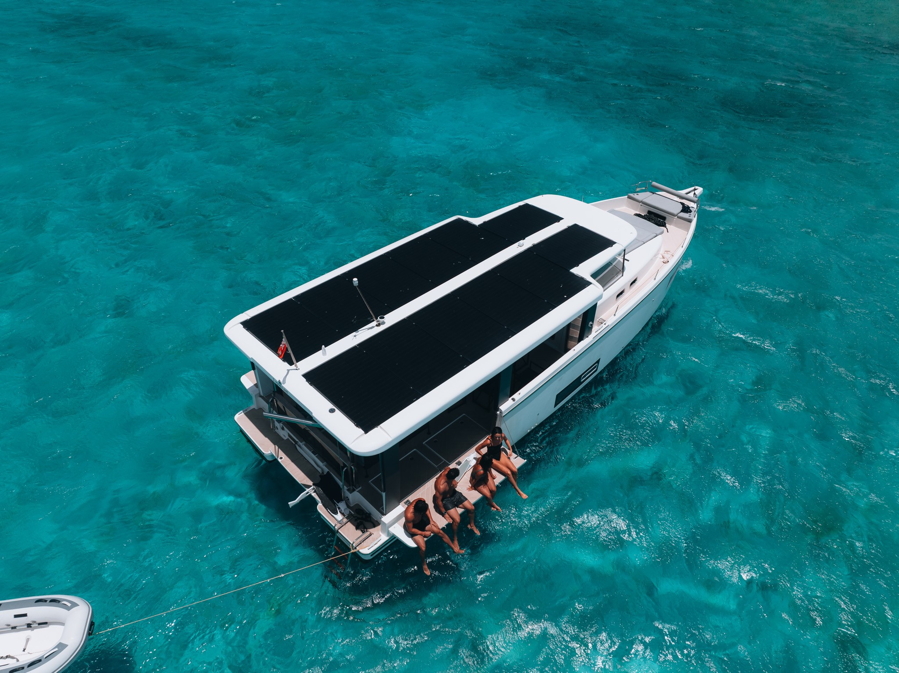
Jeanneau Sea Loft 480
An offer designed to deliver simpler, more accessible low-emission solutions for sailing
In concrete terms, the systems offered by E-Lektra Marine will provide:
- Electrification solutions adapted to all sailboat sizes from 9 to 24 metres, from full electric to low-voltage and high-voltage hybrid solutions.
- Optimised onboard energy management between solar power, engine, generator, comfort equipment and shore power connection.
- Real-time monitoring of consumption through an easy-to-use
- A standardised system supported by a global network of approved and trained service partners.
- Continuous improvements to the solutions offered to boaters, making them ever more competitive and efficient.
- A refit solution enabling current owners to switch to
With E-Lektra Marine, the ambition is clear: to offer customers low-emission solutions for sailing, tailored to their needs with no compromise on safety, simplicity or freedom of navigation.
The two French groups are aiming for a market scale-up by 2030
Groupe Bénéteau began its electrification journey more than 20 years ago, notably with the first Lagoon 421 models, before continuing in recent years with fully electric solutions on its Bénéteau Oceanis monohull sailboats from 30 to 40 feet, on its inland waterway boating offer with the Delphia brand, and expanding it with hybrid solutions on several models, including the Excess 11 and the Jeanneau Sealoft 480.
Fountaine Pajot Group, for its part, positioned itself in the cruising catamaran electrification market with the Aura 51 and the Samana 59, its first proven sailing concrete and reference models. Building on these technical validations, the Group is now taking a further step by rolling out electric solutions across all Fountaine Pajot Sailing Catamarans, Fountaine Pajot Yachts and Dufour monohull sailing brands.
By pooling the volumes of 7 brands, representing 60% of the global market, E-Lektra Marine aims to structure an open global standard at the scale of the sailing market, with a shared objective: to electrify 10% to 15% of the global sailing market by 2030, representing several hundred boats per year.

From the left: Mathieu Fountaine and Bruno Thivoyon
“With E-Lektra Marine, two major players in the sailing industry are joining forces in an unprecedented alliance to accelerate the electrification of sailing. By combining our industrial expertise, we aim to establish open standards and make low-emission solutions simpler, more accessible and scalable”. Bruno Thivoyon, Chairman of the Management Board, Groupe Bénéteau
“After several years of deployment, Alternatives Energies has demonstrated that scalable solutions do exist. The E-Lektra Marine joint venture with Groupe Beneteau shows that our industry can mobilise around shared environmental objectives. Today, electrification is becoming essential; it must now be made accessible across the entire sailing market”. Mathieu Fountaine, Deputy Chief Executive Officer, Fountaine Pajot
Opening image EXCESS 11 Hybrid; Photo credit: Julien Gazeau
(E-Lektra Marine – Barchemagazine.com – April 2026)