Pierangelo Andreani is a man of great human and professional depth. A gentle legend that all young designers should be inspired by
by Chiara Risolo – photo by Andrea Muscatello
Pasticciare: to operate, proceed in an activity without order or method, with little or no precision, due to inability or inexperience, listlessness. As per the Italian dictionary, the definition is as far removed as possible from Pierangelo Andreani. Yet, when talking about himself, the master of the hand-drawn line often uses this verb, almost as if it were a filler word, which is strange for a man like him. In his 55 years of a highly honourable career, he has authored authentic road and sea emblems. He is the father of the legendary Maserati Biturbo and Ferrari Mondial 8, to mention a few examples, but also of an endless number of Guzzi, Cagiva, Benelli motorcycles and boats registered under the names of Cranchi, Bénéteau, Fountaine Pajot.
Is it false modesty, then? Not at all! The truth is that Pierangelo Andreani has always been an intimate friend of the pencil, so much so that he could afford to be somewhat lighthearted with it and have that right amount of disenchantment typical of anyone with a razor-sharp brain. He consumed kilometres of graphite mines on his school desks: “During lessons, there was never a blank sheet of paper that I wouldn’t mess up with some doodles. Cars, motorcycles… I also enjoyed drawing portraits of my classmates, especially their caricatures”, he remembers. Andreani tends to avoid fancy words, widespread English terms in his Italian language, and all that trite narrative cliché that usually characterises the speech of die-hards who seek out the wow-effect at whatever cost. He is a man with his feet solidly planted on the ground, concrete, rational, and subdued, even if he can fly.


The skills he has acquired over time allow him to move from designing an e-bike to a coffee machine, from a boat to a refrigerator, from scooters to burners. This eclectic versatility is a strength.

«No regrets. When Pininfarina called me up, I ran there as fast as possible. At the time, at Fiat, there was an atmosphere I wouldn’t know how to describe in words. I remember that we designers felt… useless».
Raised on bread, engines, and graphite, he fulfilled his childhood dream: to design cars for the big coachbuilders. With a diploma as a surveyor in his pocket and a backpack strapped on his back, he left his natal town, Sondrio, to conquer the world without sharp elbows. First in Fiat, where he only stayed 14 months, not a month longer, even if – we must point out – he left an indelible mark, i.e. the model (except the headlights) of what would later become the Ritmo. “At the official launch of the car, I was already in Pininfarina, and this migration made any possible authorship over it go up in smoke”. The kind of stuff that would keep you awake at night, and yet Andreani didn’t flinch. “No regrets. When Pininfarina called me up, I ran there as fast as possible. At the time, at Fiat, there was an atmosphere I wouldn’t know how to describe in words. I remember that we designers felt… useless”, he thunders calmly.
“In any case, apart from the Ritmo chapter, I have never pontificated about my projects. It is not just a natural attitude towards discretion, I believe it also concerns a generational factor. When I started in this profession in the 1970s, young people – including myself – who worked for important and highly structured companies were perhaps unaware of it. At the time, no one was eager to stand out. During the week, I was busy drawing dreams – Ferrari, Maserati, Jaguar. Sure, but on weekends, I would go back home, spend my free time with friends who almost didn’t even know what I was doing in Turin”, he explains.
Pierangelo Andreani began his career as a designer 55 years ago. In December of 1970, he joined Fiat’s Style Centre, and after the experience in Pininfarina, he worked for Moto Guzzi, Benelli, and Maserati, which De Tomaso controlled at the time. In 1981, he opened his studio and continued to work in the automotive industry for Cagiva, Yamaha, Renault, Nissan, Mazda, and Toyota. In 1987, he began his consultancy for Nova Design in Taipei (designs for SYM scooters and industrial design). In the nautical industry, he started with Cranchi, a collaboration from 1975 to 2004, and then went on to Bénéteau and Fountaine Pajot. Worthy of note are his collaborations with Colombo and Besenzoni for various nautical accessories, Selva design for engines, boats and dinghies, and Blue Water, the Taiwanese yard, for which he designed the 42-foot hybrid boat.

Speaking of young people, it would be impossible not to ask him what he thinks of people today who decide to pursue a career as designers. “They have many more tools available compared to the ones we had. There are many dedicated design schools today, but I think these institutions are mostly money factories, a way of doing business. It’s absurd to assume that the market can absorb thousands of new designers annually. And then, you know, everything is designed today, and the true short circuit is inherent in the word itself. I smile when someone says: ‘I bought a designer chair’. I then ask them: ‘But is it comfortable?’ Answer: ‘No, but it’s design’. Well, then it’s crap, I think to myself’”.
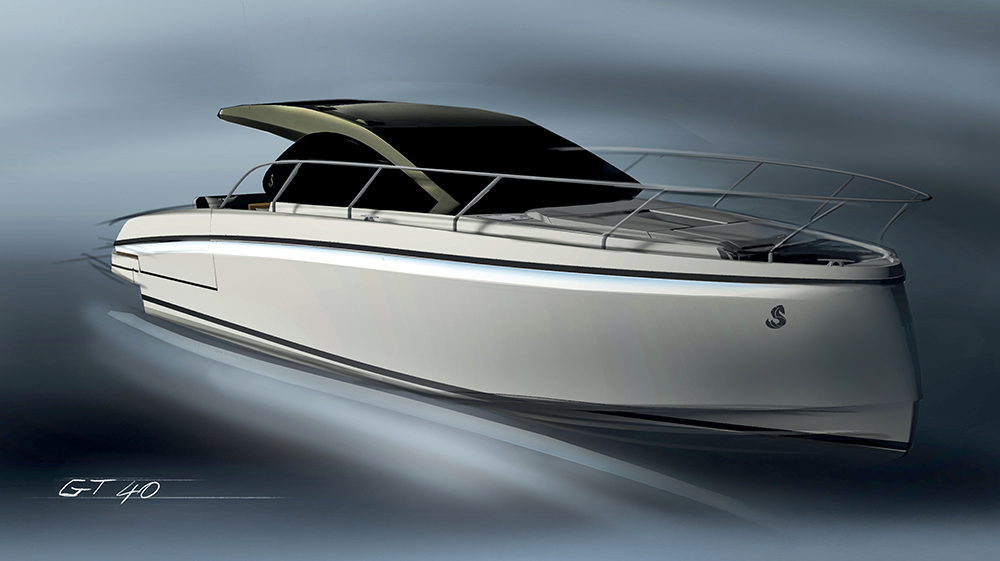

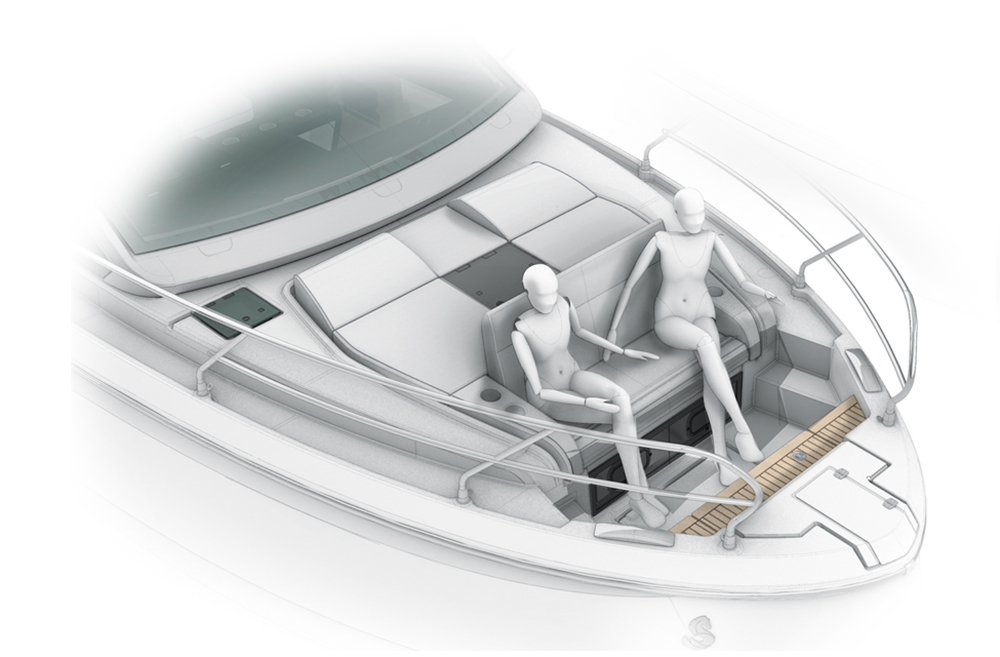
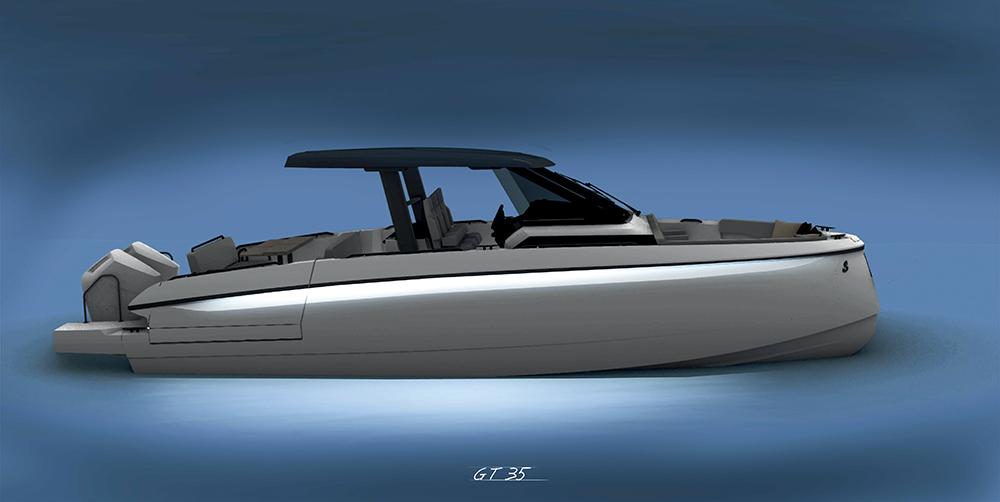
For Bénéteau, Andreani has designed the new Gran Turismo range, characterised by linear simplicity and sportiness. It is designed for a life on board that is focused on outdoor activities thanks to its large balconies and proximity to the water, not forgetting a wheelhouse that can be closed and air-conditioned, just like a real Gran Turismo.
On the other hand, the ones produced by Andreani’s pencil are actual boats in all respects – beautiful and able to sail, as the common-sense textbook prescribes. Initially, Cranchi was one of the first yards to use fibreglass. That was back in 1975. The stylist (he prefers to define himself that way, rather than designer) created both the exterior and interior designs: “I designed hundreds of boats a year, which were then put into production. Numbers that are unthinkable today, moreover, with the great advantage of having only one interlocutor, and therefore great freedom of action, another detail that would be equally unthinkable in our day”.

«When they asked me to renew the range of trawlers at Bénéteau, it was imperative to respect the cost limitations. And in the end, we succeeded. It wasn’t easy because you must develop a valid, quality product that avoids waste».
It was already unthinkable during the later collaborations with Bénéteau and Fountaine Pajot, after the happy decades at Cranchi. “Working for large groups forces you to deal with several different minds. You must tackle precise instructions related to cost containment, with constraints that make you turn up your nose sometimes, but the guidelines are part of the game. I can quote an anecdote that comes from the automotive world but is rather emblematic: when I designed the Maserati Biturbo, I asked about the bulk of the engine, seats, and about what they expected to fit into the car, and De Tomaso answered ‘don’t worry, you just make the drawing. I’ll kick the engine into it if I must’”.
Science fiction, prehistoric times. Who knows… Pierangelo Andreani was lucky enough to experience the First and Second Republic of boating and become familiar with its vices and virtues. Always with that healthy disenchantment that makes him a true professional. And not a star.
(Pierangelo Andreani – Far from stereotypes – Barchemagazine.com – Excerpted from Barche, July 2025)