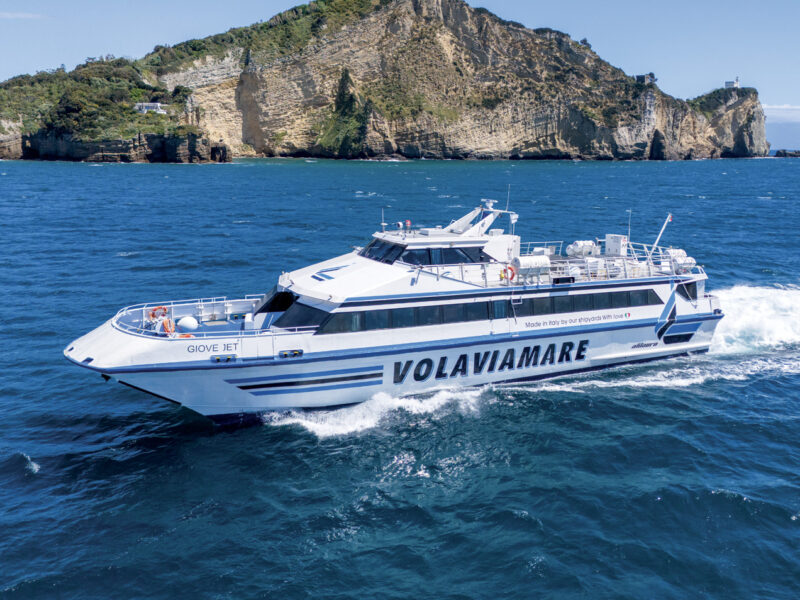
Alilauro’s new Giove Jet, the first catamaran for passenger transport in Europe to be equipped with a Volvo Penta IPS IMO III quadruple propulsion system, is welcomed in the Gulf of Naples
by Olimpia De Casa – photo by Guerrieri Visual and Andrea Muscatello
Alilauro’s Giove Jet, now powered by the new Volvo Penta, is set to sail daily from Naples to Sorrento again. After 39 years of honourable service in passenger transport (with 261 assigned seats on board) between the enchanting islands of the Gulf, the vessel (an aluminium catamaran, 33 metres long and 9.30 metres wide, built in 1985 at the Swedish shipyard Marinteknik Verkstadts AB in Oregrund) has been reborn in a more comfortable, quieter and more sustainable version, thanks to the new Volvo Penta IPS IMO III propulsion system, installed in the engine room as part of a thorough refit.
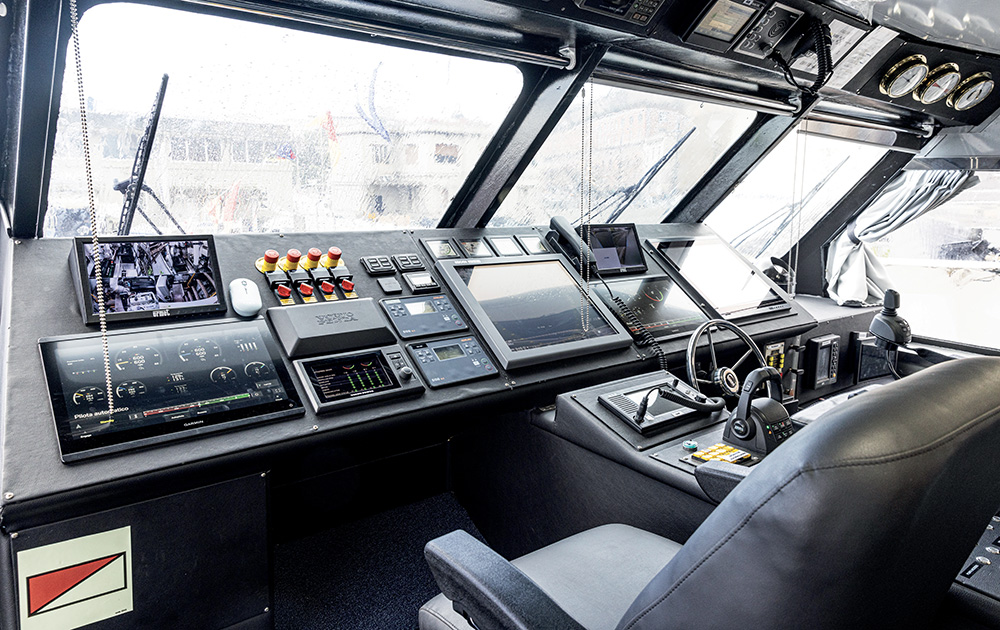
Giove Jet was presented at the Volaviamare headquarters on the Beverello pier in Naples, in the presence of local authorities, political institutions and business partners. It is a further step in the green transition initiated by the Lauro Group, which is celebrating its 80th anniversary this year.

«The IPS system, with more than 20 years of experience and 40,000 installations, guarantees extremely high levels of reliability and uptime. In the future, it will evolve with hybrid and electric solutions, always minimising onboard energy requirements thanks to the efficiency of the PODs».
Andrea Piccione
CEO of Alilauro, Eliseo Cuccaro, stated: “I came to Alilauro with a professional background matured in the world of road mobility, the field where the electric alternative was first conceived and developed. I bought the first electric bus from the Tecnobus company in Latina about 20 years ago and experienced inefficiencies and personal perplexities. Basically, there were two basic facts: the system didn’t adapt well to the needs of collective mobility and, above all, it seemed to ignore the fact that if you produce the electricity you need in coal-fired power stations, it doesn’t help at all if the vehicle you produce is net zero. And to make matters worse, you have to dispose of the batteries at the end of the product’s life. When the Lauro family approached me to run Alilauro, even the boat industry was beginning to see the appeal of electric mobility. Everyone was talking about it, so much so that it was not easy to convey my critical thoughts to the owner, who, after some initial scepticism, eventually understood my reluctance. But we still had to respond to the need to innovate and to consume and pollute less”.
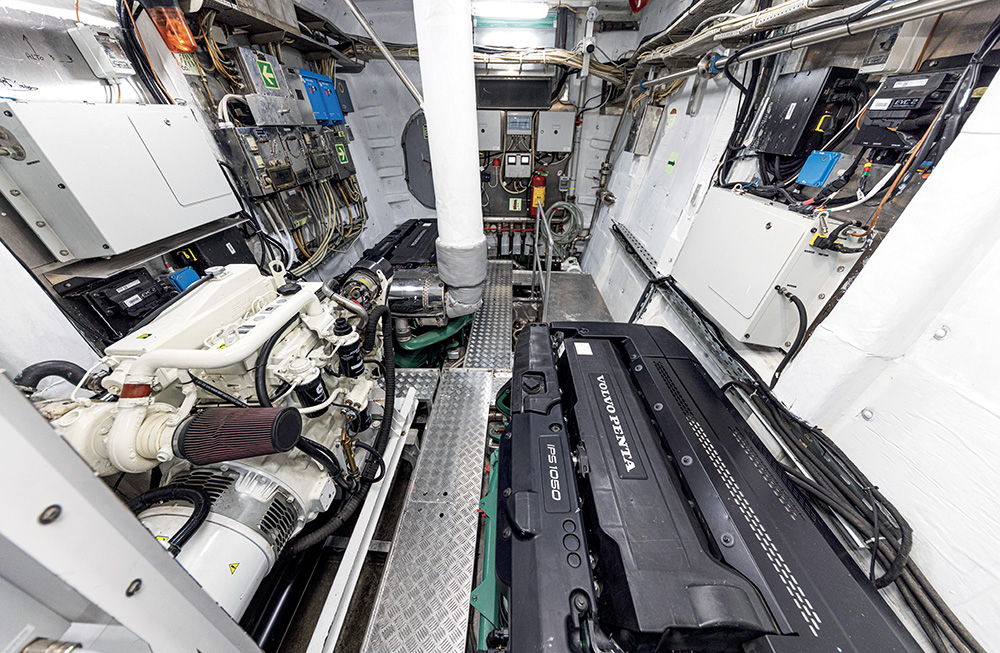
The integrated exhaust gas treatment and emission reduction system contributes to a further 75% reduction in NOx levels.
“The opportunity offered by Volvo Penta convinced us to evaluate, study and carry out tests and simulations, which were immediately encouraging and fascinating. This was the beginning of the partnership with Volvo Penta and the transition from a waterjet system to a propeller system. The decision to go back to propellers to travel at the same speed, producing the same power but consuming less fuel, may seem strange at first, but it proved to be the right one, also in terms of sailing comfort. Today the boat is much quieter and virtually vibration-free”. An added value that all passengers who board the newly powered Giove Jet will strongly benefit from.
«This new propulsion project was developed in collaboration with Volvo Penta. It allows us to increase the level of environmental friendliness beyond current EU regulations. With the support of the National Recovery and Resilience Plan, the project was successfully completed».
Eliseo Cuccaro

What performance and advantages can the Volvo Penta IPS IMO III propulsion system offer? We asked Andrea Piccione, Sales Manager at Volvo Penta Italia. The real advantage is undoubtedly the POD transmission. Thanks to the tractor and the counter-rotating propellers, it is possible to increase efficiency by up to 35%, fit smaller engines and thus drastically reduce fuel consumption, and reduce the size of the tanks on board, thus freeing up more space.


Have you already noticed these benefits on the Giove Jet? Since the first tests, we have been able to reduce diesel consumption by 30% – from 708 with the old engines, which had a fuel system with pumps and injectors, to 495 with the new ones. I challenge anyone today to find a solution that is not only suitable for prototyping, but that can be used by the owner in his operating cycles, and that ensures a reduction in consumption and emissions of more than 30%. In this specific case, these savings translate into more than one million kilograms of carbon dioxide, calculated over an average use of two thousand hours. This is a result that, with current technology, can only be achieved by improving propulsion efficiency, and the IPS (Inboard Performance System) has this great advantage. With this type of unit, the high level of comfort on board is perceived not only by the passengers, who can enjoy the journey to the full, but also by the person who uses the boat for hours on end every day: the operator
(Volvo Penta IPS IMO III, green transition – Barchemagazine.com – August 2024)