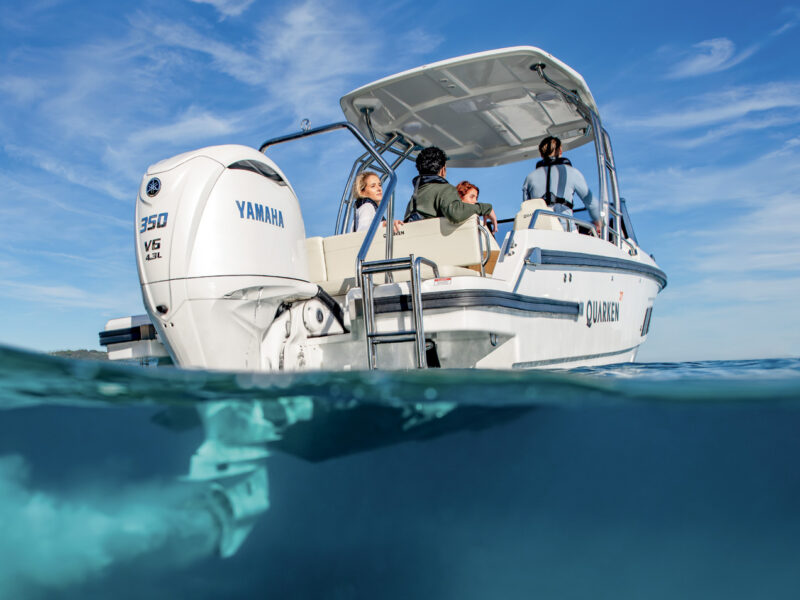
The new V6 F350 is Yamaha’s latest outboard. It fits between the V6 300 and the powerful big block V8s with 400 or 450 hp
by Sacha Giannini
The iconic logo of three tuning forks is a clear reference to the company’s history, origins and musical identity. “Sound” has always been important to Yamaha and is given the same attention as mechanical performance. Following the Jin-Ki Kanno approach, the Japanese engineers have always tried to achieve the feeling of being at one with the machine, with a smooth (and above all quiet) power delivery that makes the rider, whether on land or sea, feel in tune with the engine.

With the propellers just below the surface of the water, you can plane in a matter of seconds. There’s a real adrenaline rush when you see the grille section producing thrust and sound, leaving the hull in the wake. This is a Yamaha outboard, so you have to decide how you want to travel, and the Invictus TT420 has done just that with no less than three Super Yamaha V6 350 outboards. Capelli has done the same with its Tempest 900 and T42, Jeanneau with its Cap Camarat 10.5, Yamarine with its 80DC and MS Marine with its very fast Sterk 31. Whether with one, two or three engines, you can count on a lot of thrills and – some more than others – a very special performance, with its advantages, disadvantages, preferences and some personal doubts.

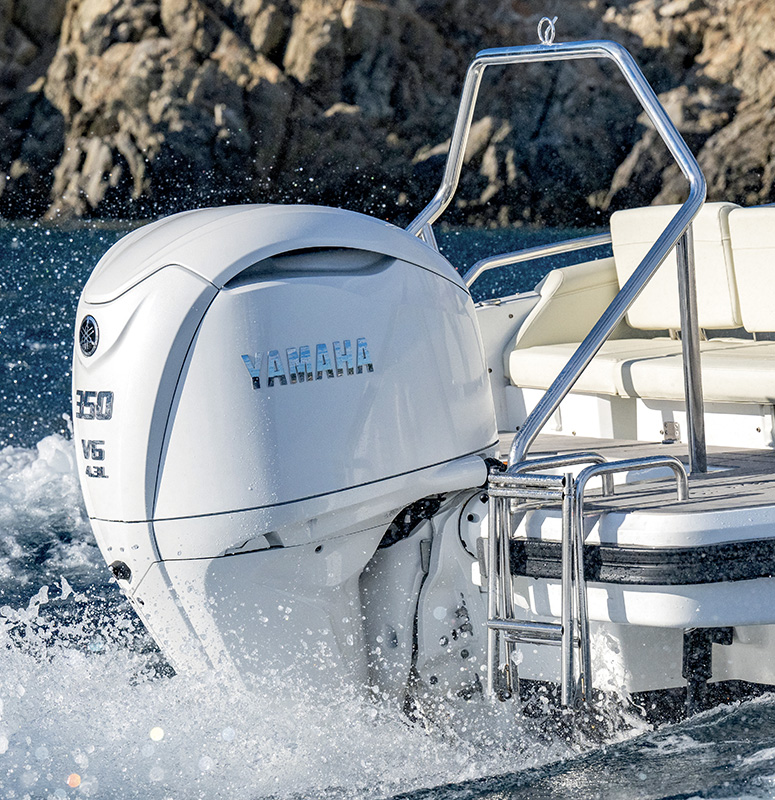
The intake and exhaust valves are larger than on the previous 300 hpversion. The throttle body is the same as on the V8 to ensure better airflow and performance, while a new crankshaft with a longer piston stroke (increased from 96mm to 98mm) and an extraordinary 11:1 compression ratio translates the extra fifty horsepower into real power, thrust and speed.
Getting rid of any extraneous noise that could pollute and contaminate this Yamaha music is just one of the many things the Japanese company focuses on. And with the new Shift Dampener System (SDS), they have reduced the vibration and dull noise that is normal when changing gears by using simple rubber springs and a spacer.
Despite the attention to detail and excellent acoustic qualities of Yamaha outboards, the sound is never the same. Combustion, mechanical elements, induction and exhaust modulate the sounds emitted so that they comply with the law and are not unpleasant to the ear. But resonance, amplification and vibration spread from the stern to the bow, with pressures and reactions that are always different for different boats. A loud noise doesn’t necessarily mean that the engine is noisy, but is the product of a hull/engine combination that is different every time, as we were able to see on the six different boats fitted with the Yamaha F350.

MS MARINE STERK 31 – F350 Twin
On the transom, the two powerful Yamaha V6s, 350 hp each, always sounded smooth and, above all, incredibly quiet, allowing the helmsman to have a natural conversation even at 50 knots! During the test we tackled the sea at all speeds, and even at over 40 knots the hull responded well, holding the course decisively up to over 57 at the top. It was as quick as a rocket to pick up the revs, glide out and reach maximum speed from a standing start, dry but above all safe at the helm. Pure enthusiasm.

CAPELLI TEMPEST 900 – F350 Single
At 3500 rpm, the engine delivered a cruising speed of 22 knots, giving an overall fuel consumption of 31 litres per hour, or 1.45 litres per nautical mile. At the various speeds tested, it maintained a steady, smooth course, even when turning sharply. However, the calm sea meant that we weren’t able to test it in more extreme conditions. From a standing start, it took 7.7 seconds to level off and ten seconds to get up to thirty knots. With the F350, Yamaha has shown that it can deliver excellent performance and power, even without the extra 150 hp. As the revs increased, so did the sound, with a firm, ever-present note more suited to driving than talking!
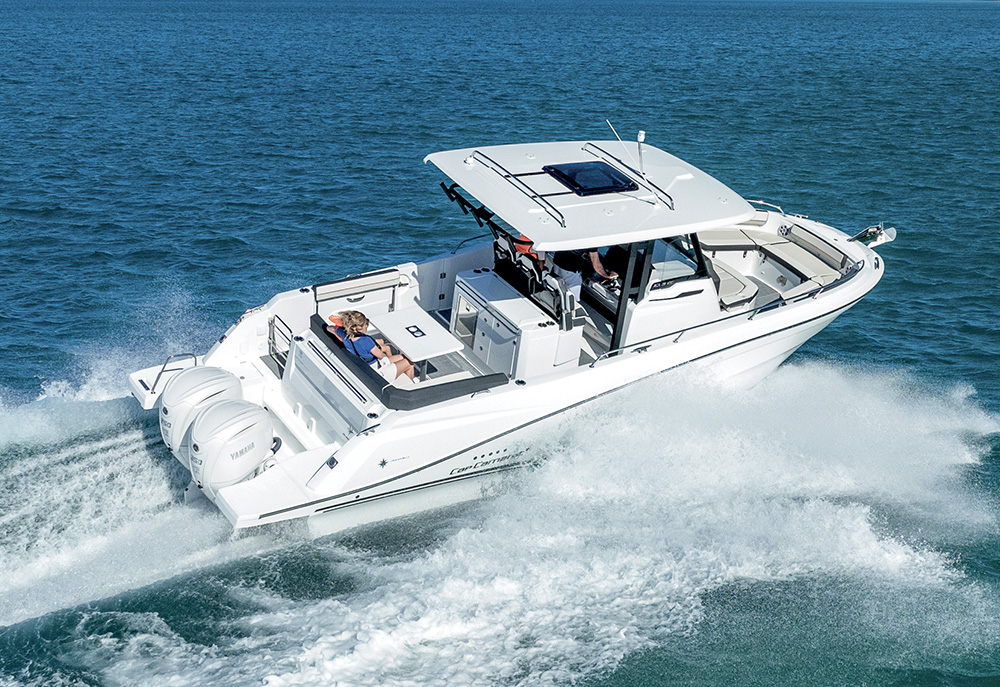
JEANNEAU CAP CAMARAT 10.5 – F350 Twin
You are planing at 24 knots at 3800 rpm, using 77 litres of fuel per hour, or about 3.2 per mile, giving you a range of up to 250 miles. The engine responds immediately when you open the throttle. At 4000 rpm we saw the economy cruising speed of 25.5 knots, consuming 88 litres per hour, while at 4500 rpm we touched thirty knots and the fuel consumption rose to 103 litres per hour. Fuel consumption remained constant, but of course changed at 5000 rpm, rising to 140 litres per hour, and reaching 230 litres per hour at 6000 rpm (which saw peaks of 42 knots). Thanks to the good Jeanneau hull, we were able to make full use of the power available, with plenty of thrust, but also safe and reliable and a lot of fun! Having the wheel in the middle is a good idea from the driver’s point of view, but a bit invasive for the passengers sitting on the side.

Yamaha make their outboards to work well on the boats they are fitted to, to glide quietly into the water with the bow slightly up, reducing displacement drag and fuel consumption, while trying to cut through the water and leave a clean, symmetrical wake. But there are hulls and then there are other hulls, and so is the wake they leave. Some come together straight, like rails, while others turn into white foam, allowing the hull and engines to be fine-tuned. The distinctive Yamaha wake on some hulls takes the form of a tuning fork that opens at the stern to dissolve the result of trim, weight, thrust and equipment in perfect harmony between sound and performance. A wake doesn’t just mean understanding the correct “posture” for the boat, detecting cavitation and turbulence, and working out balance and fuel consumption. It’s not just an aesthetic issue, but one that affects comfort. Getting your back wet from the spray on the back sofa, or walking across a deck that’s constantly wet, is not only uncomfortable, but also distracts you, reducing performance and safety.
Two 150hp engines are never the same as a single 300hp, as they provide a lot of thrust but also a lot of friction. They cost more to buy, but the upside is that if something goes wrong you’ve always got one to get you home! What works best depends on a lot of variables that Yamaha are always looking at in terms of how an engine will be used, the type of water it will be used in, the hull, the load and the budget.
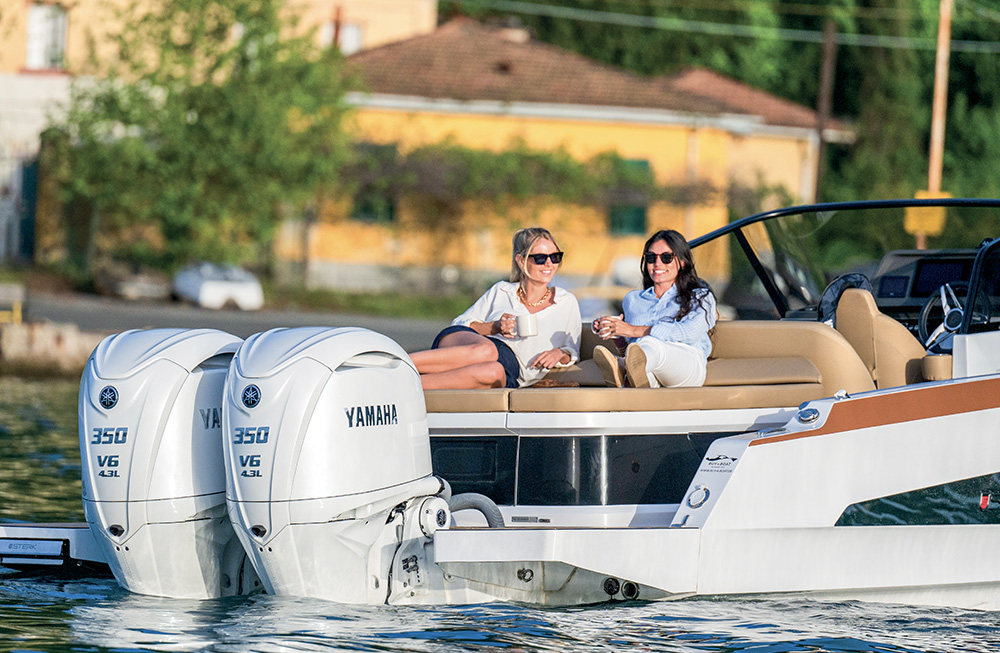
The first impression of the new Yamaha V6 F350 is that it gets full marks. Its looks are inspired by the XTO range, including Light Grey Metallic or elegant Pearl White for the grille and gear case. Priced at 45,959 Euros, the 4,256cc engine has a 60-degree V6 and weighs in at around 300kg. Those still nostalgic for straight-shaft engines or rear-wheel drive may turn up their noses at this, but one test should be enough to dispel any doubts or reluctance.


The official certification is the first thing to look at to work out how hard you can push, as it specifies full power and the number and weight of motors that can be fitted. In general, a wide V-bow works best with a nice single motor, while a deep V and steep deadrise can work well with two or three motors. If you want to have fun and make tight turns, it is best to turn on the centreline of a single outboard, while it is almost always easier to manoeuvre in harbour with a pair of engines. Nowadays, manoeuvring and loading has become even easier and more enjoyable, just like a video game, thanks to Yamaha’s exclusive optional Helm Master EX control system, which uses an integrated joystick and Vetus bow thruster. It doesn’t just mean you can dock in parallel, it makes being on board really fun – something that has to be tried to be believed.
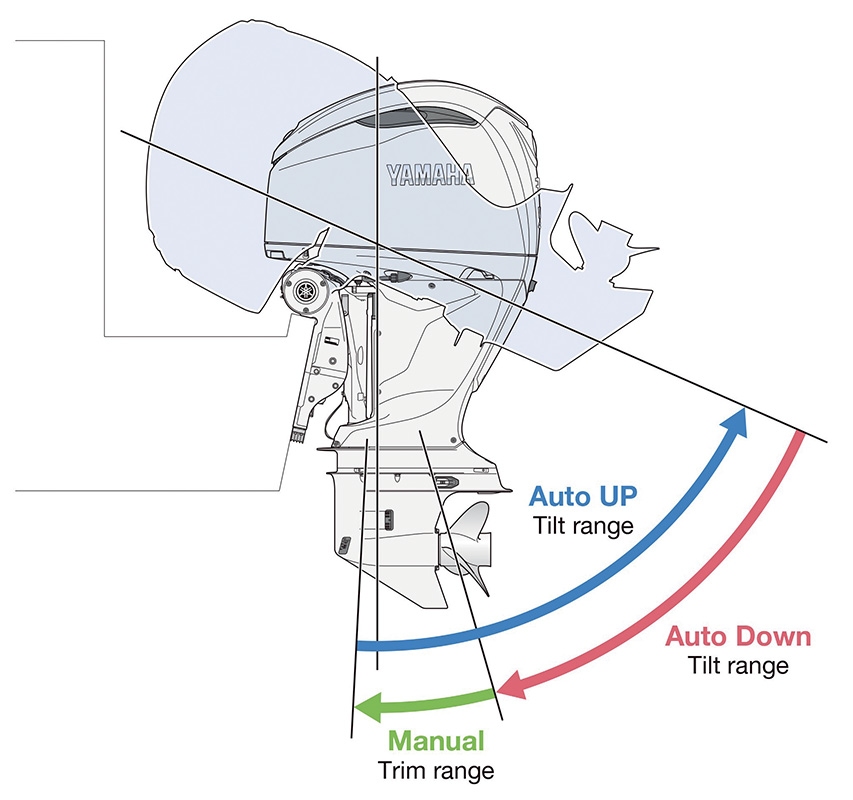
The innovative electronic steering and Yamaha-patented control software have not only done away with the pumps, hoses and outlets of previous models, but have also added a degree of sensitivity to the wheel, which is softer and lighter when manoeuvring and heavier at speed. This is as it should be – and it gives a sense of control, even when turning. The increase in torque at low speeds increases reactivity and makes it thrilling almost immediately. The TotalTilt function that lifts the engine up is comfortable and safe while again in this 350-horsepower version the Thrust Enhancing Reverse Exhaust system gives excellent thrust, as well as control when reversing and at low speeds, by keeping exhaust bubbles away from the propeller. These are all things that have been tried and tested on the earlier 225, 250 and 300 horsepower V6s.
(Yamaha V6 F350 – All sound, no noise – Barchemagazine.com – Excerpted from Barche, August 2024)