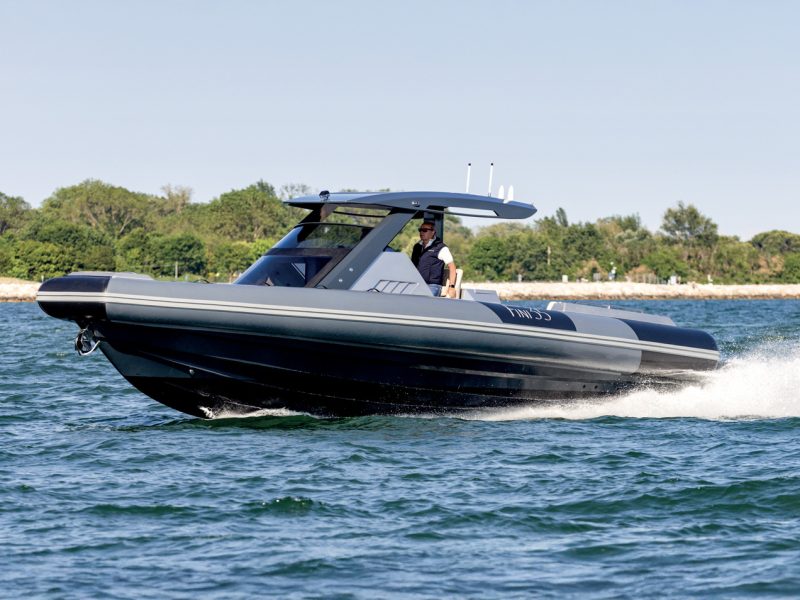
It’s entirely made from prepreg carbon fibre: the hull, deck, superstructure and even the furniture. What you get is a strong, tough, and lightweight rib
by Niccolò Volpati
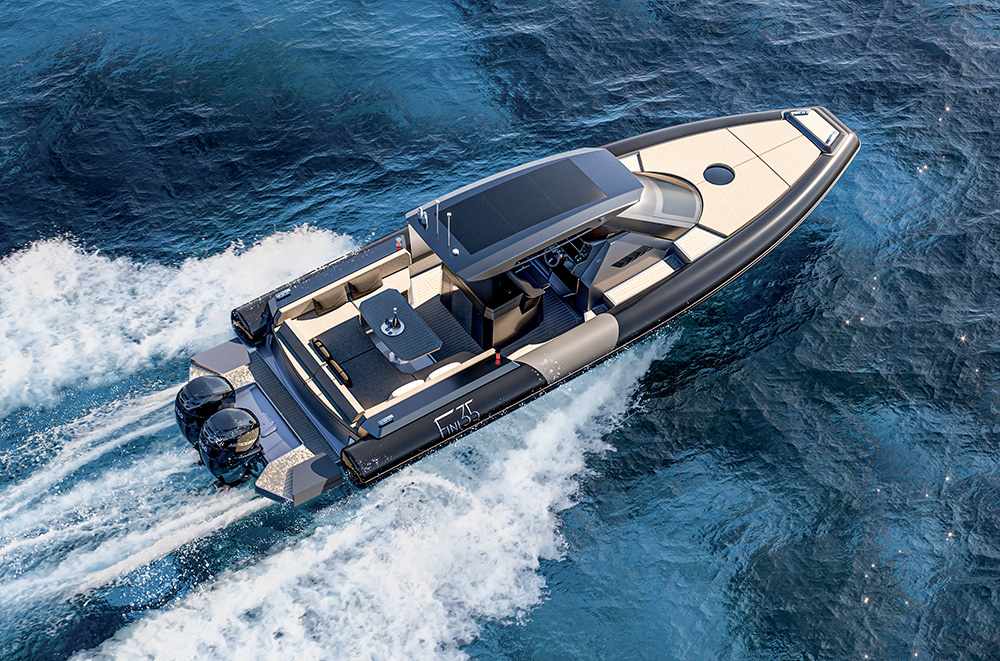
There is carbon fibre, and then there’s carbon fibre… Prepreg, pre-impregnated fibre, is definitely the most prized of the two, and it is not by chance that it is used for high-performance, custom-made sailing boats. So what exactly is it impregnated with? With epoxy resin, which makes the carbon fibre even more resistant to traction and compression. Prepreg brings out the best qualities in carbon fibre because it allows for the same strength to be achieved with a thinner layer. That’s why it is used for the fastest sailing boats. However, starting from now, this material can also be found on inflatable products. It is called the Fini 35, and it is 11.40 metres long overall, but officially comes in under ten metres, meaning it falls into the ‘natante’ category. It is the work of TecnAvan Interiors from Castelliri, in Frosinone province, a new company in the yachting world, but definitely not a new one when it comes to carbon fibre, given that it makes fuselages and spare parts for planes. Last year, TecnAvan Interiors established Fini Marine with the intention of creating a continuous, cohesive structure within the yachting industry. Indeed, the idea is to create a range and not just a single model.

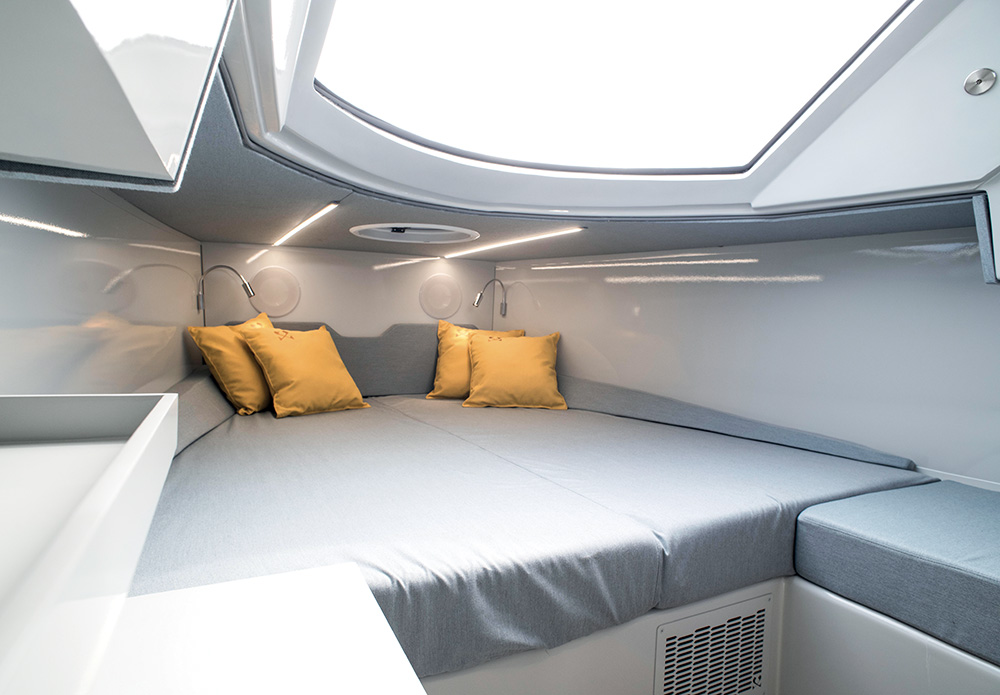
The interior layout is comfortable for two people. The habitability and size of the berth and bathroom are good. Plenty of natural light filtering through the almost all-glass deckhouse.
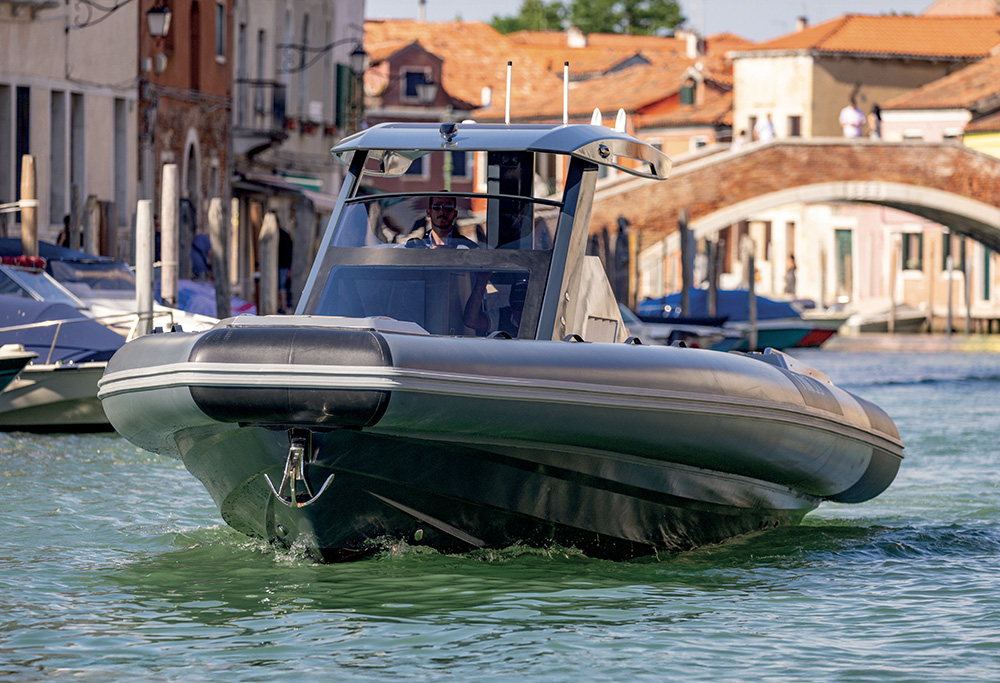
The Fini 35 design project is from Studio Ceccarelli, and extensive research has been conducted into the fluid dynamics of the hull, as well as the aerodynamics of the windscreen. What’s more, it is genuinely a full carbon boat, given that the deck furniture and interiors, and even the moulds, are in carbon fibre. There are two petrol-powered 300-horsepower Volvo V8s in the engine room, and the yard has already lined up a version with a pair of Mercury V10 outboards, each developing 350 horsepower. It feels very good to helm. Out in the open sea beyond the Venice flood protector, there were waves of nearly half a metre that should have been capable of causing problems to a boat of less than ten metres. But that didn’t happen. The V bow cut through the water, and we moved along, even at high speed, without much difficulty. The most positive things were the stability and manoeuvrability.

The hull performs well even in rough seas, but above all, the Fini 35 is very manoeuvrable and stable even when sailing at over 40 knots.
The Ceccarelli-designed hull not only makes it comfortable when underway but also provides a good sense of control. I tried turning back and forth very tightly at forty knots, and I never lost the grip on the surface. The Fini 35 definitely seemed like a safe and easy-to-handle boat. And the two stern drives attached to the Volvo engines mean you can do some fairly extreme moves, with the only issue being that anyone on board has to hang on tight to the grab handles on deck. The power available feels balanced and not excessive. I got to nearly 42 knots, a speed that was more than enough, even for a sporty RIB. I often wondered why anybody would feel the need to be able to do fifty knots, because that’s not a speed you are likely to use very often. And even for someone who likes going fast, doing well over forty is definitely satisfying. Another notable aspect is that with 600 total horsepower, you use less fuel. That’s a plus that comes from prepreg carbon fibre. The boat only displaces 3,600 kilos, and so you don’t need mighty engines to do over forty easily.


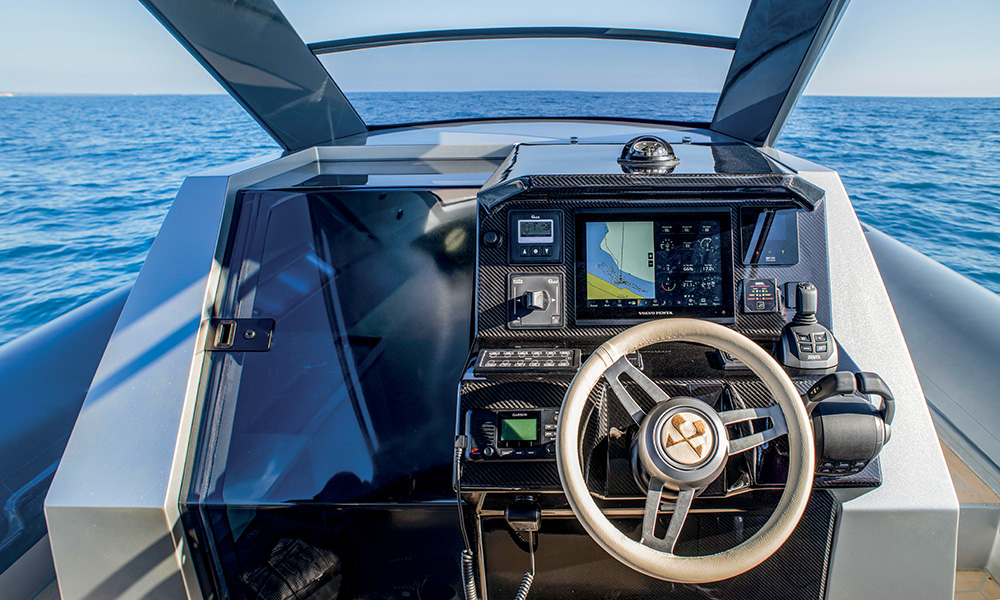
All cruising speeds, from planing minimum to 35 knots, used between 2.5 and 4 litres of diesel per nautical mile. Snapshot levels were also obviously in line with those figures. You need just under thirty litres per hour in total to plane, and 179 at top speed. The limited weight of the Fini 35 also means you can have a 700-litre fuel tank, which gives you over 200 miles of range, even at a 30 knots cruising speed. So you don’t feel any need for a bigger tank, given that with a pair of 300-horsepower inboard-outboard engines and a flyweight displacement, 700 litres are enough to go up and down the Mediterranean. The only thing that isn’t very convincing is the top part of the windscreen, which reduces visibility because it is at eye level when you stay on your fleet while steering. But the ergonomics of the set-up are convincing. Everything is to hand, and the dashboard is large enough to accommodate all the displays you need when underway.
The yard already has plans for other models that will adopt the same construction technologies and quality materials. There will also be an outboard engine version of the Fini 35..
There is a full optional setup, including domotics and a joystick to assist with docking. The deck is laid out to provide ample seating and sun pad space. The positive thing is that when underway, despite having rougher seas and a wind of over ten knots, no spray reached the cockpit. The T-Top houses 400-Watt solar panels. The interiors are generously spaced and are comfortable for two people. The bed is sizable, as is the bathroom. Another good thing below decks is the natural light. It is plentiful, as the deckhouse is effectively covered in windows, all in a single piece of glass, which serves as a windscreen extending aft. That’s not just a design element that sets the Fini 35 apart from other RIBs on the market; it is also functional and works to increase the livability below deck.

Full carbon in name and in fact. Starting with the moulds, each component has been made from carbon fibres impregnated with vinylester resin.
Engine room
Two Volvo Aquamatic V8 300-horsepower petrol engines, each with stern drive. This is the solution adopted by the yard; however, a version with two Mercury V10 outboards, each with 350 horsepower, is also available.
TECNAVAN INTERIORS
Via Pescara, Zona Industriale
I-03030 Castelliri (FR)
T. +39 0776 1805131
www.tecnavaninteriors.it
PROJECT
Ceccarelli Yacht Design
HULL
LOA 11.40m • Length 9.95m • Maximum beam 3.25m • Displacement 3,600 kg • Fuel tank volume 700 l • Water tank volume 265 l • Maximum power rated 2×350 hp
MAIN PROPULSION
2x Volvo Aquamatic V8-300 • Outlet mechanical power 224 kW (300 hp) • Swept volume 5.3 l • 8 V-shaped cylinders • Bore & Stroke 96mm x 92mm • Compression ratio 11.0:1 • Maximal rotational speed 5800 rpm • Dry weight 450 kg
EC CERTIFICATION
CAT B
PRICE*
675,000 € Excl. VAT
*The price refers to November 2025
(Fini 35 full carbon – Black Magic Rib – Barchemagazine.com – Excerpted from Barche, November 2025)