The size may have grown, but Ranieri’s maxi philosophy remains unchanged: spaciousness, comfort, attention to detail and exhilarating performance
by Niccolò Volpati
It’s one fabulous flagship after another, and it looks like Ranieri has really got the bug! You barely have time to get over the Cayman 45 before the Soverato shipyard presents the new 50. I think it’ll be pretty similar, maybe with a few updates and a bit more length, but no, it’s totally different! “Everything is new, from the hull design to the deck layout”, Salvatore Ranieri tells me with a smile just before I hop on board. And it’s true, these two maxi RIBs are like chalk and cheese. I’ve got a long list of things I like about the deck layout.
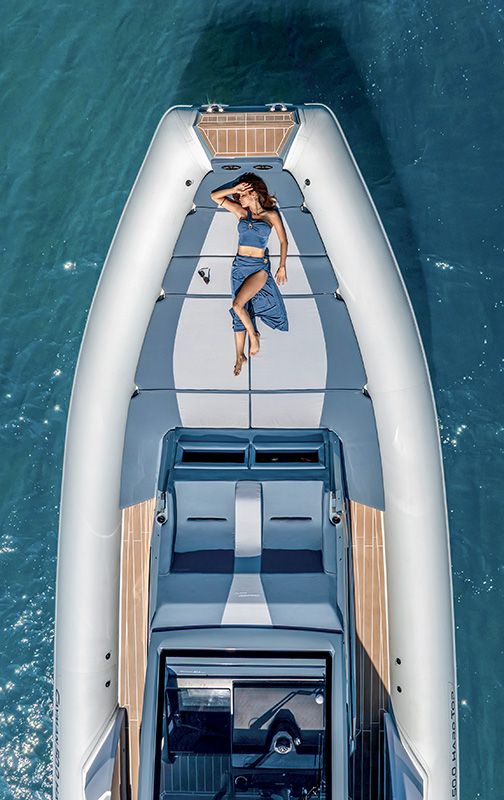
Let’s go through them one by one. I hop on from the stern, where there are four outboard motors. These are Mercury Verado V10s, with 400 horsepower each. A great engine, even if it’s not the most powerful (it can reach up to 2,000 horsepower). What I appreciate is that despite having four engines, there is a stern platform with two generously sized side decks. The second appreciable feature is the deck floor. It is all on the same level: there is not even a step, not even at the bow, where the sun deck is located.

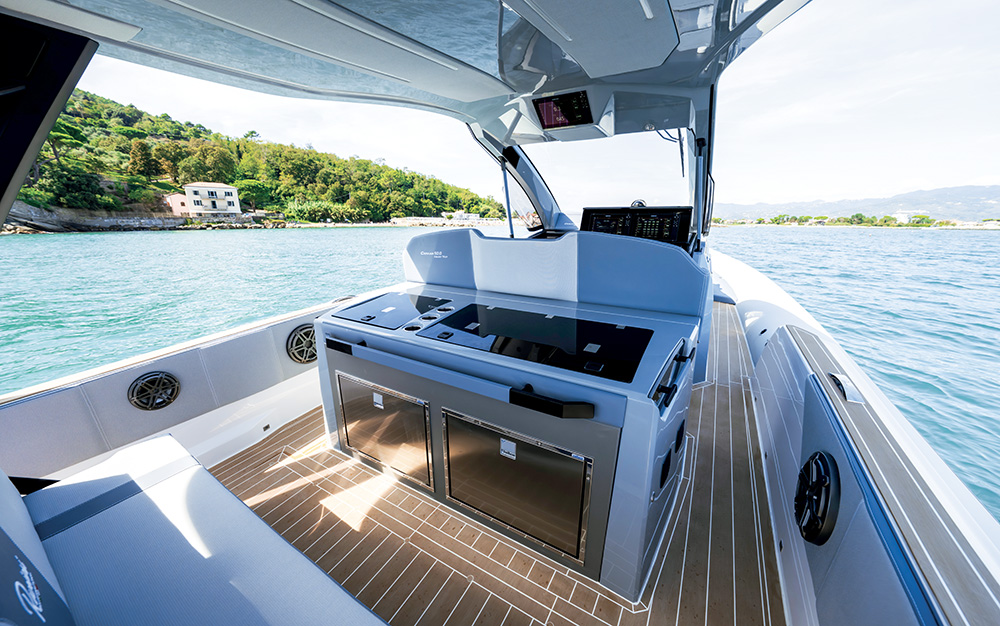
There is plenty of space on deck, and the layout is well designed. Despite this, it is always easy to move around on board, partly because there are handrails everywhere. There are three Simrad large screens on the bridge, but to make sure you don’t miss anything, there’s even a fourth under the hardtop roof.
I was very impressed by the boat’s central area and the protection offered by the hardtop. It shelters what needs to be sheltered, namely the steering console and part of the cockpit, while allowing the aft sundeck to perform its function fully and therefore be exposed to the sun’s rays. The windscreen is a single pane of glass, the pillars are sturdy, but there are no side windows. This is a good thing because it avoids having a space that is too enclosed, even if it is transparent. Here, on the other hand, you are always in a space overlooking the sea. The relationship between the fibreglass and the tubulars accentuates this sensation. Often, maxi ribs of this size are only ribs on paper, in the sense that the tubulars seem like an accessory added to a structure that is very similar to that of a boat. Not here. Here, on the side, there is fibreglass, but it stops at the height of the bridge. In the central and aft sections of the Cayman 50, you feel protected, but fortunately, there are tubes towards the bow. The free board is therefore limited, and the feeling, even to the eye, is that of being on a rib rather than a boat.


It’s been just over ten years now since Ranieri’s Cayman range first came out, and it’s so lovely to see how many models they’ve released in that time. The 50’ is their new flagship.
The layout is traditional but consistently effective. Behind the pilot and co-pilot seats is a kitchenette unit equipped with induction hobs, a sink, and large refrigerators, and further aft are two linear sofas facing each other. The backrests can be moved, allowing for two forward-facing seats, ideal when sailing, or facing each other, perfect for completing the dining area, thanks also to the central table. At the stern, as well as at the bow, there is a sunbathing area, which also benefits from the movable backrest of the linear sofa, because moving it towards the bow increases the sunbathing area. Finally, I appreciated the two chaise longues located at the bow of the raised area. They are very comfortable and can be used both at anchor and while sailing. In fact, they overlook the bow sundeck cushions and are surrounded by handrails.
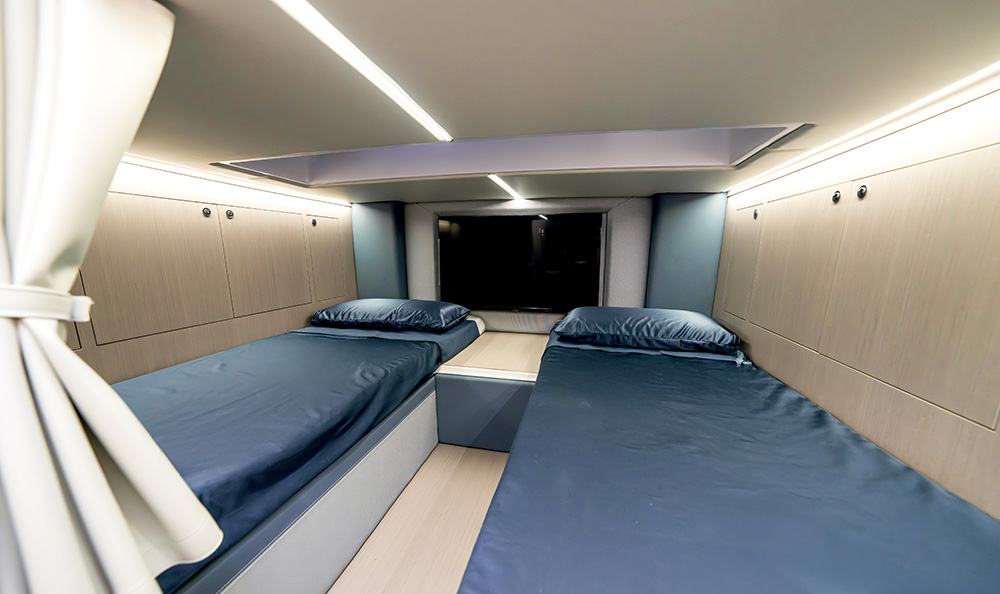

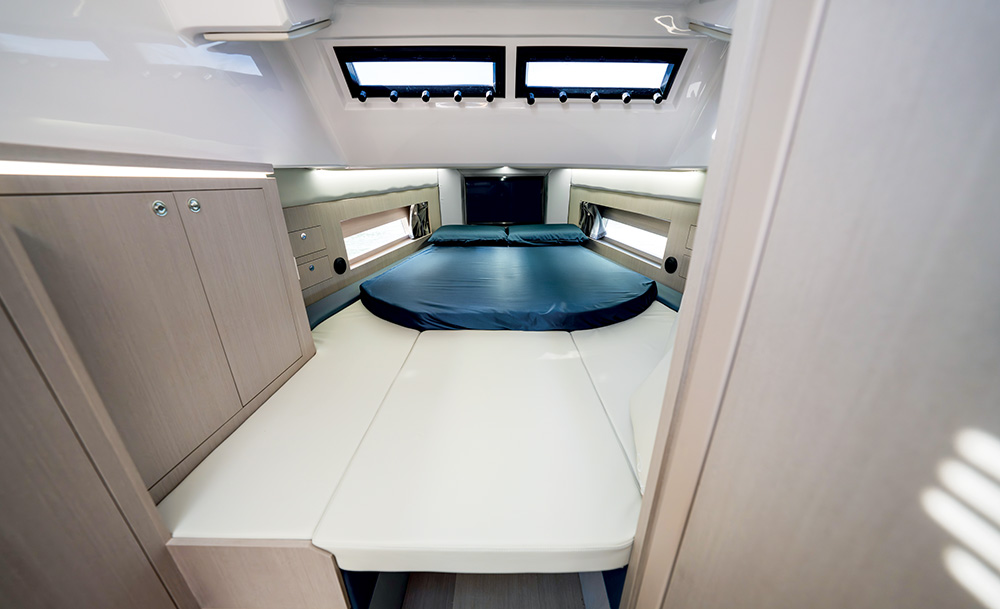
Comfort and brightness are essential for ensuring a pleasant cruise. And indeed, they are not lacking.
There are handrails everywhere on deck. Wherever you are, there is always a handle to hold on to. It is these details that make the difference and show that those who created the Cayman 50 understand what sailing is all about. There is no anchor roller at the extreme bow, which instead emerges from the hawsehole. As a result, the central part of the bow tube is covered with fibreglass and teak. It provides a good support surface for disembarking at the quayside: it is sturdy but not intrusive, in the sense that it is not one of those protruding, cumbersome rollers. And then there are the spacious, bright and comfortable interiors below deck. Windows that allow natural light to filter in are located on the deckhouse and on the sides. Usually, maxi rib boats with windows on the sides at the bow are rather bulky.

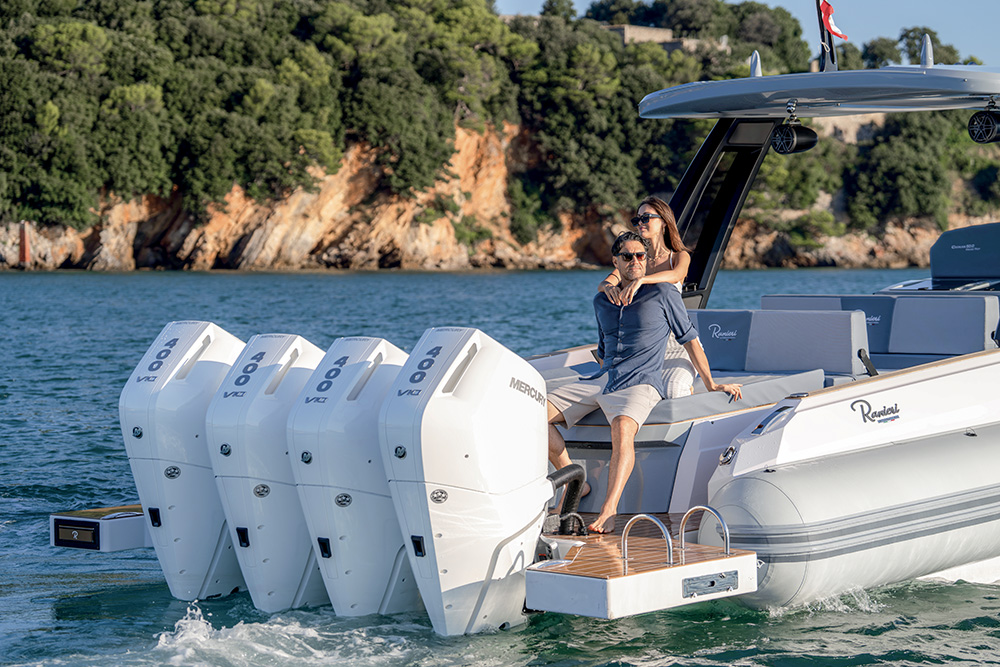
Stable, safe, manoeuvrable, but also exhilarating. Everything you could want from the hull of a maxi rib.
This is not the case with the Cayman 50, which maintains a sleek and sporty line. Habitability is remarkable across all areas, and the feeling is that four people can cruise short and medium distances without any particular sacrifices. On top of all this, there is the hull. The Cayman 50 performed exceptionally well at sea. The sea was calm, but the feeling is that the hull would not suffer even in rough seas and, above all, that it is very manoeuvrable, stable and high-performing. At the helm, it is child’s play. You can turn at full speed without ever feeling like you are losing control. With 1,600 horsepower installed at the stern, you can reach a top speed of over 57 knots, and just over 14 knots is enough to plane. The maths is simple: the cruising range is a good 43 knots. I am sure you will have no trouble finding the speed that best suits your needs.
Engine data
Four Mercury Verado engines, each with 400 horsepower, offer ample guarantees: blistering acceleration and a top speed of over 57 knots.
Motonautica F.lli Ranieri
Loc. Caldarello
I-88068 Soverato (CZ)
T. +39 0967 25839
[email protected]
www.ranieri-international.com
PROJECT
Shipyard technical department
HULL
LOA 14.90m • Maximum beam 4.30m • Light mass displacement 10,000 kg • Tubular diameter 0.68m • Compartments 10 • Fuel tank volume 1,450 l • Water tank volume 200 l • Maximum installable power 2,000 horsepower • Berths 4
MAIN PROPULSION
4x Mercury Verado V10 400 • Outlet mechanical power 295 kW (400 hp) • 10 V-cylinders • Swept volume 5.7 l • Compression ratio 2.08:1 • Rotation speed 5800-6400 rpm • Weight 316 kg
EC CERTIFICATION
CAT B
PRICE*
With four 400 Mercury engines it is 761,000 € + VAT.
*The price refers to January 2026
(Cayman 50.0 Hard Top – Over the top – Barchemagazine.com – Excerpted from Barche, January 2026)