The ClubSwan 43 is the latest boat in Nautor’s Fast Cruiser series. It was first billed as the 41, but it changed size to comply with the new ORC competition regulations and has been extended to become the current 43
by Sacha Giannini – photo by Stefano Gattini
This model looks to the future of sailing with its style and technology and has perfected a one-design racer-cruiser designed to become a point of reference for the sector. With its naval architecture, performance analysis (both of them presided over by Juan-K (Kouyoumdjian), waterline engineering by Pure Design & Engineering, and the simple but rigorous and functional interior set-up from Lucio Micheletti, this One Design crossover has been created to race, while also having the capacity to deliver comfortable, simple and sporty cruising.
It’s an innovative project cutting edge in engineering and materials use. It has combined technical prowess, reliability, and looks in a balanced way to create a perfect fusion between a potent racer and a comfortable cruiser. The boat goes beyond what you first see and allows buyers to participate in the Swan One Design and ORC circuits.

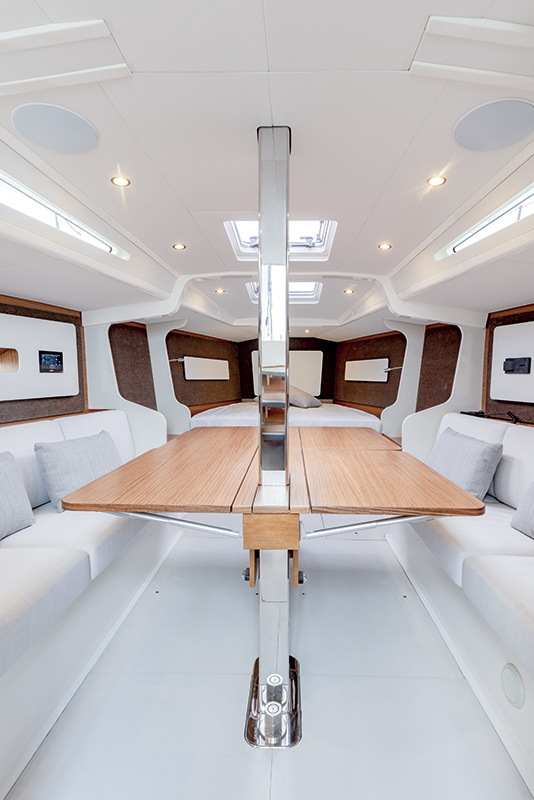

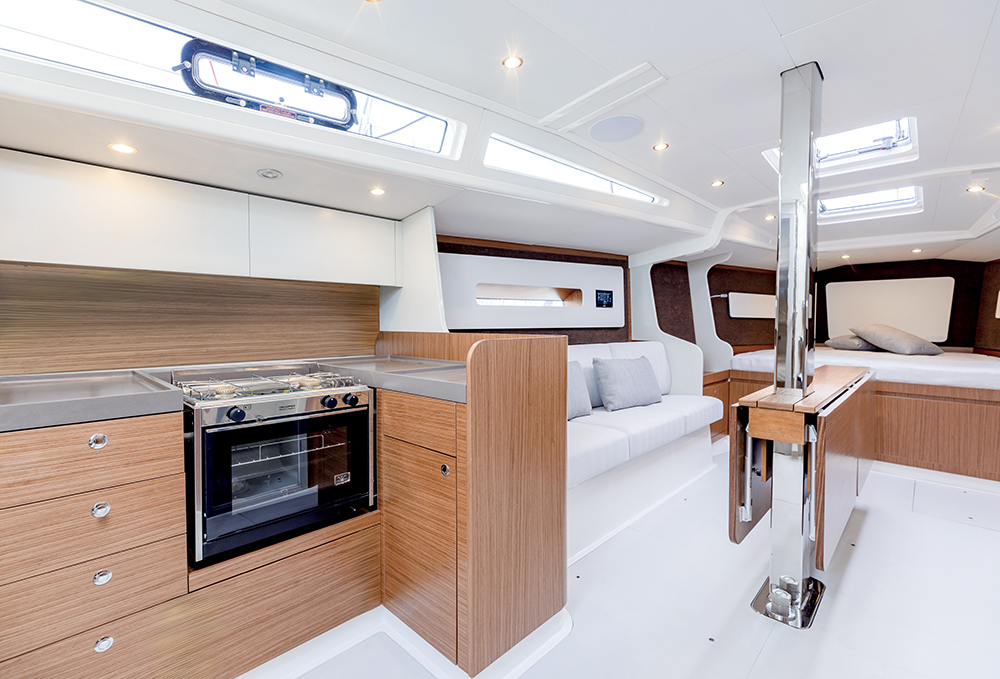
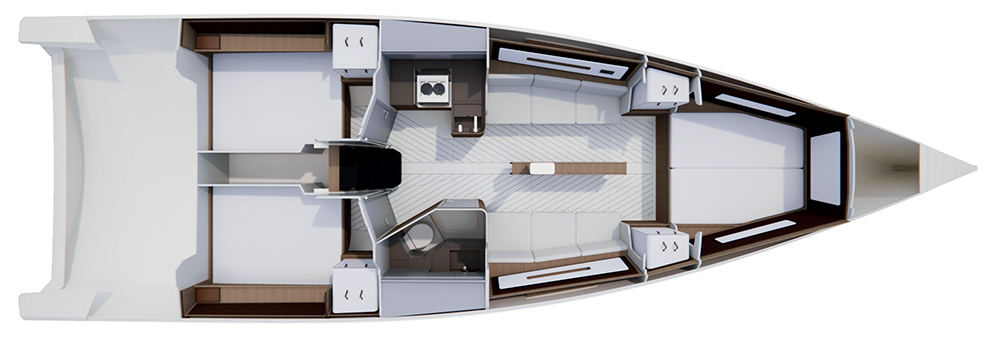
The interiors are laid out with everything needed for life on board: three double cabins, a dinette with twin beds, a fold-down table, a small galley, and a very decent wc. Although the cockpit used to sail the boat is enormous, the inside is highly spacious and usable, and the exteriors are dynamic and elegant. With a vertical bow, inverted deck flare, streamlined hull, and an aerodynamic profile with a slight edge in the stern, the volumes are created by a maximum beam fully aft and the enormous cockpit fitted out with eight winches. The build was handled by Fibre Mechanics based at Lymington in the UK, who used a vinyl ester E-glass infusion method and epoxy resin for the carbon fibre strengtheners. The boom, bowsprit, and mast are made of high-modulus carbon fibre. The L-shaped centre board isn’t just joined and in the same plane as the bottom but also fits into a special deep recess in the hull, which is integrated into the lamination and held by two large pins that also bind together the stainless steel support under the coaming together with the dinette table. The designers think that an innovative solution improves load bearing and structural integrity.
The prototype of the CS 43, which we tried out at Pietarsaari, was stripped down and didn’t have all the accessories and optional extras you would want, particularly for cruising. It lacked a windlass or chain well, there were no cleats fore and aft or a suitable foresail (but rather just a tiny, non-overlapping jib), and there was also no lazy bag or sprayhood or interior refinement because it hadn’t been fitted out yet. However, a three-hour sea trial showed that sailing can be thrilling and provides some excellent memories.
The interiors are flexible, allowing 80% of the furniture to be removed for racing and then reinstalled to allow comfortable cruising. It is a performance craft that is safe and easy to handle when cruising, even without much crew, because of the high righting moment and the low centre of gravity. It has been designed for people who want to experience the sea and enjoy competing or taking longer trips. With a very Italian soul, it is a hull that can fit anywhere, always showing its true nature – friendly, competitive and unencumbered.
The fibreglass gunwale is integrated into the hull and folded to create a safety step for archers that works as a drain. Light and packing plenty of sail power, it is 14.56 metres long overall, including the bowsprit, with a draught of 2.4 metres and 7-tonne displacement; it can take up to 120 square metres of canvas between the mainsail and genoa and can even sail at less than 30 degrees to the wind. The grip in the cockpit is excellent, and there is a decent amount of room to work the winches, the mainsail traveller system, and the running backstays. With two nicely designed carbon fibre wheels, it feels fluid and soft, almost without pressure, and is very sensitive.


The two rudder wheels tilt slightly outwards to point to the bow and give the feeling of being on the boat’s central axis. That is a clever little feature that you start to appreciate after a few miles.
The mast, spreaders, boom, bowsprit, and rudder wheels are dark carbon, while the stanchions, pulpits, blocks, and winches are painted black. The cockpit’s non-slip bottom is grey, while the rest is a white gel coat, creating a slight play of contrast and always well-balanced highlights.
It is nicely balanced and sails beautifully, moving fast when close hauled and very close to the wind. It is fun to helm and reacts quickly. Despite the relatively small foresail, which wasn’t suited to the light breeze, which started blowing at 9 to 10 knots and then had gusts of up to 14, the boat soaked up every tiny puff and variation in the wind. It reflected it in an instant incremental changes in speed.

The running rigging is organised with blocks and routes carved out of the coachroof moulding so they don’t stick out. Some details shouldn’t be taken for granted, like the mast collar, which is incorporated in the moulding of the coach roof, being slightly tilted to get the correct reflection and ORC-compatible rake.
There were seven of us on board, going nine knots TWS (actual wind speed), and with flat water, we were sailing close-hauled at 38°/40° AWA (apparent wind angle) with six knots of SOG, which is a good speed but was affected by the limited size of the foresail. We tried to push it to 33 degrees and, with 14-knot gusts, registered the same 6.5-knot speed. Bearing away to 50/55°, the speed increased to seven knots with 13 knots apparent wind speed, whereas at ninety degrees, we fell to 5.8 knots with the evident down to ten. We sailed around on the channel between beacons and islets, tacking and turning every five minutes. Even without much wind, it was as easy as being in a dinghy and left an excellent impression.
NAUTOR SWAN
Pietarsaari, Finlandia
Nautor Swan Srl Italian Headquarter is
Borgo SS. Apostoli, 29
I-50123 Firenze
T. +39 055 240382
[email protected]
www.nautorswan.com
PROJECT
Juan K Kouyoumdijan (naval architecture) • Pure Design & Engineering (structural engineering) • Lucio Micheletti (interior design) • Steve Wilson (rig study)
HULL
LOA 14.56m • Construction length 13.1m • Maximum beam 4.25m • Draft 2.4m • Light mass displacement 7,800 kg • Fuel tank volume 140 l • Water tank volume 300 l • Waste water tank volume 60 l • Main sail 35m2 • Jib 70 m2
MAIN PROPULSION
1x 40 hp
EC CERTIFICATION
CAT B
PRICE
820,000 € – As standard*
*The price refers to February 2025
(Nautor ClubSwan 43 – Rebel Archetype – Barchemagazine.com – Excerpted from Barche, February 2025)