Patrick le Quément created the exteriors, the VPLP studio did the naval architecture, and Nauta Design created the interiors. This consolidated team has developed a versatile and surprising boat
by Sacha Giannini – photo by Julien Gazeau
Even though modern-day yachting hasn’t yet found its true identity and lives in the constant search for “evolutionary” solutions and cutting-edge answers, the sector is nevertheless increasingly convinced that to create an identity and set itself apart; it will have to transfer a dwelling to a hull and adapt it, or at least some winning recipe from the building trade. In a situation with unknowns and abstractions, Lagoon has steered – with the audacity of progress – a straight line of good sense between these “solutions” within a timeframe which goes far beyond the yearnings of change for change’s sake. As an international producer of sailing catamarans, Lagoon is constantly updating its boats by eliminating any imitation or facile affectation.


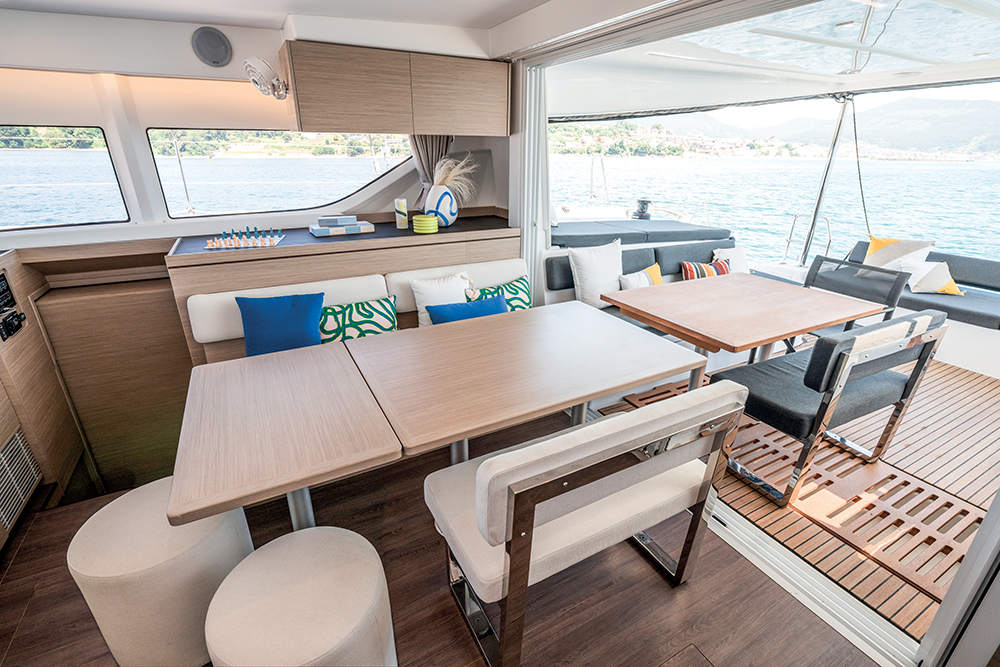
Compared to the Lagoon 42, the bow-facing galley offers more workspace without the high cupboards. The modular dining table extends into the cockpit to seat up to twelve people. Larger windows than on previous models make this functionality possible, bringing the interior and exterior spaces together and maximising the area dedicated to socialising.
From inspiration drawn from the automobile industry and the chassis and designs of cars to attempts to build houses on water, in its first forty years in the business, Lagoon has absorbed and also laid down fashion with experimentation and coherent use of design of common sense, proportions and balance between volumes, technology and marketing. The yard constantly re-evaluates the correct values associated with its yachting output, from styling to construction techniques to the design concept and lifespan estimates. It also offers a neo-refit programme to give new life to used Lagoon boats. These upgrades, or refresher programmes, come in Standard, Silent or Premium versions for a sustainable goal of reusing fibreglass through a diligent, practical archaeological, conservative recomposition of the original pieces, which are taken apart and renewed. It comes with a two-year guarantee, the same as for new builds. Although the firm recognises that an industrial good such as a production line catamaran is created with an output timeframe that only lasts as long as it takes to put the next model together, it manages to establish an innovation and research programme without many deadlines and without ever limiting itself to simplistic disguises and just to the dimensions that count.


This new midsize catamaran, the Lagoon 43, is neither too long nor too broad and is ideal for a family and for yachting since it is fitted out with everything you need not just to get somewhere but to travel. And it is precisely in that time between setting off and arriving that it finds its true expression in terms of the welcoming feel that it provides. The new 43, which is an update on the brand’s best-selling 420 (with over a thousand units built since 2016), hasn’t ventured that much into the unknown and has stuck with what it knows, with tried and tested choices by creating shapes and rhythms on board with new uses for spaces. This invites disorientated travellers with no fixed abode to enjoy a new experience on the sea that is personalised and immersive and has a comfortable, family feel.
In this new set-up, the 43 delivers attentive, carefully conceived and practical solutions that make it sail faster and work as a comfortable place to spend time. Examples of this include the side access aft on the two flanks, which makes things easier and safer when moored side-on, while the mezzanine level steering position on the port side of the deck gives you full sight of everything, either with the sails up or when mooring. The flybridge and the forward cockpit area have comfortable sun pads and sofas. At the same time, the versatile six-person table in the main salon can be extended into the cockpit – the flooring and sofas all adjust to this new 12-seater configuration. The boat is full of surprises, with various levels nicely brought together, a nice layout and sound, and comfortable areas with maximised spaces.


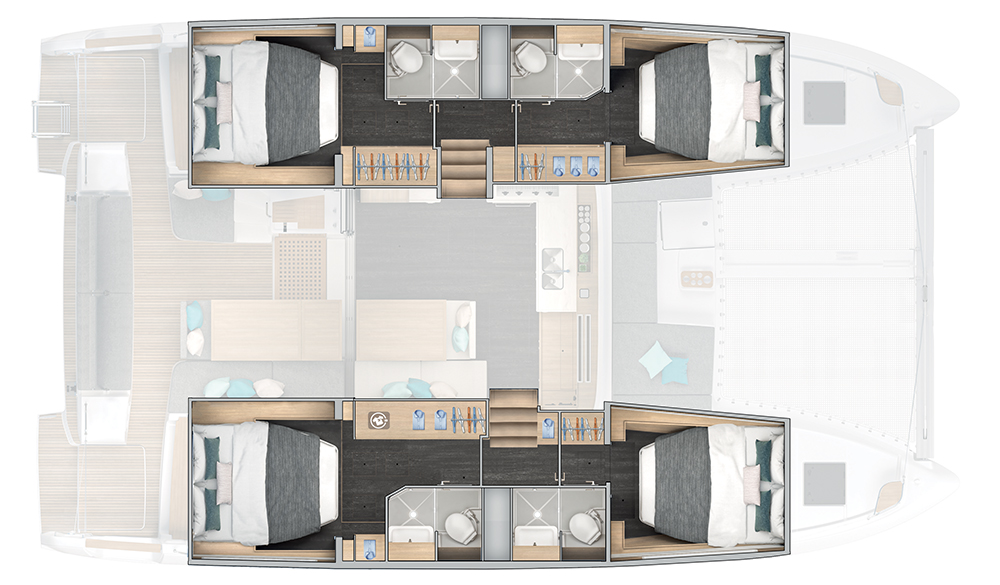
A new hull design enhances the interior space with larger cabins and superior livability. In the three-cabin version, the starboard hull features a luxurious master stateroom with a forward berth and an aft en suite with a separate shower, providing hotel suite-level comfort and privacy.
In the three-cabin version, the master room is an entire starboard hull for its double bed (forward), bathroom with shower aft, luggage storage, and hotel-level finish. In both the three- and four-room models, all double beds that do not touch the sides are the same size, thanks to an increase in the length of the bow section. That has meant that over fifty centimetres have been recovered in the bow with a band edging that covers the sides and overlaps the hulls to create a step similar to a chine flat on each side and a “knee” beyond the waterline with stabilising benefits at anchor to stop rolling. Another development is that Lagoon has installed a full-beam kitchen that looks forward, which works well in the large opening between the dinette and cockpit. It is not so good that they have removed some helpful wall units and cabinets, which, for obvious reasons, have had to be moved below the top to allow a view out. Other interesting solutions are the sofa right in the stern, which has a reclinable back, and the steel tender cranes, which mean you can sit down and look forward or at the water, which can easily be used to create a comfortable sun pad platform.

For a cruising catamaran, it shows its true colours under sail and, without any pretensions, sails smoothly and quietly, even under power. At 6 knots and 2100 rpm, it burns around 10 litres per hour per pair of engines and can cover up to 340 nautical miles in the best cruising range.
The new sail plan has a much larger overlapping Genoa as standard, replacing the self-tacking jib from the previous model. Thus, the plan maximises lighter winds, and the sizeable Code Zero (which comes as optional) delivers more power downwind. The comfortable padded helm seat is a bit low regarding the console, wheel/instruments, and eyelines. It would only take slightly under ten extra centimetres to have perfect posture and visibility, also thanks to the ideal “mezzanine” steering position on the upper deck, which accommodates every possible angle. Staying in the bridge area, the footrest to stand higher while mooring or to scan the bow and horizon is a bit too close to the helm, and you risk scraping your boat shoes, touching the edge of the wheel, which is nearly in the way. To adjust the rail at the extreme aft section of the flybridge, the mainsail traveller’s electrical control is perhaps a bit too far from the helm for the sails to be trimmed without the help of family members or friends. Lastly, owners or guests new to sailing might have liked to see a pair of grab handles on the coachroof to stay safe while adjusting the lazy jack, bag, zips and halyards. Despite those minor quibbles, the boat is full of excellent ideas, has harmonious, clean lines, and is extremely comfortable.


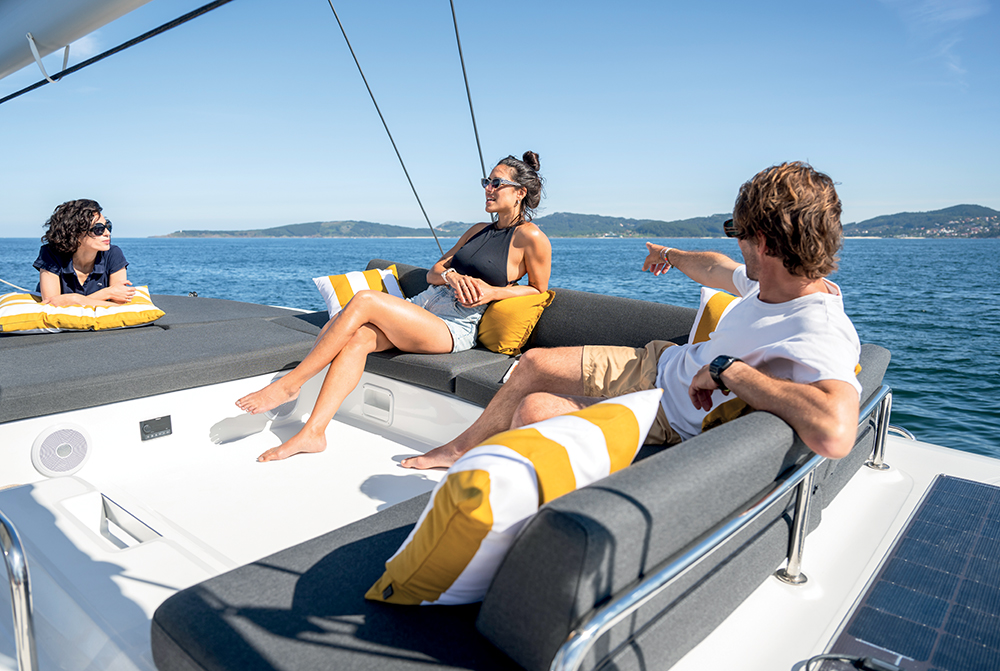
The spacious flybridge, with a sundeck, C-shaped sofas, and a relaxation area in the bow, is ideal for unforgettable sunset aperitifs.

The raised wheelhouse, a typical feature of the smaller models, improves manoeuvrability and visibility, making the boat easier to handle with a smaller crew.
The weather and the sea were calm during the trial off Palma de Mallorca, with a stiffish breeze coming in between 10 and 15 knots. There were seven of us, with the 300-litre water tank half full but all 570 litres of fuel on board. With the mainsail and new overlapping genoa (around 105 m2) and 13.8 knots of true wind, we were close-hauled at 45-50 degrees and did 6.2 knots. The wind picked up with gusts of 16.8 or 17, and the SOG increased to 6.6 or 7 knots, suitable for a cat sailing close hauled. It reached 7.1 and even 7.5 knots, and the actual wind speed rose to 17.5. On a beam reach and with the wind at just ten knots, we bore away to a broad reach at 120 degrees, and the 8-knot wind got us to 5.5 or 6 knots SOG. We turned at over 100 degrees with a 50-degree sheeting angle, and – albeit relatively slowly – we settled down and got back on course without losing our way.
LAGOON
162, Quai de Brazza
CS 81217
F-33072 Bordeaux Cedex
T. +33 (0)557 809280
[email protected]
www.cata-lagoon.com
PROJECT
VPLP Design, Van Peteghem-Lauriot Prévost (naval architecture) • Patrick le Quément (exterior design) • Nauta Design (interior design)
HULL
LOA 13.92m • Maximum beam 7.69m • Draft 1.4m • Light mass 13.9 t • Sailing surface upwind 105 m2 • Main sail 68 m2 • Genoa 37 m2 • Fuel tank volume 570 l • Water tank volume 300 l • Berths from 6 to 8
MAIN PROPULSION
2 x 57 hp
EC CERTIFICATION
CAT A:12; B:14; C:20; D:30
PRICE*
499.000 € As standard – Excl. VAT
*The price refers to March 2025
(Lagoon 43 – Versatile and surprising – Barchemagazine.com – Excerpted from Barche, March 2025)