It performs well under sail and delivers a good level of comfort, both above and below decks. Everything that you need for spending time onboard on an enjoyable cruise
by Niccolò Volpati
It can feel strange to go on board a boat like the Dufour 48, especially as summer is arriving. You’re just starting to feel the heat, and your skin begins to burn after a few hours in the sun. I was still not accustomed to the intensity of late I found it challenging to keep my eyes fully open. And if you add a setting like Palma de Mallorca to the mix, and a wind of around twenty knots, you’ve got everything you need. I was taken by a strong desire for the sea, for holidays, and to go cruising. Those were all feelings that are accentuated by the Dufour 48.


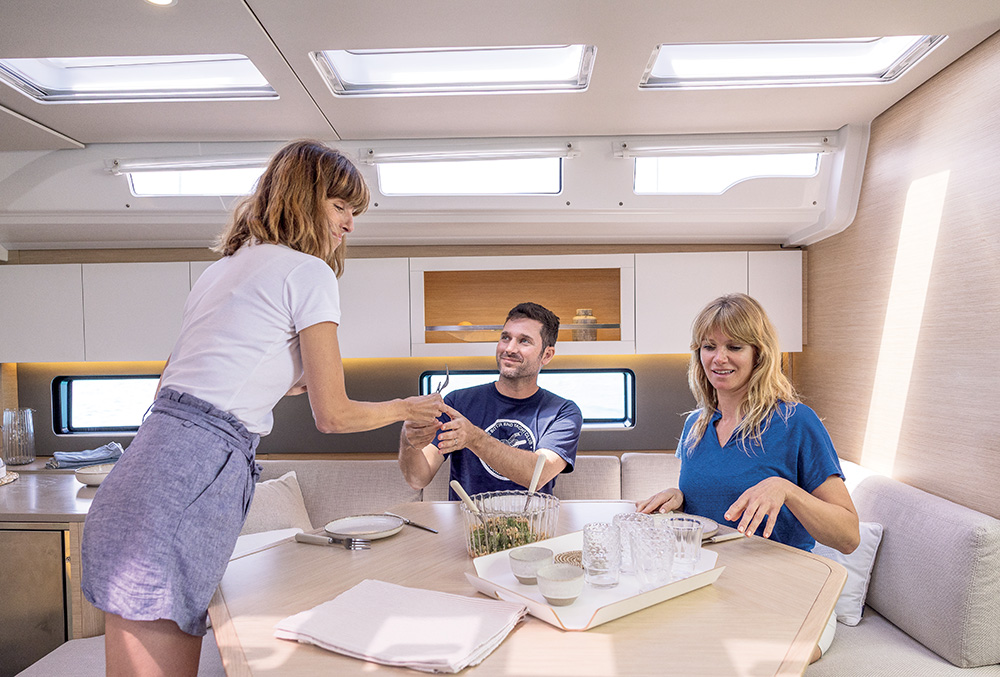
I volumi interni sono notevoli, tanto da far venir voglia di rimanere a bordo a lungo. Merito degli allestimenti e di alcuni dettagli che amplificano la sensazione di spazi voluminosi.
I know that’s something often said, but I mean it: the interiors and deck give the impression that you’re on a much larger boat. There is an excellent balance between furniture and open areas, giving an impression of substantial volume. The cabins, living spaces, dining areas, and sun pad are all areas where you can be sociable or seek privacy if desired. There are two tables on extendable legs in the cockpit, each of which creates a sun pad when combined with the benches. The only drawback is that the bench backs are short, which can make them a bit uncomfortable when sitting down. The seats right in the stern can be transformed in multiple ways. When underway, they work best as a single long sofa that stretches right across the beam. However, when at rest, the centre part can be extended forward to create a further two-person sun pad. The transom tilts outwards to create a substantial swimming platform. The aft sofa hides the grill unit, which can be used from that platform.

Diesel or electric?
Dufour has planned two types of propulsion for the 48: a traditional option with a standard 57 horsepower diesel engine or an 80 horsepower engine, and an Odsea package. This system consists of a 25 kW electric motor, 32 kWh of lithium-ion batteries, a 14 kW generator, a hydrogen generator, and 1,300 W of solar panels. The boat I tested had this version and, with the hull sailing at almost nine knots and the sunlight on the panels above the hardtop, we even managed to charge 2 kW. It is a highly efficient system that utilises renewable sources, including solar energy from the panels and hydro-generation, which acts on the engine propeller. In electric mode, with the batteries fully charged, the range is six hours at a speed of six knots. On balance, then, about 36 miles. For cruising, however, more is needed, and then the 14 kW generator kicks in. These renewable sources are fascinating because they provide a lot of energy. Recharging 2 kW means that, while sailing and therefore without the alternator running, you can always have batteries available for use during daytime or nighttime stops. It is a system that enables you to extend your cruising range by allowing you to stay away from the harbour quay. I’m not totally in agreement about using this energy for propulsion, given that the electric range is only 36 miles. I prefer a traditional diesel engine for propulsion and renewable sources, such as solar panels and a hydrogenerator, to power the service batteries, rather than relying on 220V from a quay or a noisy generator.
The version of the Dufour 48 I tried had a fixed hardtop, but that’s an optional feature. You don’t have to have it, but I would say it doesn’t get in the way too much and is helpful because it protects the entire cockpit area from the sun, sitting on a very solid stainless-steel structure. It also features two windows, allowing you to check the sails from the wheel positions. The fact that you can stand on the hardtop means that it is easier to furl the mainsail and stow it in the lazy bag, while the stern support structure, which is also in stainless steel, folds down to recover the tender, meaning you don’t have to leave it in the water and tow it. For the foresail, you can choose from a genoa on the furler or a self-tacking jib. There is a split backstay to ensure it doesn’t get in the way on deck, and the winches are set forward of the wheels and outside the main cockpit well.

Odsea Pack is a system with a 25 kW electric motor powered by a generator or renewable sources such as solar panels and hydro-generation.

The area below decks is also pleasant to be in. The master cabin in the bows is substantial, with plenty of room for storage and even bookshelves. The bathroom is divided into two, with the wc and basin on one side, and to starboard a shower room. Just as soon as you go below decks, you find yourself in the living area, with the dinette and the hexagonal dining table. The choice of shape is deliberate, as it is a good-sized table but doesn’t block the passage. The galley is located aft of the master cabin and makes the most of the available space. The keel-stepped mast is set twenty centimetres or so from the master cabin bulkhead. The dinette feels like a more open and spacious area. Without that gap, the cabin would be a few centimetres bigger, but everything would have seemed a bit more restricted.
Moving aft, there are two mirror-image double rooms with ample headroom and a second bathroom that lacks a shower cubicle. And then there is the last cabin, with fold-down berths and room for a washing machine – a smaller room that is perfect for a sailor or children, or just as a place to stow things and keep everything tidy. As I said earlier, my eagerness to slip moorings and spend some time sailing the Dufour 48 was increased by the conditions we had at Palma. There was a nice, stable wind of between 16 and 18 knots, making it a perfect day for sailing. Umberto Felci’s design project proved to be a success. This is a cruiser, but that doesn’t mean it can’t be thrilling when under sail. As close to the wind as possible, we achieved 7.7 knots, and by bearing away at 60 degrees, we reached speeds of up to 8.5 knots. That improved with the gennaker up, increasing from 9.5 to over ten knots as we moved from a beam reach to a broad reach. The wind and waves made the helm quite stiff, but not excessively so. The boat held its course and was also reasonably responsive when we had to manoeuvre through the waves on the beam and prevent it from gybing.


The deck layout allows for easy transformation of outdoor spaces. The result is a boat that is functional for sailing and comfortable at anchor.
DUFOUR YACHTS
La Rochelle, Francia
www.dufour-yachts.com
PROJECT
Felci Yacht Design e Ardizio Design (interiors)
HULL
LOA 15.29m • Length 14.32m • LWL 13.35m • Maximum beam 4.85m • Light mass displacement 13,900 kg • Ballast 3,850 kg • Draft 1.75m • Fuel tank volume 250 l • Water tank volume 530 l • Main sail 64 m2 • Genoa 53 m2 • Self-tacking Jib 42 m2 • Gennaker 180 m2
MAIN PROPULSION
Odsea+ Pack • Hybrid/electric • Outlet mechanical power 25 kW • Lithium batteries 32 kWh • Generator 14 kW • Hydrogenerator 1.5 kW • Solar panels 1,300 W • Converter 6 kW
EC CERTIFICATION
CAT A
PRICE*
Starting from 432,000€ Excl. VAT equipped with Pack ODSea and a 14 kW generator. Starting from 355,000 €, powered with a 57 hp engine
*The price refers to September 2025
(Dufour 48 – I want to be Free – Barchemagazine.com – Excerpted from Barche, September 2025)