Performance under sail, volume, comfort on board, ease of handling. The latest addition to the Swan family is Maxi in every way
by Niccolò Volpati – photo by Stefano Gattini/Studio Borlenghi
The aeroplane taking me to Kokkola is small. There are only 17 rows, and unfortunately, I am sitting next to the propeller, which is clearly visible outside the fuselage. Despite this, I manage to fall asleep. Aeroplanes have the same effect on me as moving cars do on newborn babies. When I wake up, we are descending. The airport is close. Looking down, I see a massive pile of neatly stacked wooden logs at the end of a pier.
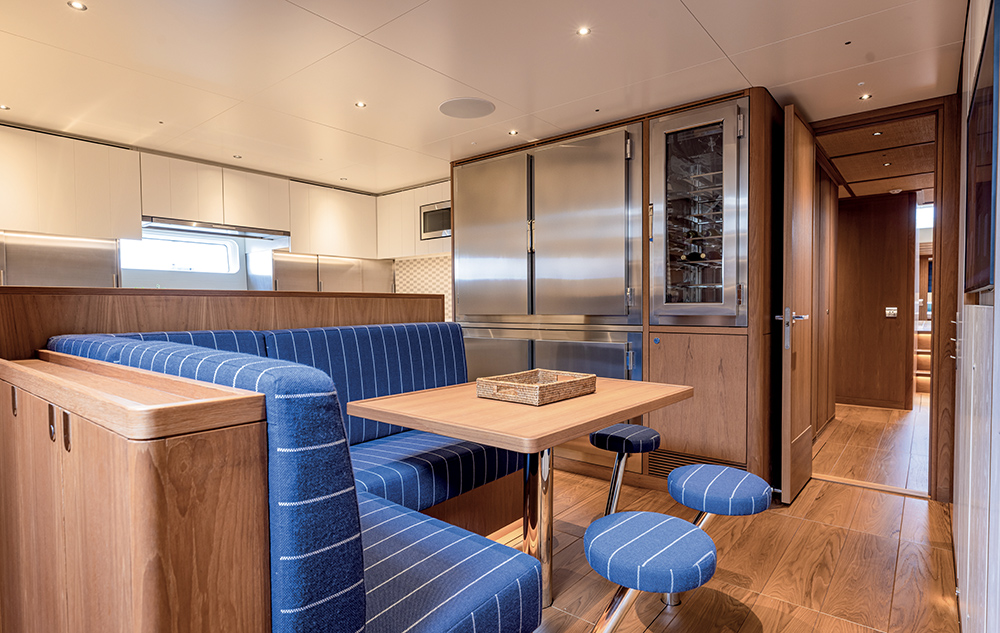
The raised ward room, accessible via an extra-large entrance companionway, offers three levels of natural light with panoramic views both standing and seated. The two areas, clearly divided between the saloon and dining area in the standard version, offer numerous customisation options, including day beds to enjoy the large hull windows even while sailing. The TV lounge can be converted into a large dining room seating up to ten guests.
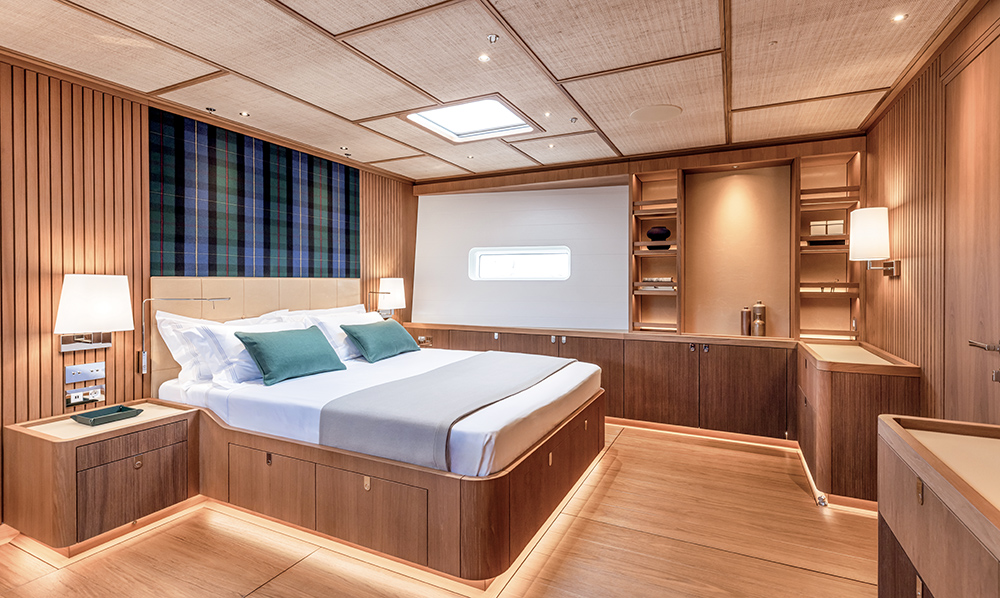
The owner’s apartment features a full-beam cabin and a bathroom. There are endless possibilities for customisation, given the spaciousness of the rooms and the reduced structural constraints of the area, which is well defined by regular-shaped bulkheads. The various guest cabins can be configured in different ways, with single or double beds, additional pullman beds, and bathrooms that can be equipped with a bidet.
Misa Poggi.
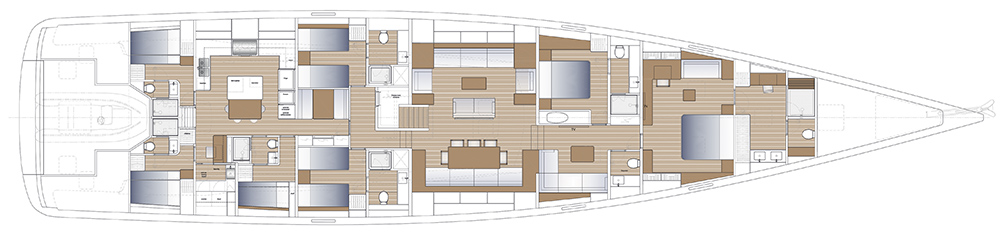
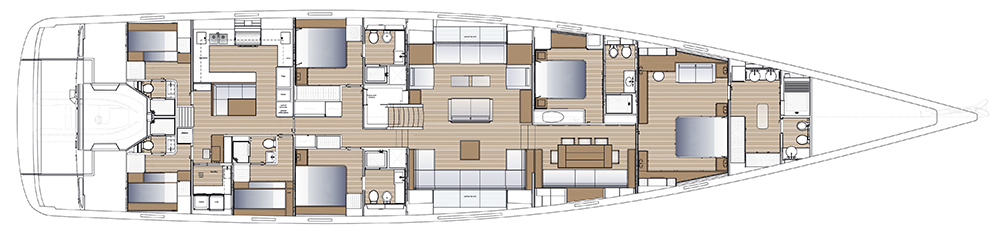
Misa Poggi has created an optimal, flexible layout for the interiors, with a spacious owner’s apartment in the bow and a generous crew area in the stern.
Sailing boats are not the only productive activity in northern Finland; there is also a large paper mill. After all, the forest is dense, stretching as far as the eye can see. Below me, there are only trees. This isn’t my first time visiting Nautor Swan, 500 kilometres from Helsinki, but I always find it hard to get used to two peculiarities: the few people around and the sun that never sets, even at midnight. And another one is added to these: Swan 128. It’s not strange because it’s eccentric, but because it’s very large. Swan has only ever built one boat longer than this one. It was 2006, and the model was the Swan 131. “At our Pietarsaari facility, we can build a maximum of 148 feet. The design is already there, everything is ready, and, as always, it was created by Germán Frers”, says Giovanni Pomati, Chief Executive Officer of Nautor Swan.
Over the last ten years, the collaboration between Studio Frers and the shipyard has resulted in the completion of 13 projects, seven of which are over 80 feet in length.
Like all Swans built between 1981 and the present day, the 128 was designed by Germán Frers. “The waterlines are optimised for true winds of between 8 and 10 knots, but this is obviously a boat that can sail in all conditions”, explains the designer. The philosophy remains the same, and this maxi is no exception: it is a comfortable boat, ideal for long stays on board and extensive sailing in all the world’s oceans. In two words: performance under sail and comfort on board. The deck, designed by Lucio Micheletti, features a cockpit divided into three areas. Close to the deckhouse, protected by a retractable sprayhood, is the classic configuration with two C-shaped sofas and tables for guests. Towards the stern, the space is left clear to allow for customisation according to the owner’s preferences. The stern, in addition to a garage that can accommodate a four-and-a-half-metre tender, transforms into an extensive beach area to be used at anchor. The central area of the cockpit is dedicated to manoeuvring. The steering wheels are positioned forward to ensure maximum control, both of the sail adjustment and of everything around the 39-metre-long hull.
The moderate heel, around 20° in optimal conditions, also offers considerable comfort when sailing, making every part of the boat accessible without acrobatics. The generous sail plan, as always with Frers’ designs, provides the power needed to make the ship lively and fun even in light winds, while remaining docile and controllable even when conditions become more challenging.
The Swan 128 has impressive deck equipment, especially given its size. The jib is self-tacking and, with captive winches and electric winches, it is not difficult to imagine that it does not require a large crew to sail and manoeuvre it. The only thing that didn’t convince me entirely was that I would have liked a few more centimetres of floor space behind the two rudder wheels. There is plenty of space, of course, but there is a step that could cause you to lose your balance if you move back slightly while steering. This doesn’t necessarily happen, but perhaps a few more centimetres could be provided for the helmsman on a 39-metre hull.
The deck plan clearly separates the forestay from the Code Zero. The sleek, sculpted deckhouse, albeit in a semi-raised saloon configuration, gives the boat a distinctly sporty feel.
Germán Frers.
Let’s be honest, handling a very large sailing boat is never easy. However, Germán Frers and the shipyard have found a solution. The rudders are large to make manoeuvring easier, even at mooring. Large rudders can, however, be synonymous with friction and therefore make sailing more difficult. The Swan 128, however, has a system similar to that of a bicycle, allowing a ‘full rudder’ when manoeuvring in port and a ‘reduced rudder’ for sailing. This is all thanks to two gears and two cogwheels that act as a reduction gear when needed. It feels the same as a car with power steering. Steering is effortless, partly because course corrections are minimal when sailing. You really feel as though you are on board a smaller, more agile boat than the Swan 128’s 39-metre-long hull.
Giovanni Pomati.
The polar curve indicates that, in strong winds, the Swan 128 can reach 17 knots.
Not only is the performance impressive at the helm, but the sensation you experience is too. There is almost no drag, as evidenced by the practically non-existent wake. The hull sits perfectly parallel to the water’s surface, making full use of the waterline length. Furthermore, the system designed specifically for rudders makes steering very easy. I am on board a 40-metre boat with a dry displacement of 123,000 kilograms, yet I feel like I am on a hull half the size. It is very manoeuvrable and responsive. Even the slightest course corrections are never a problem. The wind was not particularly strong. We sailed at speeds of between six and eight knots true wind and, with the mainsail and jib, we managed to reduce the apparent wind angle to 27°. With a true wind of 6.6 knots, the instruments showed a speed of 9 knots. When the wind picked up slightly, widening the sailing point by a few degrees, we exceeded 10 knots.
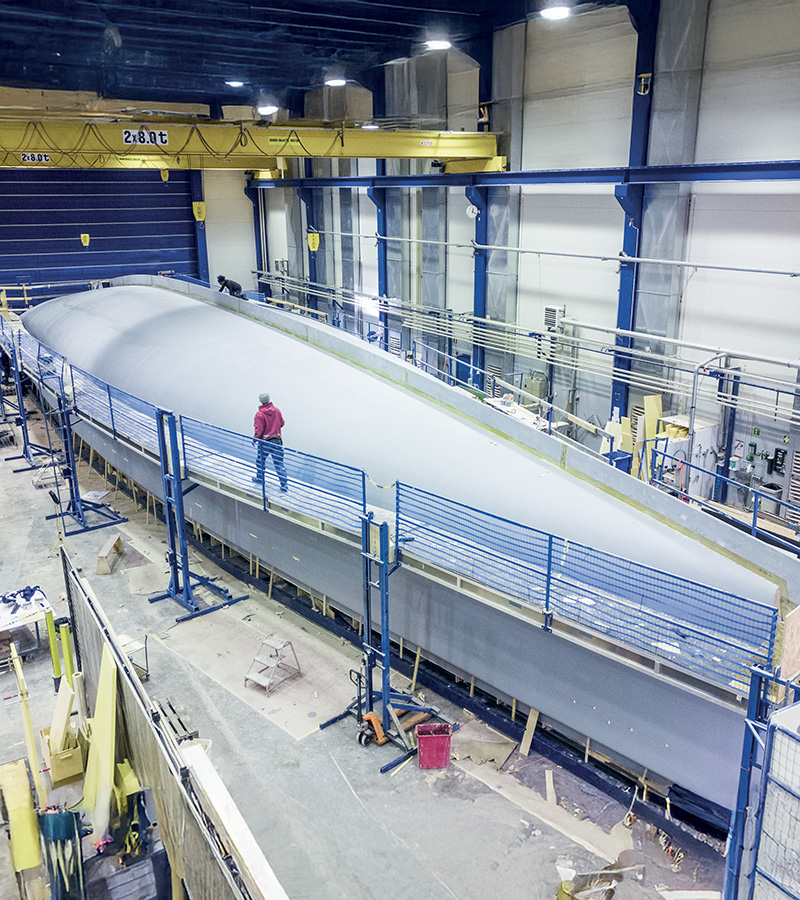
Maxi Swans are made entirely of carbon fibre. The technology used is sandwich lamination with carbon fibre fabrics pre-impregnated with epoxy resin, using Sprint technology, and a Corecell core, produced and engineered by Gurit. The process involves post-curing in an oven for approximately 18 hours, with a characteristic curve reaching 90°, and is divided into two main phases, plus a third final phase.
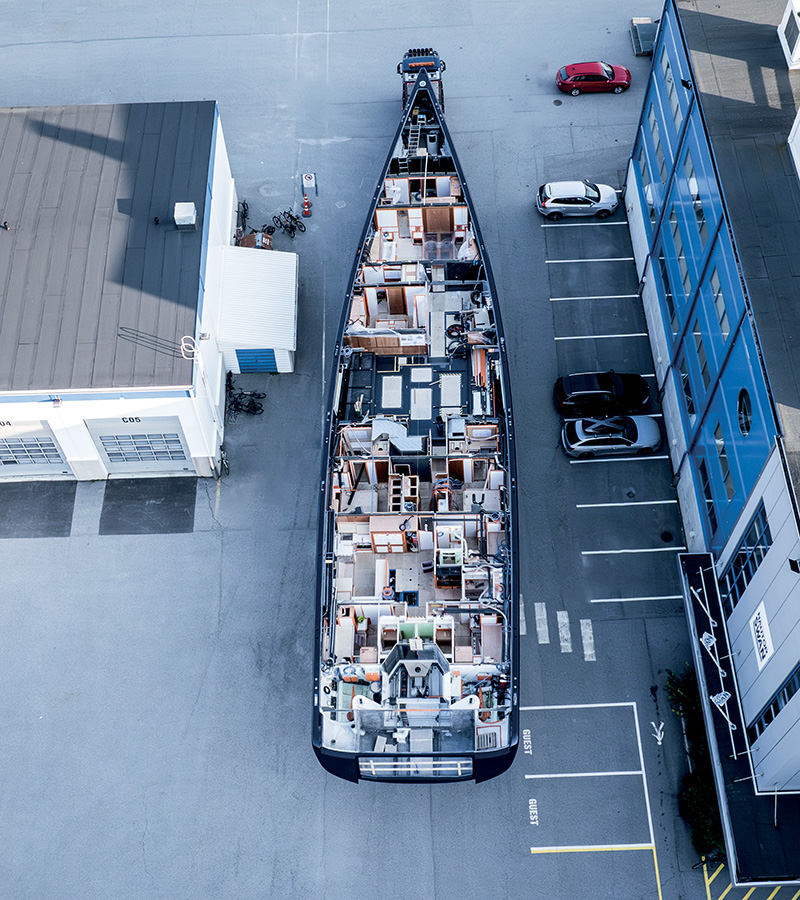
Frers’ design allows a heel of no more than 20° in optimal conditions, resulting in remarkable comfort when sailing. The interiors are the result of collaboration between Frers, the shipyard and architect Misa Poggi. The volumes are so large that there is considerable scope for customisation. In this case, the owner chose to dedicate the central part to the living area and move the dining area towards the bow. The entire bow is dedicated to the master cabin and is located well away from the crew area, which is located at the stern. However, this is not a sacrificed area, far from it. The cabins are spacious, as is the living area, and the galley is also located in the stern. To access the crew area, the ladder is located in the centre of the cockpit, between the two steering wheels, to be separate from the companionway below deck for the owner and his guests.
The cockpit features the typical three-area layout characteristic of all Swans. The forward area, close to the deckhouse and protected by a sprayhood and bimini, is reserved for guests. The central area of the cockpit includes all the elements for sailing the boat, from the forward-positioned, panoramic steering positions to the winches for controlling the sails. The entire stern is dedicated to the beach club, which connects seamlessly to the large platform.
NAUTOR SWAN Pietarsaari, Finlandia Nautor Swan Srl Viale San Bartolomeo,362 I-19126 La Spezia www.nautorswan.com
HULL Length 38.98m • LWL 35.94m • Beam 8.65m • Draft 4.70m • Lifting keel draft 3.70/5.70m • Light mass displacement 122,800 kg • Full mass displacement 136,200 kg • Ballast 39,500 kg • Fuel tank volume 5,500 l • Water tank volume 2,650 l • Main sail 443.80 m2 • Genoa 401.50 m2 • Spinnaker 1,180 m2
MAIN PROPULSION 405 kW (550 hp)
EC CERTIFICATION CAT A
PRICE* Starting at 21,000,000 € Ex-RIG, EX VAT
*The price refers to December 2025
(Swan 128 – All Maxi – Barchemagazine.com – Excerpted from Barche, December 2025)