Sail in comfort, with excellent performance and style. You don’t have to compromise on any of this, even if the boat is used as a day cruiser
by Niccolò Volpati
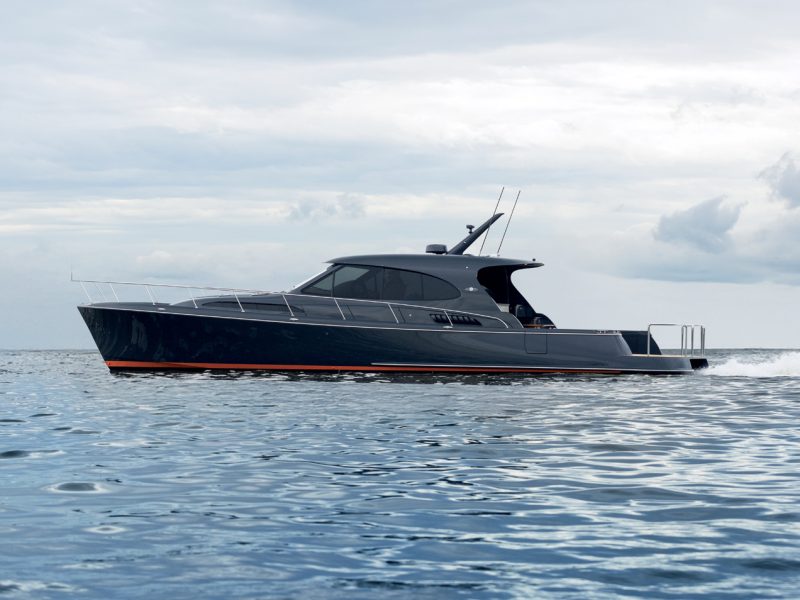
Palm Beach is a brand inspired by traditional lobster boats. However, unlike those boats, the latest model, the GT60, can reach an impressive speed of 36.6 knots. The credit for this performance goes to Mark Richards, the shipyard’s CEO. A designer and expert sailor, Richards has participated in many regattas and is very popular in Australia. Since acquiring Grand Banks and Palm Beach, he has redoubled his efforts to improve performance while reducing fuel consumption. This has been achieved through a unique hull design, the strongest and lightest available materials, and cutting-edge construction technology, all executed with meticulous attention to detail. The GT60 uses V-Warp technology, which Richards believes so strongly in that he has patented it. The construction process involves the use of vinyl ester resins, glass fibres and unidirectional and multiaxial carbon fibres. Naturally, vacuum moulding is employed to limit the amount of resin used and thus minimise weight. The result is exceptional strength and reliability below the waterline, and maximum lightness in the superstructure thanks to the extensive use of carbon fibre.

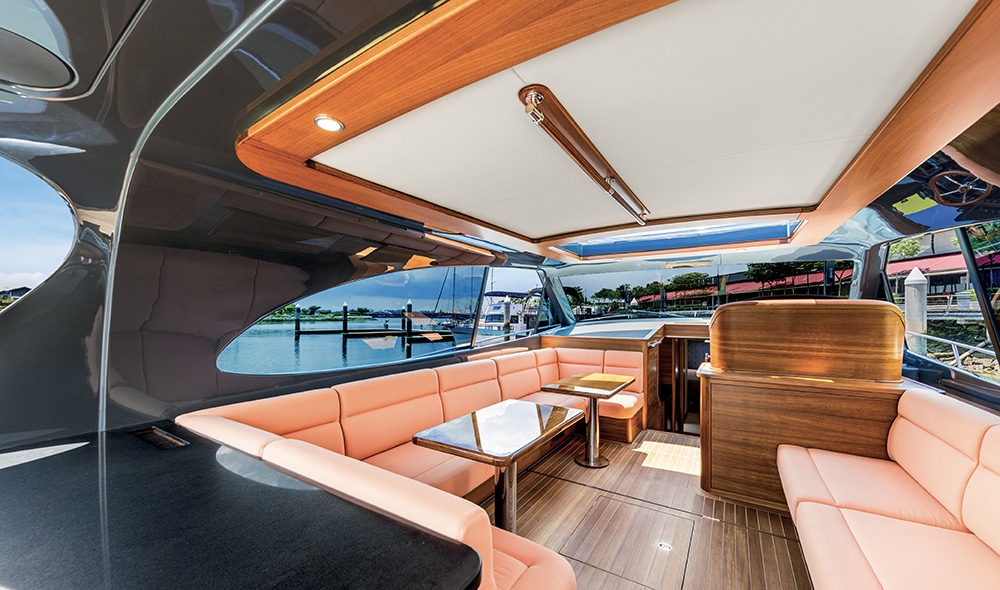
The superstructure is characterised by its spaciousness.
Comfort is provided by the available surface area and by the pleasure of an unobstructed view.
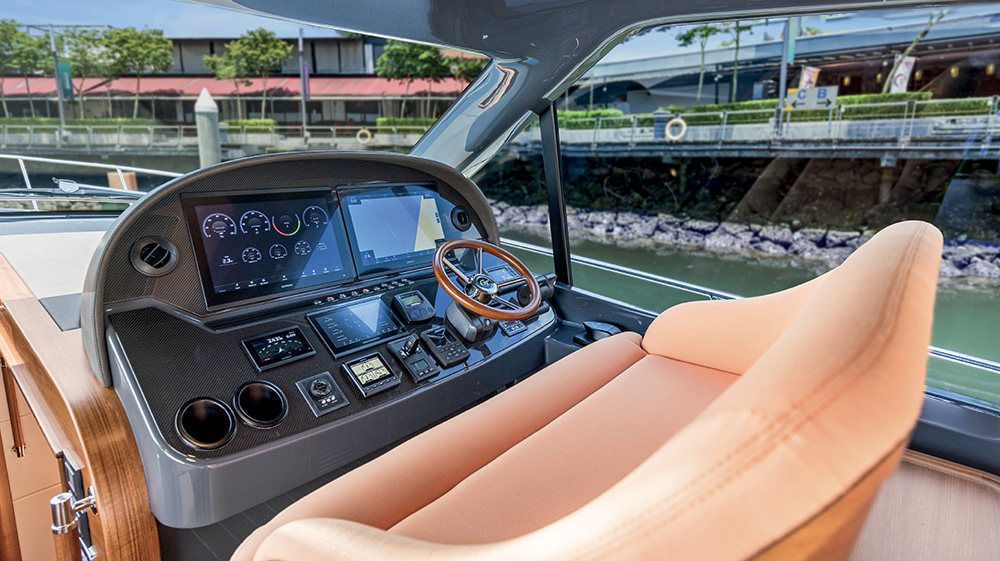
The GT60’s defining feature is that it is a day cruiser or weekender that doesn’t compromise on performance, comfort or style. The deck is a single, open space that is sheltered yet not enclosed. The stern is open with no doors separating the cockpit from the platform and no divisions between the dinette and cockpit. This creates a single, ample space that is very livable and pleasant. There is a great deal of space available. The outdoor area, consisting of the cockpit and aft platform, is not cluttered with furniture. The only linear sofa, facing aft, is located aft of the dinette. There is no dining area, as this has been placed amidships, i.e. in the area protected by the hardtop. Here too, there is no shortage of space, and in fact, the dining area has two large fixed tables, one following the other, on the left-hand side, surrounded by a large U-shaped sofa. On the starboard side, there is another long linear sofa. The result is a spacious dining and living area. The single steering position ensures excellent visibility at all times. The windscreen is a single pane of glass with no pillars to obstruct the view towards the bow.
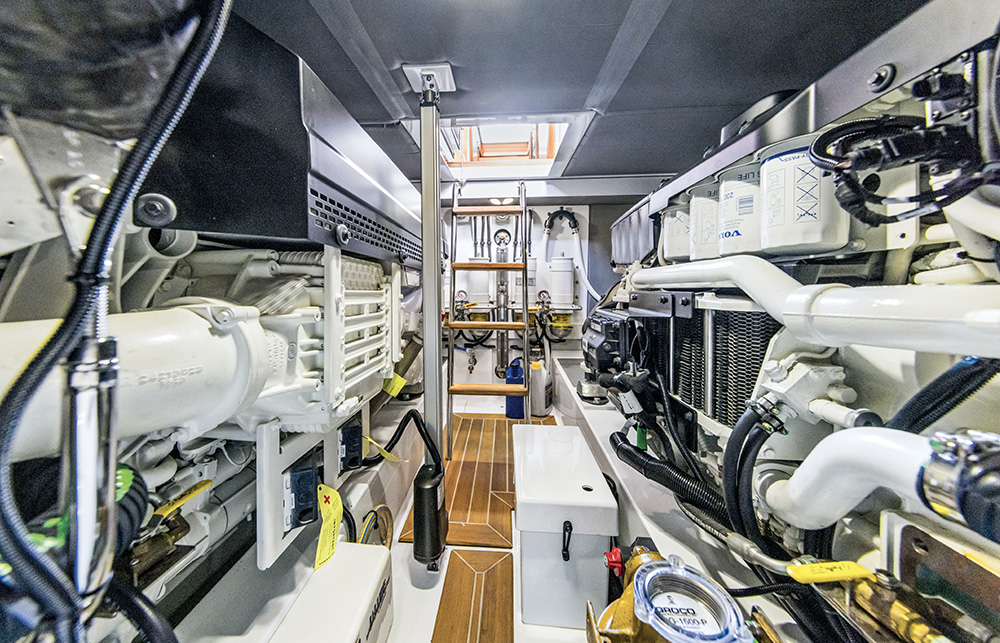
The trim also helps to keep everything under control while sailing, as it is always correct. The boat is well balanced and parallel to the water surface. Whether underway or planning, the console offers a perfect view. The engine room houses two Volvo Penta D13 engines, each with 1,000 hp, but the unique feature is that the shipyard decided to forego propellers in favour of Hamilton jet drives. The feeling at the helm is very positive. Not only does the boat accelerate quickly, but its manoeuvrability is also perfect. It is easy to steer, and you never feel like you are struggling to maintain control. I reached a maximum speed of 36.6 knots, and it took just over 14 knots to glide. The results of V-Warp technology are certified by the numbers. Fuel consumption is low at all cruising speeds. When planning, it consumes 107 litres/hour, for a maximum total of 390. In my opinion, the best speed is between 20 and 25 knots, with fuel consumption between 220 and 270 litres per hour.

The layout includes a very comfortable master cabin. It is ideal for two people, and the design allows you to enjoy even long stays on board.
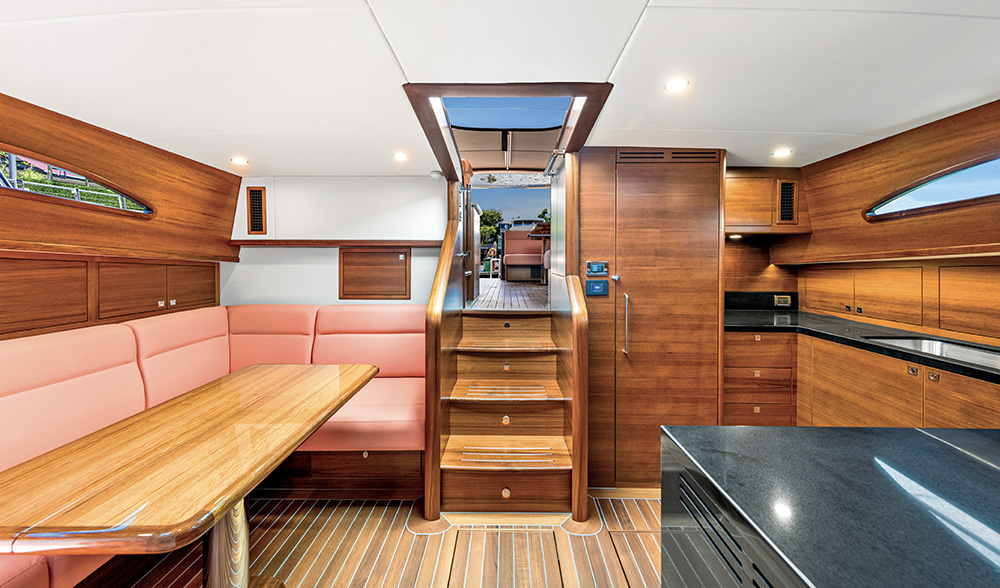
Comfort in the cockpit and dinette areas is also guaranteed by natural ventilation. The hardtop has a sliding hatch, and the side windows next to the windscreen slide as well. All the controls for raising and lowering them are electric. Given the 33 °C temperature during testing in Malaysia, I would say the airflow is more than sufficient. While driving, we didn’t feel the need to turn on the air conditioning. For those who prefer not to use jet drives, an IPS transmission is available as an alternative. As is traditional for the shipyard, this is not the only customisation option. The shipyard is always willing to meet owners’ needs so that they can indulge every whim. The lower deck is accessed via a wide, safe and comfortable staircase.

It is stable and safe when sailing, but that is hardly surprising. What is striking is how easy it is to handle and steer, even with jet drives. The V-Warp technology used to construct the hull was patented
by the shipyard’s CEO, Mark Richards.
There is no shortage of handrails, including those that have become a distinctive feature of Palm Beach and Grand Banks, which run lengthwise across the ceiling of the dinette. The galley is located on the lower deck just down the ladder. This is a good solution, both because it creates a hallway area before entering the master cabin and because it leaves more free space for comfort in the dinette. It is a fairly large, well-equipped galley with a small table surrounded by a small sofa.
Engine room
Two D13 engines, each with 1,000 horsepower, are more than enough to achieve optimal speed performance. For transmissions, you can choose between jet drives and IPS.
PALM BEACH MOTOR YACHTS
1 Queens Parade, Newport
New South Wales 2106, Australia
T. +61 2 99795601
www.palmbeachmotoryachts.com
PROJECT
Mark Richards and the shipyard’s technical department
HULL
LOA 19.85m • Maximum beam 5.23m • Draft 1.10m • Displacement 23,251 kg • Fuel tank volume 3.200 l • Water tank volume 950 l
MAIN PROPULSION
2x Volvo Penta D13 • Outlet mechanical power 735 kW (1,000 hp) • 6 in-line cylinders • Swept volume 12.8 l • Bore&Stroke 131mm x 158mm • Rotation speed 2300 rpm • Weight 2,458 kg
EC CERTIFICATION
CAT A
PRICE*
4,250,000 $ as tested
*The price refers to December 2025
(Palm Beach GT60 – Fast Lobster – Barchemagazine.com – Excerpted from Barche, December 2025)