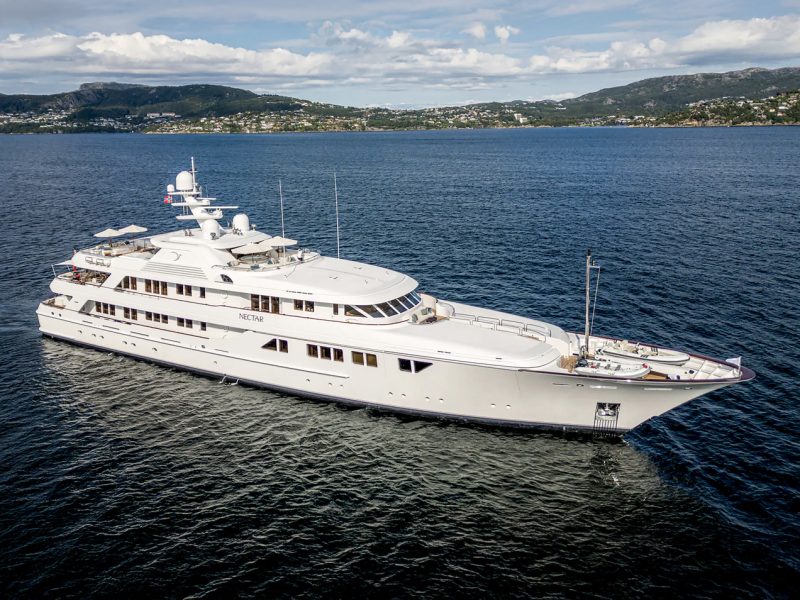
The refitting project of Nectar is signed by Francesca Muzio, creative director of FM Architettura. The thread running through this work is a rigorous style and a deep nautical culture
by Sacha Giannini – photo by Giorgio Possenti
The only real difference today between a private yacht and a civilian home is the ‘movement’ with all its nuances of roll, pitch and vibration. Apart from the internal height and systems, everything else is largely the same, as the interior design is essentially identical. However, some people explore ‘off-catalogue’ ways of living, establishing a relationship of control with the physical and emotional spaces that will be inhabited. It is precisely in this area that Francesca Muzio’s work as creative director of FM Architettura is defined, through a cultured language of dialogue and participation that explores the boundaries of luxury, deep-sea navigation and on-board comfort.
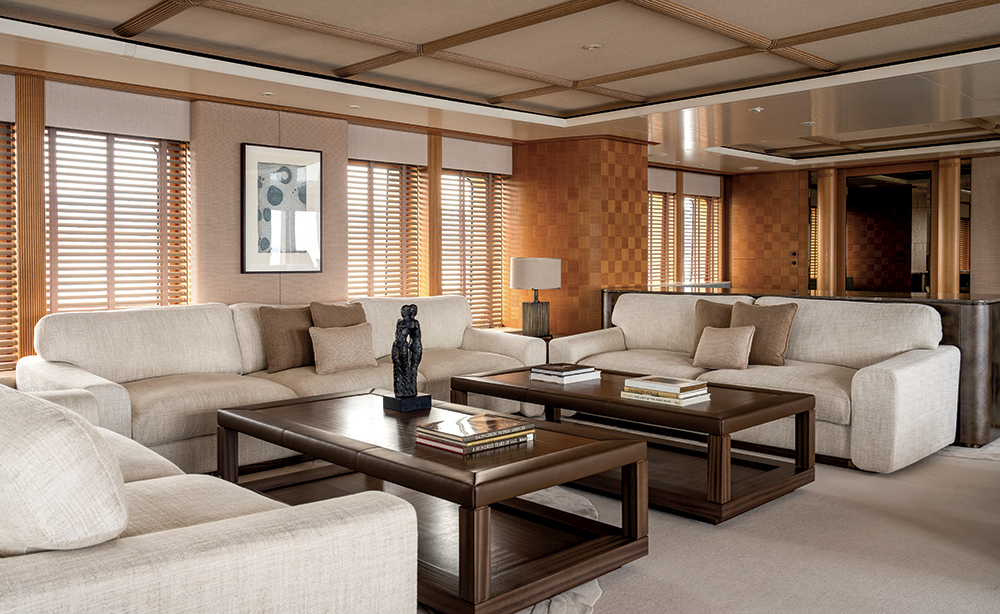


A strong component of emotional intimacy shines through in Nectar’s interior, which opens up to cottons, raw linens and fine wood furniture, alternating with leather, metals, bronzes, sculptures and family art pieces positioned to become visual and sensory landmarks.
«We worked on this ‘grand lady’ Feadship, trying to remove not only what had been added, customised and designed for the previous owner, along with all those gold accents and contrasts that gave a perhaps too classic reading, but also to give an excellent original layout a new interpretation and reading».
Francesca Muzio
To Francesca, the boat is no longer simply a place, but rather a ‘transit’ according to which a space can also become more than a place to live, precisely like “…a caravan, a boat or a tent can also be a home” (Mary Douglas, British anthropologist). The work that FM Architettura developed in 2024 for the refit of the M/Y Nectar, formerly Callisto, a 65-metre Feadship from 2006, was the spark that lit up the indoor scene with an analysis about the role of furniture, which acts as an intermediary in the relationship between man and space and therefore offers a unique perspective on experiencing new horizons in movement. The intervention is an update of both furnishings and onboard atmospheres for a new owner who wishes to transform Callisto into Nectar, with an almost complete reinterpretation of the interiors. While maintaining the functional distribution of the original layout and structural bulkheads, the intervention changes and enhances only some of the new destinations of use.
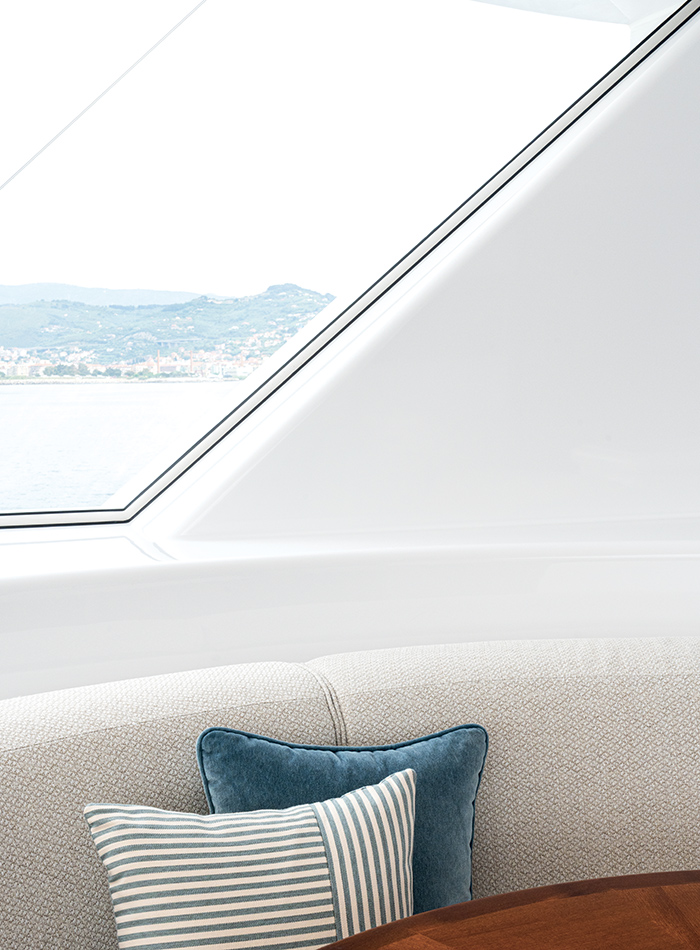


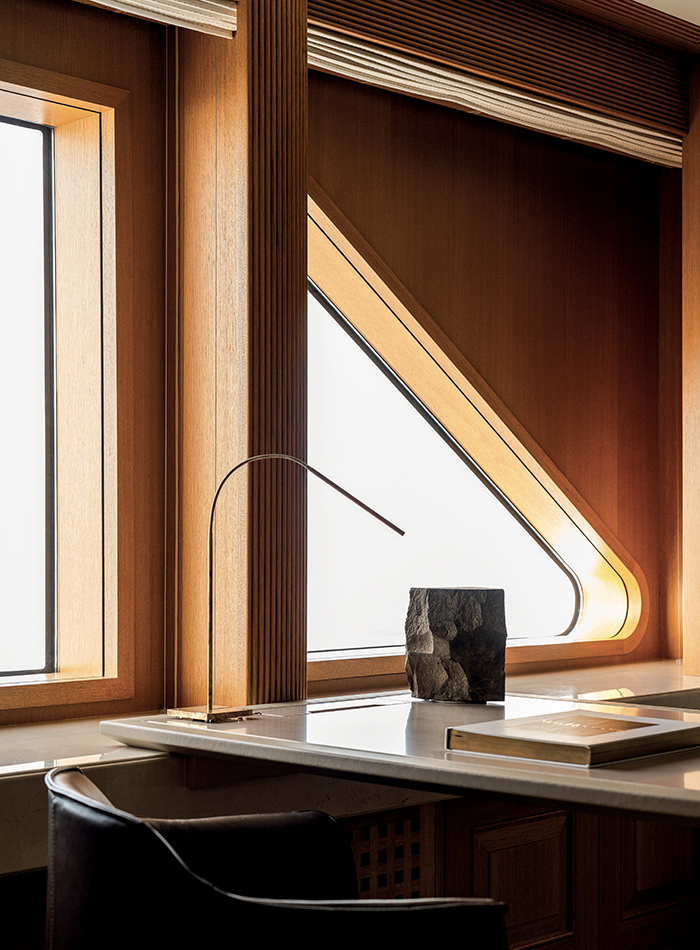


Light plays a significant role; it becomes scenic, serviceable, and an accent for works of art, but also natural, rendering “…every moment of the day into a journey to be experienced with all the senses”.
Interiors become increasingly meaningful when furnishings, objects, and their perception are separated from the external space – in this case, the sea – and a direct dialogue is established through continuous daily practices. Some design gestures that Francesca skilfully employs anticipate the emergence of these ‘rules’ of living and structure, with carefully studied interpretative hierarchies, the internal dimensions, and relationships of the living space. It is precisely this structuring or putting so that allows you to take possession of a space and make it home, because the sense of living is also about putting things together according to a certain logic, which is not always rational, but at times instinctive and random, made of details and ‘things’ that transform the place into a filter of rhythms, pauses, placements and displacements. Interiors are not just the space in which we settle down, “the internal surface of the casing”, as Aristotle argued, but rather the interval to cover between suggestions and sequences of images.


The project makes precise choices that become the expression of a personal diversity, but also of adherence to a more collective identity composed of customs, rituals, and habits.
Living in a boat, a house, or a hotel room means giving it character, equipping it with things, furnishings, attention, compliments and meaningful objects that declare a presence. However, it also means using it to perform different functions or the same tasks in various ways. Without all this, it isn’t easy to understand where we are, precisely because we express ourselves through all these things and allow them to represent us. On this principle, Francesca Muzio has developed a particular refit that highlights aspects of uniqueness and depth in a fitting solution, which is an almost biographical outline of the client intertwined with her creativity. And then there is something magical about all these things, because they become symbolic vectors, expressions of participation in a space in which they are placed.
The textile coverings of the bulkheads are textured materials that intertwine with other fine fabrics by Dedar and Loro Piana, with synthetic rattan, pure cashmere and then again with terracotta colours, blue, mahogany, American oak, desks, sofas, coffee tables, game and dining tables, all designed by FM Architettura to tell a story of dreams, future journeys and suggestions drawn from different cultures or from the ship’s “pre-existing” features.
The realisation of the refit employed the tradition, art, and expertise of Made-in-Italy production from Le Marche, the technique and top quality of Dutch artistry in the Feadship yard, where every detail and finish highlights an idea of balance between artisanal and industrial production and the creative discipline of design that Francesca uses and interprets as a binding substance, direction, and originality. Her interior design proposal, however, is not simply a selection of choices or a custom-made production of objects conceived and made for the occasion. It is, rather, the construction of cultural scenarios and connections that evoke familiar atmospheres, allowing one to live in normality, within the habits of the owner, without ever dissolving those convivial cadences typical of any home. Above all, it is about avoiding homologated, neutral, and temporary episodes. On board, everything is connected in a custom-made domestic everyday pace, which, in the texture, weave, and pattern of an upholstery, of a fabric, a bulkhead, a contrast, the shape of a designed piece of furniture or a purchased object, takes on new interpretations and readings.

«It was not just a ‘cleaning’ job, but an enhancement and flexibility
of use for each area of the ship, made of rhythms and shared, personal and playful moments». Francesca Muzio
NECTAR BY FEADSHIP
PROGETTO
Naval architect Feadship De Voogt Naval Architects
Exterior design Studio De Voogt
Interior design Terence Disdale Design 2014 • 2024 Refit
Interior design FM Architettura Francesca Muzio
Launch 2006
Refit 2024
Launch name Callisto
Current name Nectar
HULL
LOA 65.20m
Beam 11.28m
Speed 16 knots
Range 5,300
Main engines 2 x Caterpillar 3516B DI-TA 1,491 kW at 1600 rpm
Fuel tanks capacity 126,400 l
Water tank capacity 32,000 l
Guests 12
Staterooms 6
(NNectar by Feadship – Intimate connections – Barchemagazine.com – Excerpted from Barche, November 2025)