SX120 blends pioneering technology and the latest in nautical design. She embodies Sanlorenzo’s commitment to both the evolution of its products and innovation, and she is the first composite-built yacht to feature the IPS Professional Platform by Volvo Penta
by Sacha Giannini and Francesco Michienzi – photo by Breeds Media Creative (exterior) and Federico Cedrone (interiors)
1822. With their boats, Bolivar and Don Juan, the poets Byron and Shelley were perhaps amongst the first to promote the concept of yachting for pleasure and the idea of wandering around at sea. They might also have been pioneers of on-board comfort. The former’s boat measured 24 feet, and the latter’s was just over 30 – yet, in Byron’s words, “sufficiently spacious to accommodate everybody comfortably” – but they nevertheless sailed around, between Genoa, La Spezia and Viareggio, enjoying a feeling of luxury, of exclusivity, even if only in terms of the time they had available.
2025. Two hundred and three years later, in places where there was once poetry and significant challenges, we find the same spirit, but with new owners and shipbuilders. They continue to build, inviting designers and architects to find new solutions for new requirements through prose, poetry, culture and skill. The boats are 120 feet long, have three usable decks and a sundeck, and are powered by four 1,000-horsepower engines driving two Volvo IPS Professional Platform pods. There are also at least four double VIP cabins to accommodate everyone comfortably.
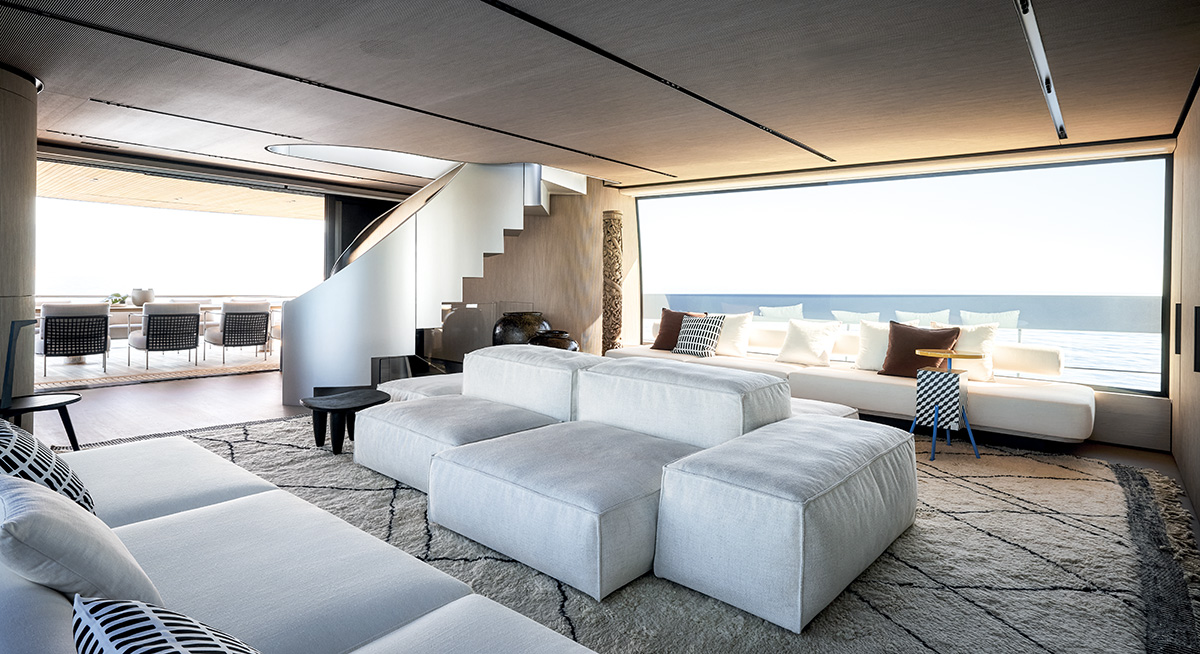
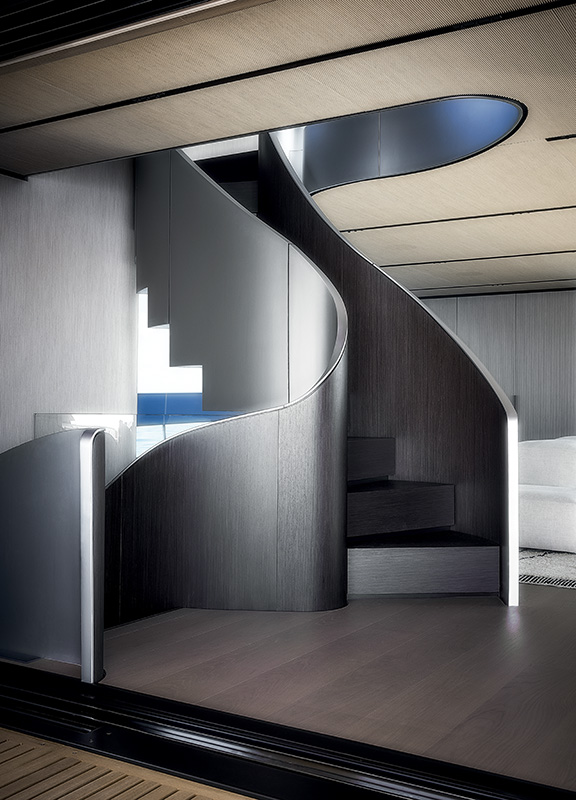
The lounge on the main deck is bathed in natural light through
the large windows, where guests’ attention is drawn to a sculptural staircase that enhances the environment and, at the same time, serves as a functional solution, allowing a smooth connection between the decks.
The new Sanlorenzo SX120, the flagship of the brand’s crossover range, is all that and more besides. “The SX120 has changed the way in which yachting was conceived, and redefined the experience of life on board, introducing a new idea of space, liveability and connection with the sea”, says Tommaso Vincenzi, CEO of Sanlorenzo. These days, as well as sustainability, comfort and performance, there is also a call for sensitivity, as a social commitment to reach the conscience of people who do the design, and thus break into the view of somebody else who will always be found on shore just looking, since “architecture belongs to those who look at it” (B. Zevi).
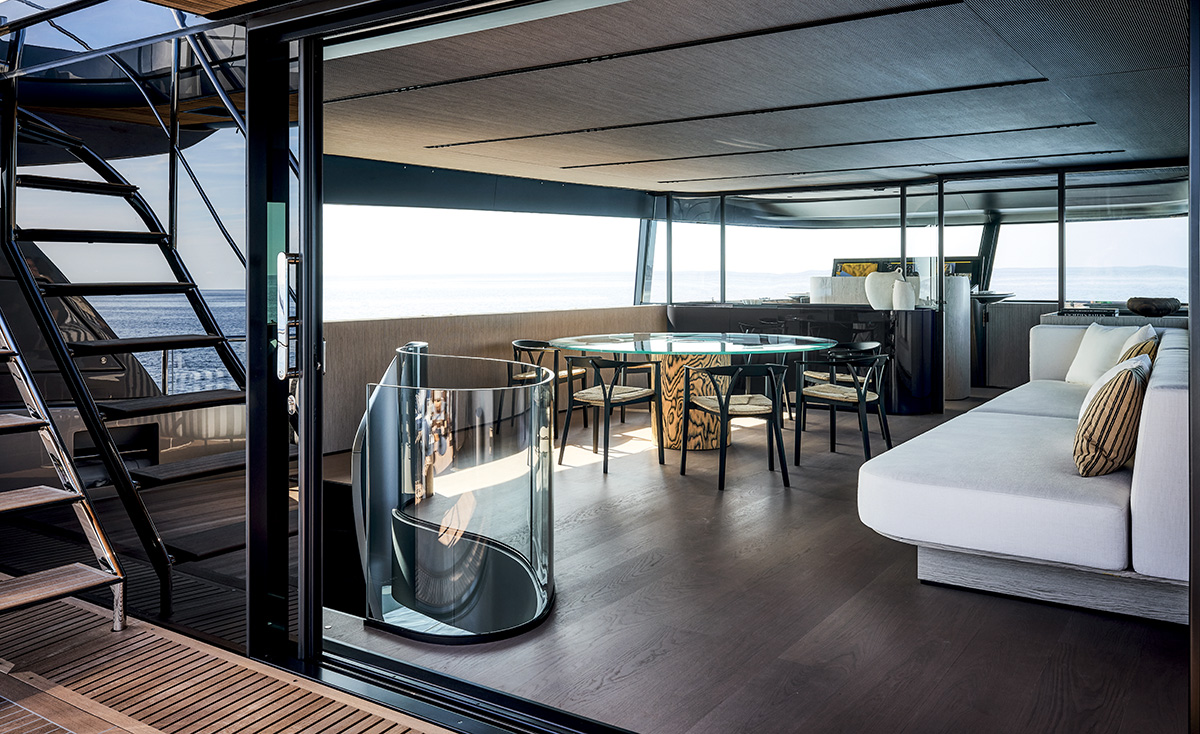
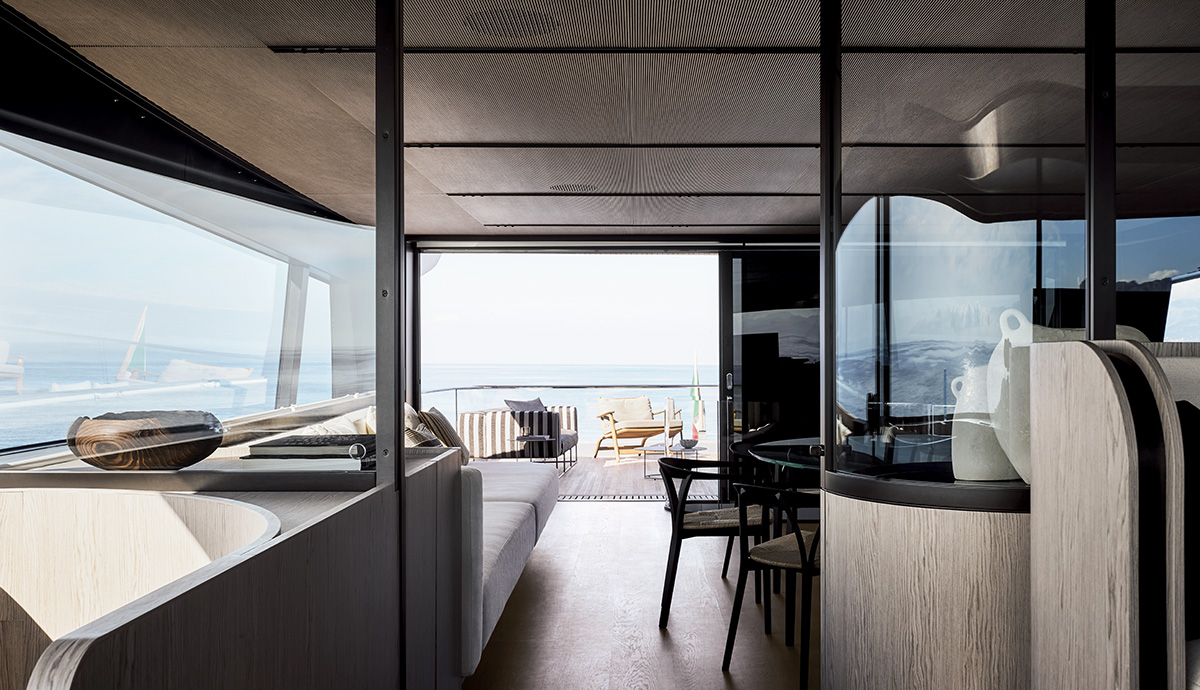
The interiors are enriched with many pieces that have made Italian design history, such as the Donzelletta chair by DePadova, designed by Michele De Lucchi. The frame is made of solid black ash wood, and the seat is woven straw. Xila, the Silcolak kitchen by Boffi, was designed in 1972 by Luigi Massoni.
This act of responsibility represents the cultural and conceptual basis on which Zuccon International Project has developed the exterior concept of the new flagship of the Sanlorenzo SX series. The SX120 encapsulates ethics and a strength that puts itself beyond the outer wrapping, and beyond the operation of design as a creative act, and is increasingly a matter of “Less Aesthetics, More Ethics” and of projecting itself into the eyes of whoever merely sees it, whether in port, at anchor or at sea.
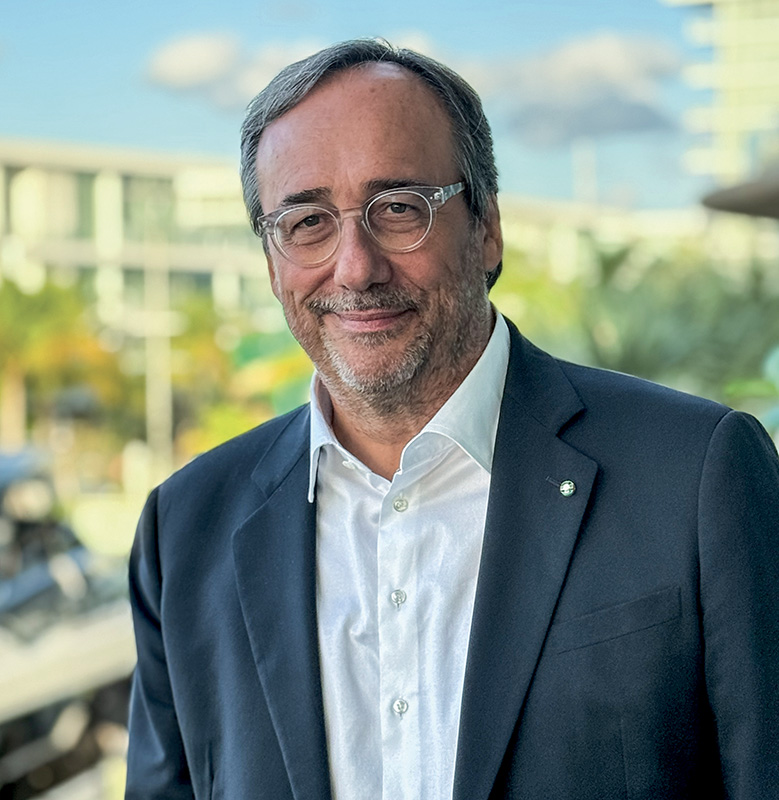
«The SX line, presented in 2017 with the SX88, opened a new chapter in international yachting. Almost ten years later, the SX120 carries this journey forward, reaffirming Sanlorenzo’s vision: to innovate with elegance, looking ahead with sensitivity and creating solutions merging beauty and sustainability».
Massimo Perotti, Executive Chairman Sanlorenzo
Bernardo and Martina Zuccon have chosen Sanlorenzo, or vice versa, in the exclusivity of a process of growth and education that has yielded genuinely surprising results. “People often call architects to tell them what to do” (Frank Gehry). Other times, they do so not to tell them anything, and still other times, one calls a client to tell them what to buy. That is what the SX120 offers: a finished product, intentionally so, developed by three design groups: the knowledgeable boatbuilders at Sanlorenzo, the sophisticated Zuccon family, and the stylish, essential Piero Lissoni.

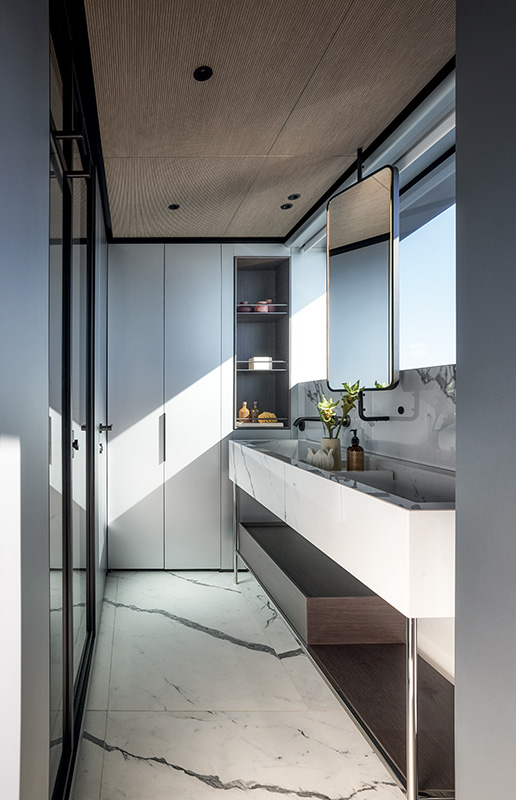
Throughout the boat, the ceilings are marked by wooden panelling, a series of dense cusps that extend vertically along the walls, creating an architectural effect of continuity and depth. Some vertical inserts have been covered with a steel-effect film, which gives a contemporary touch to the rooms. The floors alternate between parquet and carpet, while marble-effect ceramic tiles have been chosen for the bathrooms, combining aesthetics and functionality.
«The SX family, which I believe is the most creative one from the past thirty years, has had the addition of the 120. The SX120 is spectacular floating architecture. We have taken everything that the other SX boats have taught us and put it in. It has got beach areas, floors that interconnect, large openings… it is a real villa on the water, which is part of an absolutely extraordinary project, the SX».
Piero Lissoni, Lissoni & Partners

From the liner Rex to the Andrea Doria, from Poltrona Frau to Cassina, from Gio Ponti to Carlo Scarpa, and even on board the new 120-foot crossover, the story seems to repeat itself after nearly a century, with craftsmanship and customisation coming together to innovate. The new modular “Smart Island” sofa that we find on board goes well beyond the simple production of furniture, because it explores that privileged area of stylistic and technical experimentation that has allowed residential design to take to the water, but this time above a covered deck, the fourth and top one of the SX120 – it is new, and a sundeck that acquires more meaning as it delivers outdoor solutions.
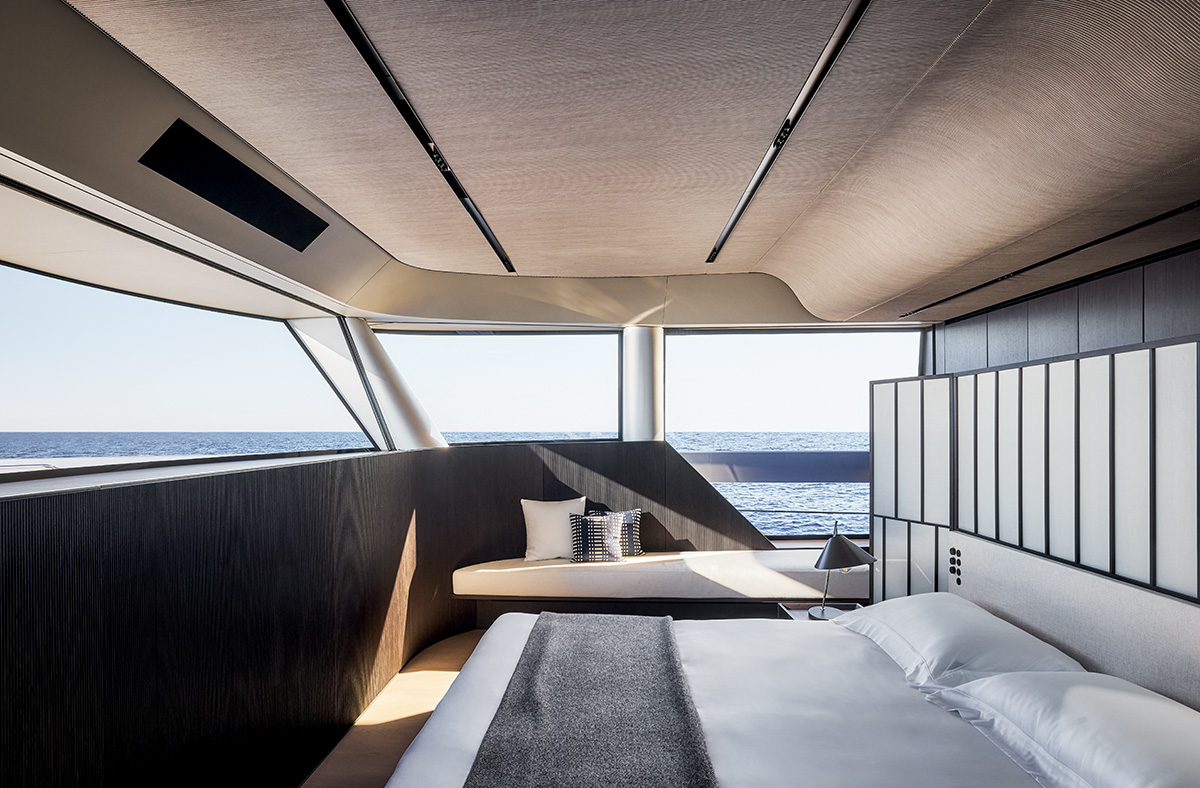
The master cabin features a backlit headboard, a decorative screen that discreetly separates the sleeping area from the wardrobe, ensuring comfort and privacy.

«The new flagship of the SX line combines functionality and aesthetics, simplicity and elegance, performance and sustainability in a single product. In addition, the SX120 is the first large yacht to integrate Volvo Penta’s new IPS Professional Platform, a compact and efficient system designed for hybrid energy sources and engineered to improve performance, autonomy and comfort while sailing. This innovative propulsion platform allows for the achievement of certainly unique design solutions related to the use of efficient PODs drive even on large yachts».
Tommaso Vincenzi, CEO of Sanlorenzo
With its 37-metre length, 8-metre beam and 270 gross tonnage, this crossover – a blend between an explorer and flying bridge boat – is the stylistic evolution of the preceding 112’ and the SX100. It is a boat on the boundary, in an open research environment – a frontier of convergence and intersections – where comparison and the ritual nature of building and inhabiting are adjusted through fragments of contemporary life and land-based architecture rather than yacht design. With a composition that is never suffocated by its own shapes, by its apparent monumental appearance, or worse still, by individualism, as a trace imposed by its own passage, it is instead projected into nature and into the viewer who perceives a message suspended between responsibility and the desire to please, even significantly so. It is an act of “style” and “education” in all of the disciplines involved, which are expressed through the value of authenticity, because they are the fruit of the educated reading of the history of the 20th century.
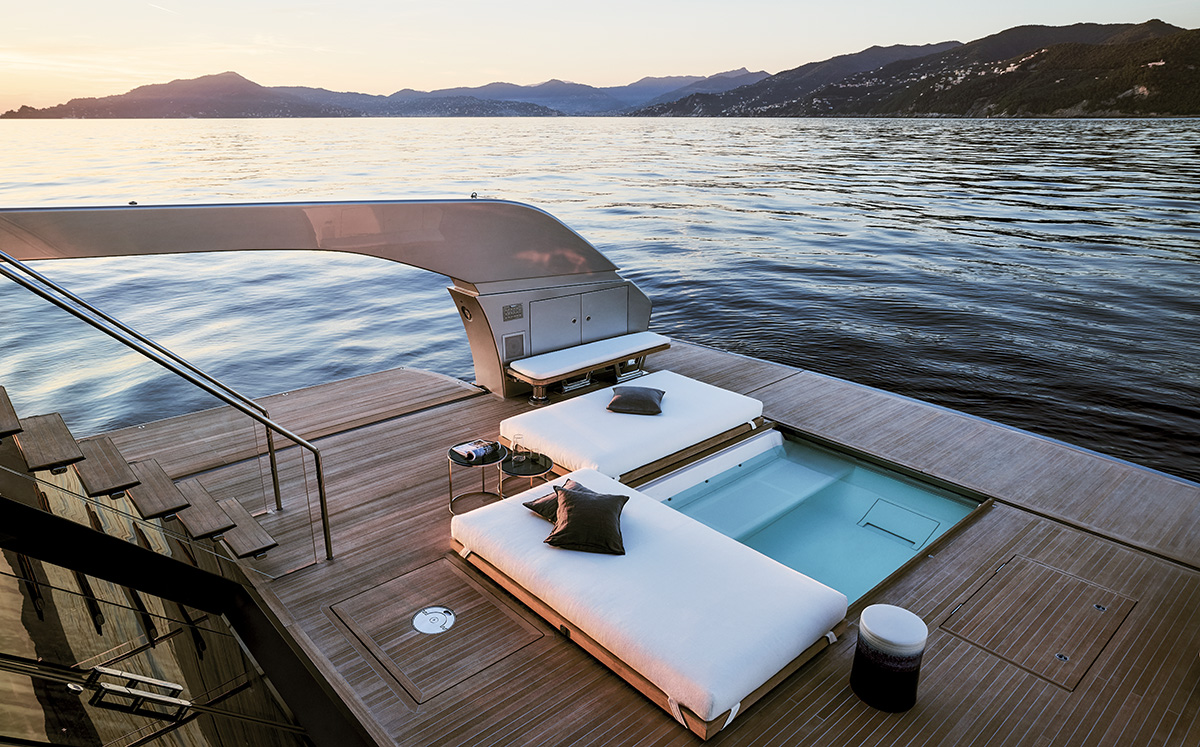
The beach area covers 70 square metres with opening side walkways, a 360° panoramic view from the upper deck and a sun deck with a configurable Smart Island. The beach area also offers owners the flexibility of a retractable pool, which can be covered or uncovered using a lifting and sliding mechanism on the sun bed, ensuring aesthetic appeal, privacy and safety when sailing.
The SX120 draws inspiration from a variety of sources, including homes, buildings and cities. She embraces a coexistence of different scales, prioritising functionality over superfluous elements and often sacrificing internal symmetry. This asymmetry on board seeks to maximise functionality and aesthetics by bringing light and space to areas that need it more than others, without compromising on either. It never neglects the real complexity of living on board, promoting new spatial and technological possibilities, especially in relation to the need for variety in visual experiences.

This is not a novelty boat seeking to break boundaries. Instead, SX120 is full of surprises, such as the internal, offset, sculptural spiral staircase that takes you on a short, dreamlike journey between decks, or the portside crane that continues the trajectory of the long carbon fibre gunwale of the upper main deck when not in use. And then there are the two extra-size sides that fold out to extend the stern beach area up to 70 square metres, or the new concept sundeck. These are small victories in linguistic and functional communication that can change the way we look at boats and the sensitivity to going beyond their apparent order to find at least a viewpoint, or a “flight” from pre-ordained schemes.
«The SX120 stands out thanks to its quality, adaptability and comfort. She can convey architectural choices and solutions that have been perfected through valuable lessons learned from the pioneers of modern architecture. Cleaning up and taking away superfluous signs, following an ethical basis and an idea that increasingly has to take into account the landscape and the responsibility in relation to anybody who might find themselves between the horizon and the boat… We often ask ourselves how every new presence on the sea, and in the panorama, is accepted and experienced…».
Bernardo e Martina Zuccon

photo by Andrea Muscatello.
Leaving aside the geometric set-up, one senses that there is always another dimension on board the boat, a flip side, a double, a polarity, a somewhere else that extends the physical and perceptual space. Transparency prevails in the inner spaces, which are broken up by blocks of light-coloured material and the wooden ribbing of the ceiling, or by the darker exotic woods of the bulwarks that close up areas used more at night. The master cabin is set forward on the main deck, with a central island bed, a backlit, translucent bedhead, and a perimeter of glass that closes the room.
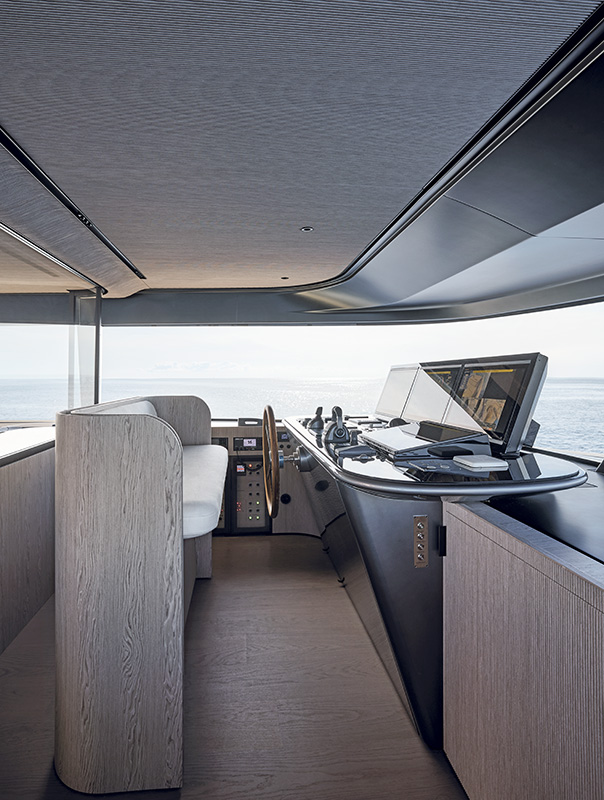
The helm station on the bridge deck is behind a transparent screen, more like a glass showcase, where slender supports and compositional rigour evoke elegant displays by Franco Albini, flowing and weightless. There is always something, whether inside or out, that reflects a journey of decisions borrowed from a vocabulary of experiences from the 20th century, but constantly reworked and well shared. The volumes out of the water have been moved slightly towards the bow, projected forward – including at a visual level – from the reverse windscreen of the master cabin and the upper bridge deck, with angles parallel to the two “powers”, which nevertheless preserve just the memory of the weight and static support function.
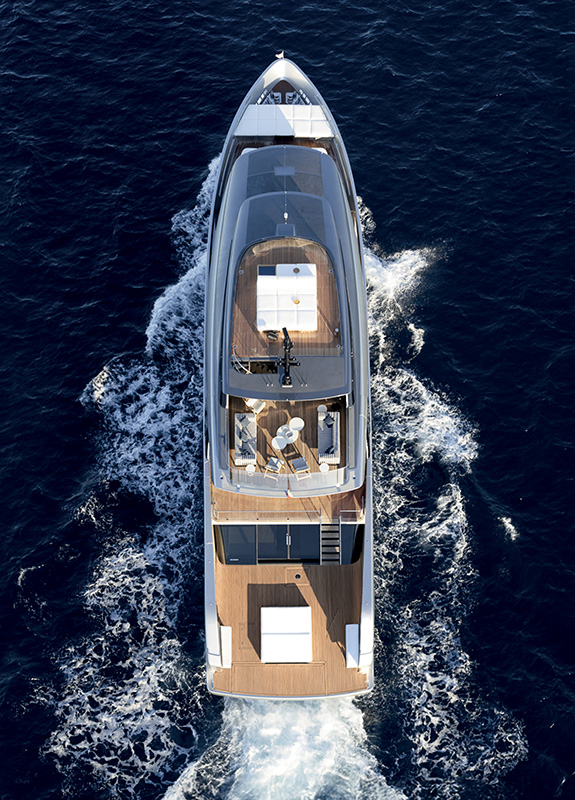
The flybridge, which, for the first time on this type of yacht, transforms into an elegant sun deck. Here, the Smart Island concept is introduced: a system of modular, freely configurable seats equipped with additional features. A private, almost hidden space, a locus amoenus where you can enjoy maximum privacy.
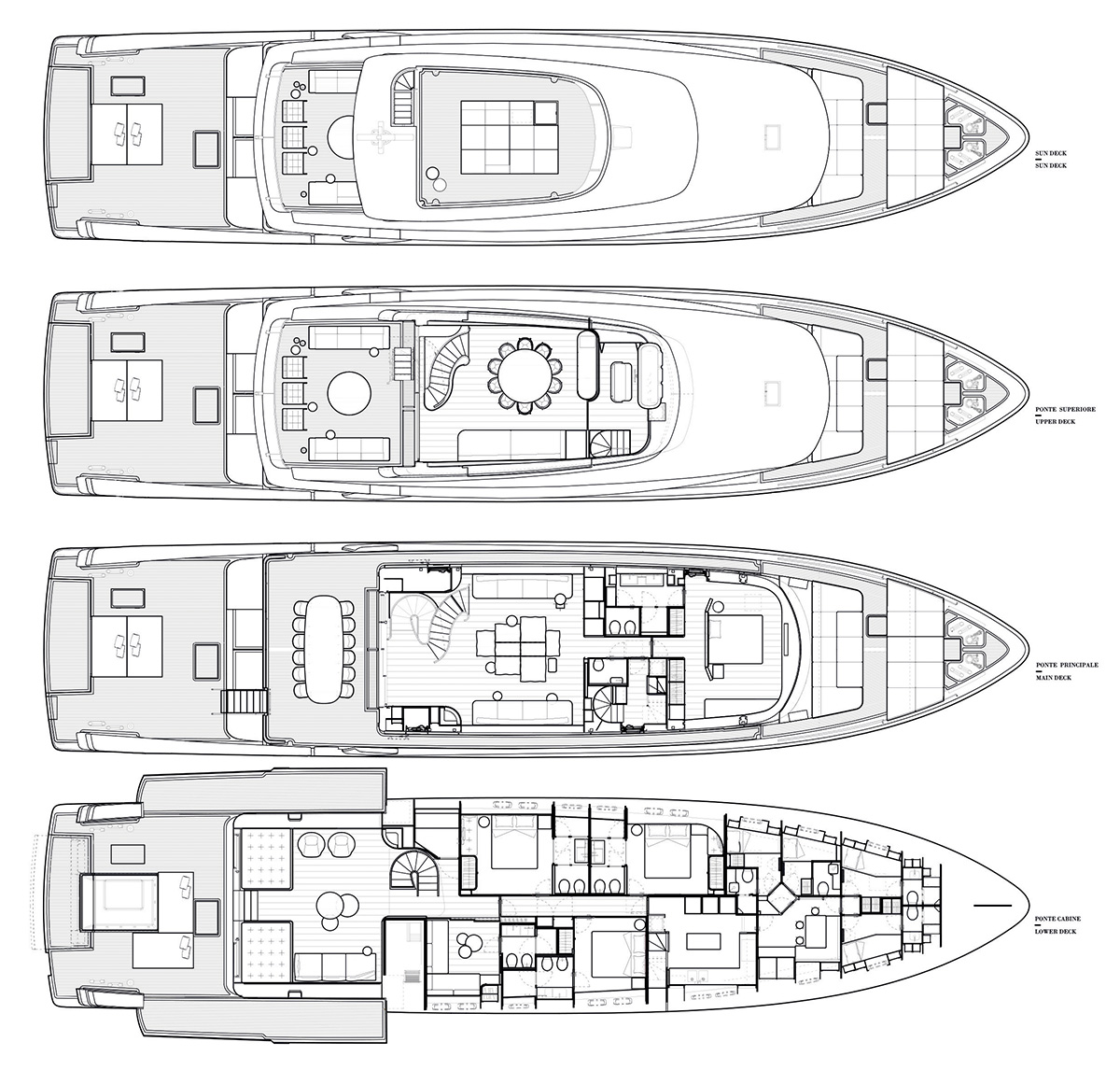
This central body, open on four sides on the main deck, acts as a block of smoked tempered glass, joined without frames or seals, with internal uprights cleverly concealed by continuous glass walls. It does not seek to ‘envelope’ the parts, but maintains compactness and balance in the composition, which then opens up onto the sea. The upper deck, on the other hand, follows Philip Johnson’s ambiguous approach to diaphanous transparency in his ‘Glass House’, where the volume, although fixed in its stereometry, is in fact a transparent observatory overlooking the surrounding landscape. The interior of these biaxial values is set out in an open space that seeks out asymmetry, to subdivide the space through furniture complements, chosen and designed by Piero Lissoni, the arrangement of which gives life to a living room, a dining area, a play room or various interior lounges that interconnect fluidly with the exterior. The lower deck is only open aft, and houses the first filter for staff and guests. It is directly connected to the external beach area, which is well-equipped with HVAC, sofas, a washer/dryer, a wc, and a mess room. Going inside, there is a small space that can be kept open as a lounge or closed to become a cabin, as well as a small hammam and a crew area.
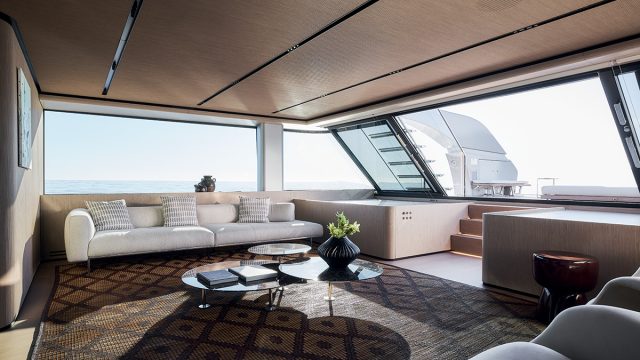
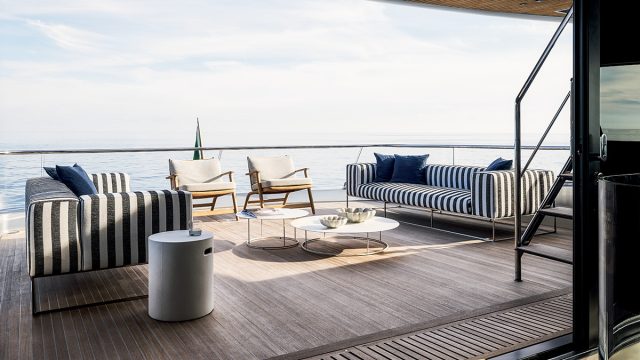

The lower deck houses four guest cabins, one of which can be kept open as a lounge or closed to become a cabin, a small hammam and the crew area.
We had the chance to try out the SX120 on the water, and after just a few miles, I got confirmation that it is a new-generation yacht. The naval architecture includes a significant central skeg and two Sleipner stabilising fins. The hardtop of the fly bridge is in carbon fibre, as are the over 14 metres of continuous gunwale of the main deck bulwark, while various raised sections of the deck house are in carbon fibre mix.

«In terms of propulsion, the Volvo Penta IPS Professional platform represents a technological evolution geared towards efficiency. The system makes use of steerable units with hydrodynamically-optimised counter-rotating propellers, which allow a significant reduction of energy waste, and a marked improvement in manoeuvrability, especially at low speeds». Nicola Pomi, VP Marine Sales,
Yacht and Superyacht Division
The SX120 is the first non-commercial vessel in the world to use Volvo Penta’s IPS Professional platform. This propulsion system combines efficiency, comfort and modularity. It uses four D13 engines, each developing one thousand horsepower, two for each pod, which means that in EcoMode you can do a cruising speed of ten to twelve knots and only use 100 litres of fuel per hour. Top speed is 23 knots, while economy cruising will give you a range of around 2,000 nautical miles and a reduction in fuel consumption, emissions and clutter. The Electronic Vessel Control modulates power in real time based on engine load and the operating profile, automatically activating and deactivating power sources. The pods are hydrodynamically optimised to allow a distinct improvement in manoeuvrability, especially at low speeds.
Sleipner stabilisers
The Sleipner-patented Vector Fins, with their curved profile, channel forces in a more vertical direction, achieving notably superior efficiency and much lower energy consumption than with traditional fins. The longer strokes and an extended lever arm generate more powerful stabilising forces, while the patented noise-reduction system ensures it operates much more quietly than other solutions. The fins’ special shape generates lift, reducing resistance and improving performance at constant speed, while the compact drives easily fit into the yacht’s layout. The system is effective during fast sailing and at anchor, ensuring stability in all conditions.

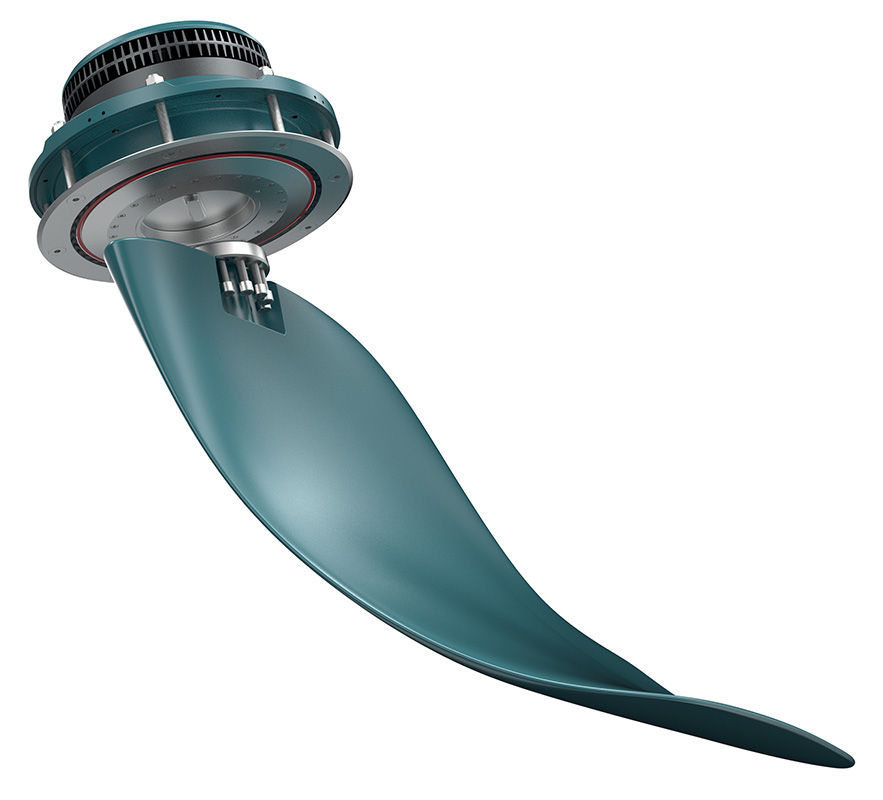
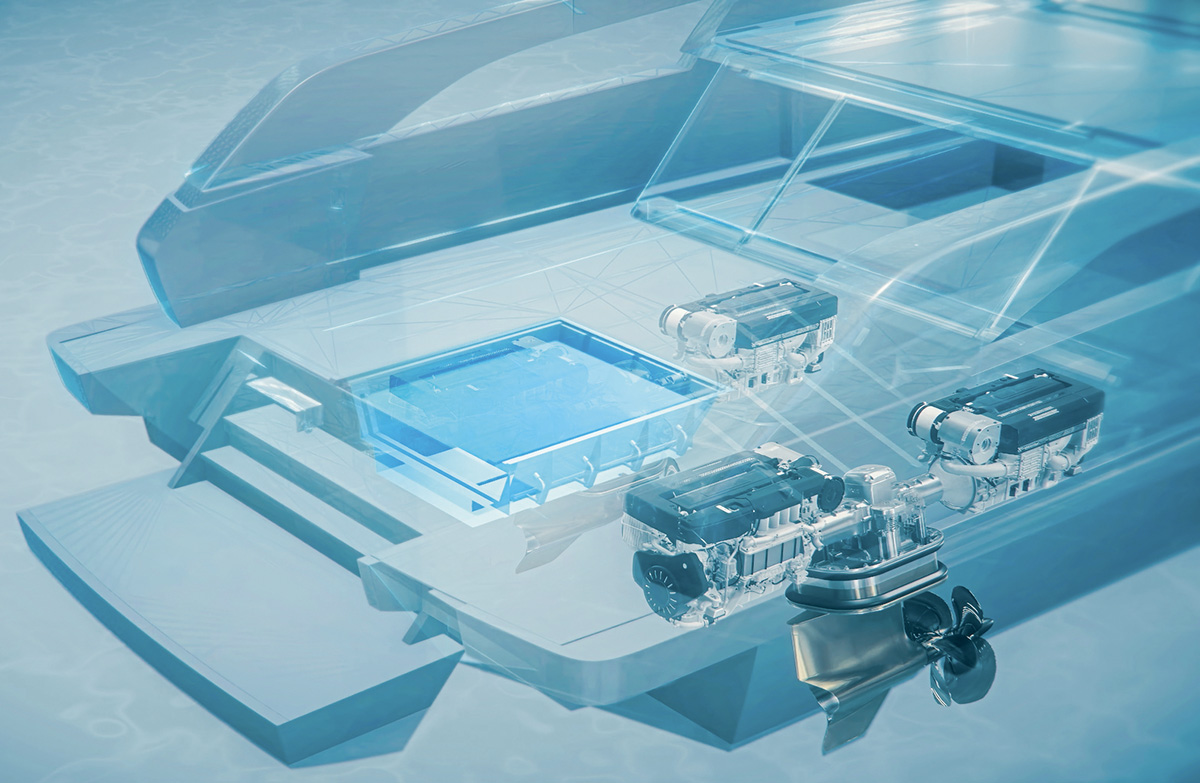
Volvo Penta
The IPS Professional Platform uses two engines up to 1,000-horsepower per pod, delivering performance superior to that of larger engines while occupying less space, consuming less fuel, and producing fewer emissions. This platform, designed for the modular integration of traditional and alternative energy sources, stands out for its extreme compactness and optimised propulsion architecture. These features mean that the space needed for the engine room can be significantly reduced, freeing up valuable volumes that, in the design phase, can be repurposed for the owners, guests and crew. A distinctive feature of the platform is the Eco Mode function, which optimises engine output when not operating at full power, such as during manoeuvres or at lower speeds underway. It enables automatic synchronisation of the power units, reducing the number of active engines or lowering the rev level while maintaining optimal thrust and control levels.
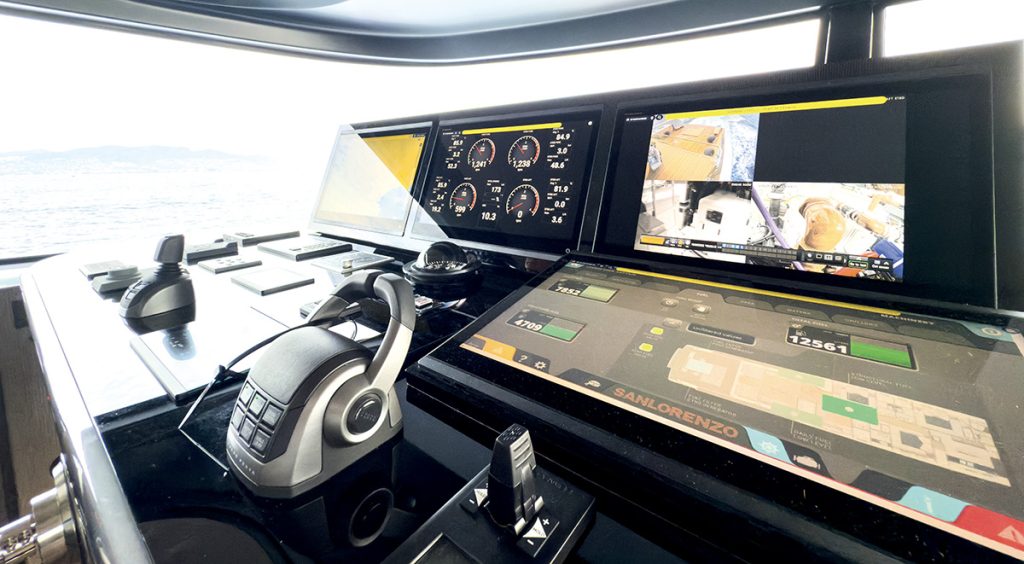
The Nav-Com system has been created by the Furuno Italia team, integrating the latest generation of multi-function displays, NavNet TZtouchXL. Four TZT24X 24-inch displays have been installed with added processing power and the new proprietary TZ-Maps system. These latest-generation tools include advanced functions developed by Furuno, such as AI Avoidance Route, which, thanks to artificial intelligence and in combination with the Risk Visualizer and the radar, calculates and automatically displays the safest route to avoid collisions with other boats or obstacles. Also using AI, TZ-Maps enables you to draw up point-to-point routes extremely quickly. So in just a few seconds the system posts a safe path, taking into account the characteristics of the boat and the pre-imposed safety parameters (such as minimum draught, and distance from land) The Nav-Com system includes latest-generation sensors, including the Solid State DRS12A-NXT radar, the GP-330B GPS, a SCX-20 satellite compass, the DFF1-UHD CHIRP eco sounder, and the Class D VHF DSC. Since it is a commercial yacht, the boat has been finished with Wheelmark-certified apparatus and GMDSS, including GPS GP-170 type approved, VHF FM-8900, MF/HF FS-1575 150W, Inmarsat STD-C FELCOM-18 and the Navtex NX-900 receiver. The Wheelmark-approved Furuno BNWAS BR-500 unit is also included. It is obligatory for vessels of over 150 GT, with alarm panels located in the wheelhouse, crew mess, and the captain’s and first mate’s cabins. Finishing off the radio station are some Ocean Signal safety units: EPIRB E3 PRO, the portable VHF unit GMDSS V100 and the SART Radar Transponder S100.



Spanning four decks, the SX120 has a Gross Tonnage of 270 GT, characterised by the displacement of volumes at the bow
and a cockpit at the stern entirely dedicated to activities at sea.
SANLORENZO
Cantieri Navali di Ameglia
Via Armezzone 3
I-19031 Ameglia (SP)
T +39 0187 6181
[email protected]
www.sanlorenzoyacht.com
PROJECT
Zuccon International Project (exterior design) • Lissoni & Partners (interior design) • Lou Codega (hull design)
HULL
LOA 36.58 m • Maximum beam 8 m • Gross Tonnage 270 GT • Draft at full load 2.28m • Half load displacement 165 t • Full load displacement 176 t • 10 guests in 5 cabins • 6 crew members • Tender’s length 6.25m • Fuel tank volume 20,650 l • Water tank volume 2,200 l • Waste water tank volume 1,050 l • Grey water tank volume 900 l
MAIN PROPULSION
IPS Professional Platform D13 – 2700 IMO III / 4x 1000 hp (735 kW) • Maximum speed: 23 knots • Cruising speed: 20 knots • Economic speed: 10 knots
(Sanlorenzo SX120 – Cross the future – Barchemagazine.com – Excerpted from Barche, January 2026)